

Last updated: November 1, 2026
The SAP world is changing in more ways than just its products. The concepts we use to design, develop, and operate SAP systems are evolving just as quickly.
For many years, SAP operations were primarily associated with servers, databases, transports, user management, authorizations, backups, and system performance. None of these have disappeared. But as SAP environments become more distributed through cloud services, integration, data platforms, and artificial intelligence, the scope of operations is expanding as well.
Today, it is becoming increasingly difficult for an SAP professional to discuss architecture or operations without encountering concepts such as BTP, Clean Core, Cloud ALM, Observability, FinOps, Business Data Cloud, or Agentic AI.
These concepts are not all of the same type. Some are SAP products, some are architectural principles, some represent development models, while others describe entirely new approaches to operations.
The purpose of this article is not to create a conventional SAP glossary for beginners. Instead, it brings together 16 key concepts that are relevant to SAP projects today and are likely to remain important across technology, architecture, and operations in the years ahead, explaining briefly what they mean and why they matter.
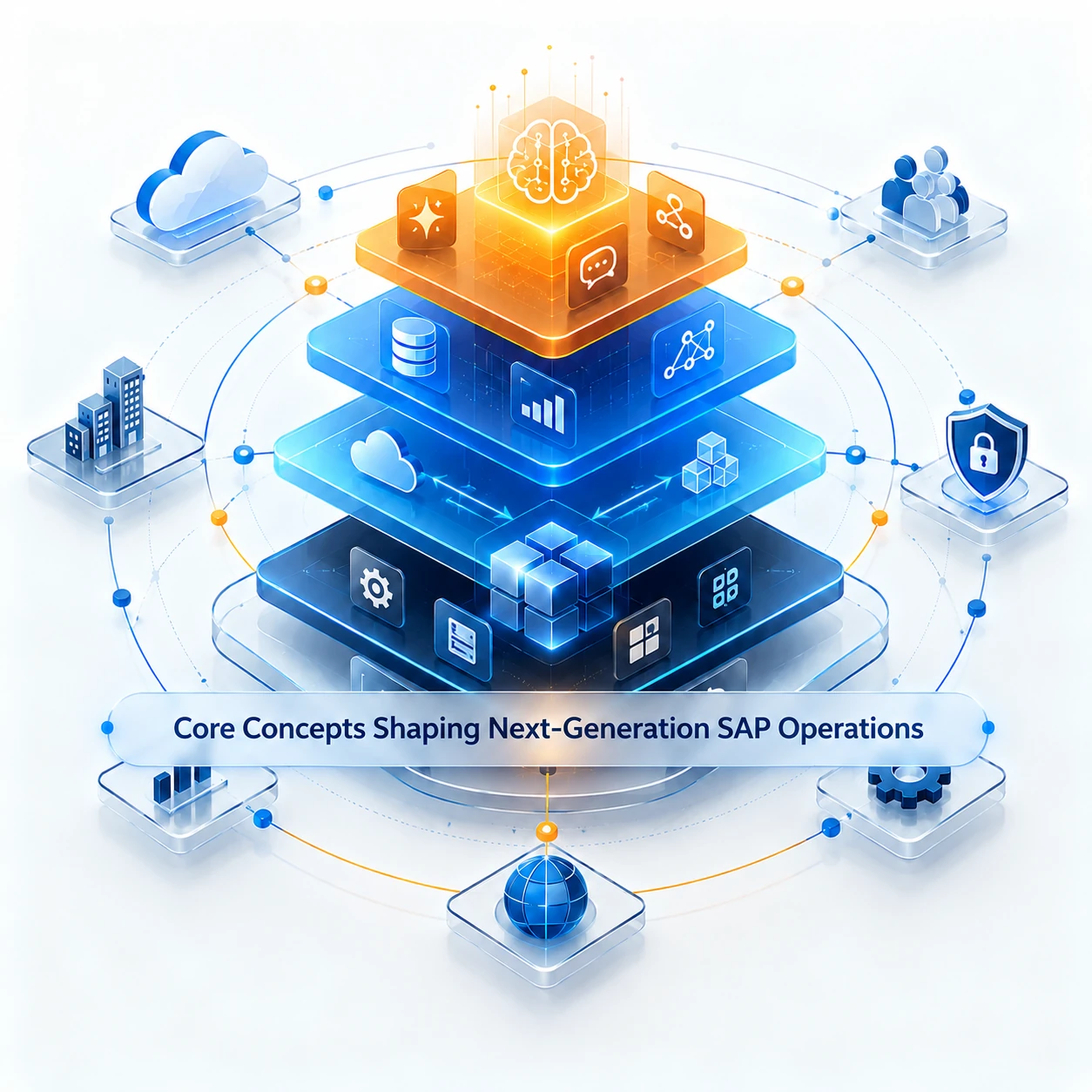
Concept Map for Next-Generation SAP Operations
| Category | Key Concepts |
|---|---|
| Architecture and Platform | SAP Cloud ERP, SAP BTP, Clean Core |
| Development, Integration and Data | ABAP Cloud, SAP Integration Suite, API-First & Event-Driven Architecture, SAP Business Data Cloud |
| Operations, Architectural Visibility and Transformation | SAP Cloud ALM, Observability, FinOps, SAP LeanIX & SAP Signavio |
| AI and Agentic SAP | SAP Business AI Platform, Joule & Joule Studio, AI Agents & Agentic AI |
| Security, Identity and Governance | SAP Cloud Identity Services – IAS / IPS, SAP Cloud Identity Access Governance – IAG |
A. Architecture and Platform: The New Foundation of SAP
1. SAP Cloud ERP
What is it?
SAP Cloud ERP represents SAP’s next-generation ERP approach, delivering core ERP capabilities through a cloud operating model. In SAP’s current terminology, SAP Cloud ERP and SAP Cloud ERP Private are the main options addressing different requirements for standardization, flexibility, and operational control. The terms SAP S/4HANA Cloud Public Edition and Private Edition also continue to appear in technical documentation.
Public Edition offers a higher degree of standardization and a more frequent SAP-managed update cycle, while Private Edition provides a different operating model for organizations that require greater flexibility, customization, and system control.
At this point, you may also encounter the terms GROW with SAP and RISE with SAP. GROW with SAP is associated with the adoption of SAP Cloud ERP/Public Edition, while since 2025 SAP has increasingly positioned RISE with SAP not as a specific product or solution package, but as a transformation journey and methodology supporting existing on-premise SAP customers as they move toward SAP Business Suite and Cloud ERP.
Why is it important?
Because the question is no longer simply, “Are we using S/4HANA?” The deployment and operating model of the system affects many decisions, from update cycles and customization strategies to integration design and operational responsibilities.
Understanding this distinction is one of the starting points for understanding modern SAP architecture.
SAP source: SAP Cloud ERP and deployment models
RISE with SAP: RISE with SAP Methodology
2. SAP Business Technology Platform – BTP
What is it?
SAP BTP is SAP’s technology platform that brings together capabilities for application development, integration, automation, data management, and artificial intelligence on a common foundation.
It can be used in a wide range of scenarios, such as building new applications outside the S/4HANA core, integrating SAP with third-party systems, automating business workflows, or consuming AI services.
Why is it important?
Because SAP architecture is increasingly extending beyond the boundaries of a single ERP system.
Instead of developing every new requirement directly inside the ERP core, the emerging model is to protect the core while allowing different services to work around it. In SAP’s new Business AI Platform approach, BTP also serves as an important technology layer for integration, development, automation, and AI capabilities.
For this reason, BTP should no longer be viewed simply as “SAP’s cloud development platform.”
SAP source: SAP Business Technology Platform
3. Clean Core
What is it?
Clean Core is an architectural approach designed to protect the ERP core as much as possible from unnecessary modifications and custom developments that directly interfere with SAP standard functionality.
The objective is not to eliminate custom development altogether.
The goal is to develop in the right place and with upgrade-stable methods, using released APIs, supported extension points, and side-by-side extensions on SAP BTP wherever appropriate.
Why is it important?
Because the heavily customized development models that worked in the past can become significant technical debt in a cloud environment, slowing down upgrades and limiting the adoption of innovation.
Clean Core allows organizations to keep the ERP core simpler while still addressing new business requirements through extensions.
In short, Clean Core is not merely about technical cleanliness; it is an architectural discipline that directly affects the cost and speed of future change.
SAP source: SAP Clean Core – Overview
B. Development, Integration and Data Architecture
4. ABAP Cloud
What is it?
ABAP Cloud is not an approach designed to replace ABAP development. Instead, it is a development model intended to make ABAP cloud-ready, Clean Core-compliant, and upgrade-stable.
Its core principles include tighter control over which APIs and development objects can be used, reducing direct dependencies on SAP standard objects, and ensuring that extensions are less affected by future release changes.
Why is it important?
Because as SAP moves further into the cloud, ABAP is not disappearing; the way ABAP is used is changing.
For the SAP developer of the future, the challenge will not simply be knowing ABAP. It will also be understanding which developments belong in the ERP core, which should be built on BTP, and which released APIs should be used.
SAP source: What is ABAP Cloud? – SAP Help Portal
5. SAP Integration Suite
What is it?
SAP Integration Suite is an enterprise integration platform used to connect SAP and non-SAP applications, data, and business processes.
With capabilities such as Cloud Integration, API Management, and Event Mesh, it supports both traditional integration scenarios and more modern API- and event-driven architectures.
Why is it important?
Because a modern SAP landscape is no longer made up of SAP systems alone.
S/4HANA increasingly works alongside CRM platforms, e-commerce systems, banking applications, SaaS solutions, hyperscaler services, and AI agents.
Integration is therefore no longer a matter of building a few interfaces at the end of a project; it has become a fundamental part of the architecture itself.
SAP source: SAP Integration Suite
6. API-First and Event-Driven Architecture
What is it?
API-first means exposing system capabilities through controlled, reusable APIs.
Event-driven architecture means that instead of systems constantly polling each other, other systems or services are notified when an important business event occurs.
For example, the creation of a sales order can be published as an event, allowing subscribed applications to trigger the relevant follow-up actions.
Why is it important?
Because these models reduce tight coupling between systems.
One of the main goals of next-generation integration is no longer simply to connect systems, but to enable them to operate as independently from one another as possible.
This approach becomes increasingly important in architectures involving cloud services, microservices, real-time processes, and AI agents.
SAP source: Event-Driven Architecture – SAP Developers
7. SAP Business Data Cloud – BDC
What is it?
SAP Business Data Cloud is a managed cloud data platform designed to bring together SAP and non-SAP enterprise data while preserving its business meaning and semantics.
SAP Business Data Cloud also brings existing SAP data capabilities, such as Datasphere, into a broader data and AI architecture.
Why is it important?
Because in enterprise AI, simply having large volumes of data is not enough.
AI also needs to understand what objects such as “customer,” “order,” “invoice,” or “supplier” mean and how they relate to one another.
For this reason, the focus of SAP’s modern data architecture is increasingly expanding from moving data to preserving business context.
SAP source: SAP Business Data Cloud

Further Reading
You can check out our analysis, How Is SAP’s Product Positioning and Marketing Messaging Changing?, to learn about SAP’s new vision, market messaging, and the evolving narrative of its enterprise solutions.

C. Operations and Transformation Management
8. SAP Cloud ALM
What is it?
SAP Cloud ALM is a cloud-native Application Lifecycle Management platform designed to manage the implementation and operational lifecycle of SAP landscapes.
It provides centralized capabilities across areas such as implementation, testing, deployment, monitoring, and end-to-end traceability.
Why is it important?
It would be too narrow to view Cloud ALM simply as “the product replacing Solution Manager.”
As SAP systems move toward cloud and hybrid architectures, operations increasingly need to become more automated, centralized, and service-oriented.
Cloud ALM is also becoming a more central operational and lifecycle layer within SAP’s newer transformation tools and agent-led transformation approach.
SAP source: SAP Cloud ALM
9. Observability
What is it?
Observability is the ability to understand the internal behavior of a system through the logs, metrics, traces, and other operational signals it produces.
It is not the same as monitoring.
Monitoring usually asks predefined questions such as:
“How high is CPU usage?”
“Is the disk full?”
“Did the interface fail?”
Observability asks a broader question:
“What is actually happening in the system, and why?”
Why is it important?
As cloud services, APIs, events, integrations, and AI agents become more common, fewer business transactions begin and end within a single system.
The problem may no longer be limited to the performance of one server; it can emerge at any point across a chain of services.
For this reason, next-generation SAP operations are gradually expanding from monitoring toward observability.
SAP source: Observability – SAP Help Portal
10. FinOps
What is it?
FinOps is an operating model that turns cloud costs from something monitored only by finance into a shared operational responsibility across technology, finance, and business teams.
The objective is not simply to reduce cost.
FinOps also focuses on understanding which resources are being consumed, how that consumption relates to business value, and what financial impact technical decisions create.
Why is it important?
As SAP landscapes expand through cloud services, BTP consumption, hyperscaler resources, and consumption-based AI services, traditional infrastructure cost management may no longer be sufficient.
It is becoming just as important to understand which service is generating consumption and why as it is to ensure that the system is running properly.
A simple way to summarize the distinction is:
Observability answers: “What is the system doing?”
FinOps adds: “What does it cost?”
SAP source: SAP Cloud FinOps Community
11. SAP LeanIX and SAP Signavio
What is it?
SAP LeanIX is an Enterprise Architecture Management solution that provides visibility into an organization’s application and technology architecture.
SAP Signavio focuses on process modeling, process mining, understanding how processes actually run, and managing process transformation.
A simple way to distinguish the two is:
LeanIX: What are we running?
Signavio: How are we working?
Why is it important?
Because SAP transformation is not simply a technical migration.
It is difficult to simplify a technology architecture without understanding why each application exists, and equally difficult to plan a successful transformation without seeing how business processes actually operate.
When Cloud ALM is added to this picture, a simple framework emerges:
LeanIX: What are we running?
Signavio: How are we working?
Cloud ALM: How do we implement and operate the change?
SAP sources:
SAP LeanIX – Enterprise Architecture Management
SAP Signavio

D. AI and Agentic SAP
12. SAP Business AI Platform
What is it?
SAP Business AI Platform is SAP’s emerging platform approach for bringing together AI, enterprise data, business process context, integration, and governance capabilities under a shared enterprise AI foundation.
The goal is not simply to connect a large language model to SAP. It is to create the context AI needs to understand the organization’s data, processes, policies, and business relationships.
Why is it important?
Because SAP’s AI strategy can no longer be understood simply as “using Joule.”
Behind the scenes, Business Data Cloud, BTP capabilities, business semantics, models, security, and governance increasingly work together.
Concepts such as SAP Knowledge Graph and domain-specific business context are also becoming more important here. The objective is for AI to understand not only language, but also how the business actually works.
SAP source: SAP Business AI Platform
13. Joule and Joule Studio
What is it?
Joule is a key part of SAP’s Business AI experience, helping users interact with SAP applications through natural language.
Joule Studio goes a step further by providing an environment where organizations can build their own AI agents and agentic workflows.
Why is it important?
Because the role of AI in SAP is evolving from a copilot that answers user questions toward digital actors that participate directly in business processes.
This shift affects not only how applications are developed, but also how operations and security need to be designed.
SAP source: SAP Joule Studio
14. AI Agents and Agentic AI
What is it?
Generative AI primarily produces answers or content in response to a request.
An AI agent, by contrast, can determine which steps are required to achieve a goal, use tools, call APIs, retrieve data, and execute specific actions.
Agentic AI refers to the use of these capabilities across broader workflows, including scenarios in which multiple agents collaborate with one another.
Why is it important?
Because at this point, AI is no longer just a technology that provides recommendations.
It is becoming a technology that performs work.
This raises a new set of questions for SAP operations: How much authority should an agent have? Which data sources should it trust? How should its actions be monitored? How can it be stopped when something goes wrong?
The importance of Agentic AI lies not only in the automation it enables, but also in the way it forces organizations to rethink SAP’s identity, security, and operating models.
SAP source: Build AI Agents on SAP BTP – SAP Architecture Center
E. Security, Identity and Governance
15. SAP Cloud Identity Services – IAS and IPS
What is it?
SAP Cloud Identity Services is a family of services used to manage identities across cloud and hybrid SAP landscapes.
Two commonly encountered components are:
IAS – Identity Authentication Service:
Provides user access capabilities such as authentication, Identity Provider functions, and Single Sign-On.
IPS – Identity Provisioning Service:
Helps create, synchronize, and manage the lifecycle of users and groups across systems.
Why is it important?
Because identity in the SAP world is no longer limited to a user account created in SU01.
Access to multiple SaaS applications, trust relationships between an enterprise Identity Provider and SAP cloud services, and the automated provisioning and deprovisioning of users are now natural parts of the modern SAP landscape.
As AI agents become more widespread, this area is expanding even further.
Today, organizations manage human user identities and technical identities. In the coming years, concepts such as workload identity and agent identity are likely to become much more common.
For this reason, Identity & Access Management is no longer just a separate security topic; it is becoming a core design element of cloud and agentic SAP architecture.
SAP source: SAP Cloud Identity Services – SAP Help Portal
16. SAP Cloud Identity Access Governance – IAG
What is it?
SAP Cloud Identity Access Governance (IAG) is an access governance solution that helps organizations analyze, request, approve, and regularly review user access and authorizations in cloud environments.
With capabilities such as Access Analysis, Access Request, Certification Review, Privileged Access Management, and Role Design, SAP IAG is designed to provide greater control over which systems and transactions users can access.
Why is it important?
Identity management is not only about creating user accounts or enabling Single Sign-On. The more critical question is:
What should a user actually be allowed to access, and how should that access be controlled over time?
In cloud and hybrid SAP landscapes, users may hold different authorizations across multiple applications and services. This makes excessive access, Segregation of Duties (SoD) risks, and forgotten or outdated permissions increasingly important governance issues.
IAG adds a governance layer on top of identity management. Controlled approval of access requests, periodic reassessment of existing permissions, and improved visibility into high-risk access are key parts of this model.
For this reason, the modern SAP security model is no longer centered only on the question “Who is the user?” It must also answer: “What can this user access, why is that access necessary, and is it still valid?”
SAP source: SAP Cloud Identity Access Governance – SAP Help Portal
Conclusion: The Concepts Are Changing Because the SAP Operating Model Is Changing
Some of these 16 concepts are products, some are technologies, and others are architectural or operational principles.
What makes them meaningful, however, is that they do not exist independently from one another. In next-generation SAP operations, each represents a different layer of the operating model, and they increasingly work together.
| Concept / Area | Role in the New SAP Operating Model |
|---|---|
| Clean Core | Keeps the ERP core simpler, sustainable, and easier to upgrade. |
| SAP BTP & ABAP Cloud | Provide the foundation for modern development and extensibility. |
| SAP Integration Suite | Connects distributed systems, applications, and services. |
| SAP Business Data Cloud | Makes data usable together with its business context and semantics. |
| SAP Cloud ALM & Observability | Improve visibility and operational traceability across increasingly complex landscapes. |
| FinOps | Brings the economic impact of cloud and consumption-based services into day-to-day operations. |
| SAP LeanIX & SAP Signavio | Support the transformation of technology architecture and business processes together. |
| SAP Business AI Platform, Joule & AI Agents | Add a new digital work and automation layer on top of the existing architecture. |
| Identity, Access & Governance | Bring together identity lifecycle management, user access, authorization risks, and access governance across the entire environment. |
This table reflects a broader transformation taking place across the SAP world: a shift from a more closed, ERP-centric architecture toward a multi-layered operating model in which cloud, data, integration, AI, and security work together.
In the past, strong SAP expertise was often defined by deep knowledge of a specific product, module, or technical domain. That depth remains highly valuable. But modern SAP environments increasingly require an additional capability: understanding how different technology layers relate to one another.
For this reason, next-generation SAP expertise is no longer only about knowing the screens, transactions, or technical parameters of the products we use.
It is becoming increasingly important to understand how the architecture is changing, how systems are connected, how data is managed, how the core is kept clean, how operations are observed, how consumption is governed, and how AI works across the entire landscape.
Frequently Asked Questions
Because SAP is no longer defined only by traditional ERP and on-premise systems. Cloud platforms, data architectures, integration, artificial intelligence, and consumption-based services are increasingly coming together within the same technology landscape. This shift is not only creating new product names; it is also introducing new concepts to describe how SAP systems are designed, operated, and governed.
Not at the same level of depth. For a Basis professional, Cloud ALM, Observability, FinOps, and Identity may be more critical, while for a developer, ABAP Cloud, BTP, and API-first approaches may be more important. However, as these areas become increasingly interconnected, it is becoming more valuable for SAP professionals to understand the key concepts outside their own specialization at least at a conceptual level.
No. System administration, performance management, users, transports, backups, security, and technical operations remain essential. What is changing is that these responsibilities now need to be considered together with cloud services, integration layers, data platforms, and AI components. In other words, traditional Basis skills are not disappearing; their scope is expanding and becoming more closely connected with new technology layers.