
SAP’s official announcements in 2026 show that the company is doing more than launching new products. SAP is repositioning its approach to applications, data, artificial intelligence, and enterprise transformation around a more unified strategic direction.
The Autonomous Enterprise vision, SAP Business AI Platform, agent-led transformation, Cloud ALM, strategic acquisitions, and changes to on-premise support policies are developments that matter across the entire SAP ecosystem—from existing SAP customers and consultants to developers, architects, and project managers.
In this article, we examine seven of the most strategically significant developments announced through SAP’s official channels between January 1 and July 31, 2026. Rather than looking at them simply as news, we assess their impact today, what they may signal for the future, and why they matter to SAP professionals.
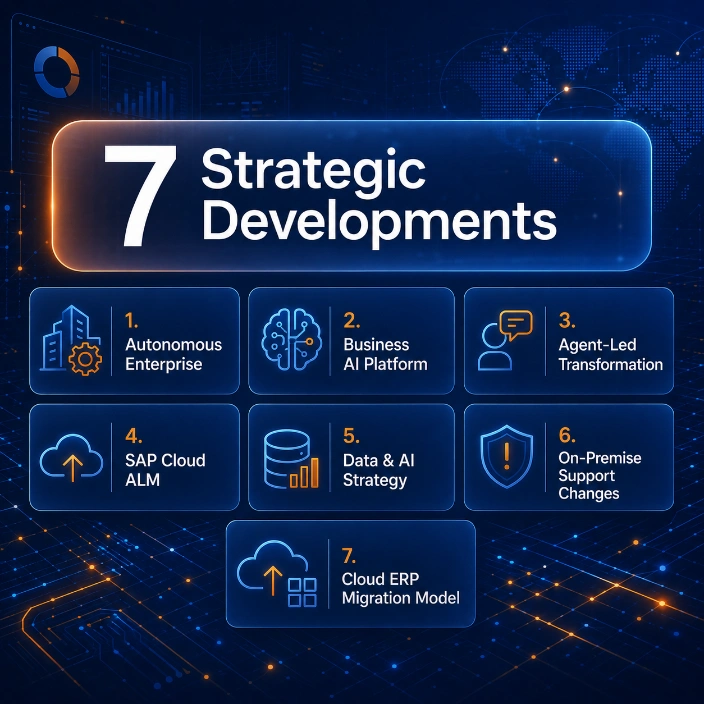
At a Glance: SAP’s Strategic Agenda for 2026
| SAP Development in 2026 | Strategic Impact on the SAP Ecosystem |
|---|---|
| Autonomous Enterprise | AI agents becoming part of business processes |
| SAP Business AI Platform | Convergence of application, data, and AI architecture |
| Agent-Led Transformation | S/4HANA modernization and Clean Core |
| SAP Cloud ALM | Transformation of project and operations management |
| Dremio, Reltio, and Prior Labs | Data management and enterprise AI |
| European Commission decision | On-premise maintenance and support policies |
| SAP, Palantir, and Accenture | A new collaboration model for Cloud ERP transformation |
1. The Autonomous Enterprise Era: SAP’s Vision for AI Agents
At SAP Sapphire in May 2026, SAP introduced its Autonomous Enterprise vision. The concept describes a new operating model in which people and AI agents work together across critical business processes such as finance, supply chain, procurement, human resources, and customer experience.
As part of SAP Autonomous Suite, SAP plans to deliver more than 50 domain-specific Joule Assistants orchestrating over 200 specialized agents. Joule Work is designed to allow users to describe the business outcome they want to achieve in natural language, rather than navigating through multiple applications and screens. SAP also announced a €100 million fund to support partners in deploying AI assistants and agents for customers.
Why is it strategic?
SAP’s AI strategy is moving beyond assistants that simply answer questions or generate recommendations toward agents that actively participate in business processes. This shift points to a future in which AI becomes an embedded part of enterprise operations rather than a separate technology layer alongside ERP.
Impact today and in the future
Organizations will increasingly need to address data quality, authorization, segregation of duties, human approval, and auditability as part of their AI governance models.
Strategic assessment
The success of the Autonomous Enterprise will not be determined by the number of agents deployed, but by which decisions organizations can safely delegate to them—and under what governance controls.
Official SAP Announcement:
SAP Unveils the Autonomous Enterprise — May 12, 2026.
2. SAP Business AI Platform: Joule, Business Data Cloud, and an Integrated AI Architecture
SAP has brought together SAP Business Technology Platform, SAP Business Data Cloud, and SAP Business AI under a unified and managed environment called SAP Business AI Platform.
The platform is designed to enable enterprise AI solutions to work with real business data, business-process context, and governance rules. SAP Knowledge Graph provides context for business objects and their relationships, while Joule Studio supports the development of agents, applications, and agentic workflows. SAP AI Agent Hub is positioned as a common management and governance layer for both SAP and third-party agents.
Why is it strategic?
The success of enterprise AI projects depends on more than the capabilities of the underlying model. AI must have access to the right data, understand business-process context, and operate within controlled authorization boundaries. With Business AI Platform, SAP aims to bring these elements together within a common architecture.
Impact today and in the future
BTP can no longer be viewed solely as an integration and side-by-side application development platform. Identity services, APIs, data access, security, and AI governance increasingly need to be addressed as parts of the same architecture.
SAP’s announcement does not provide a detailed pricing model explaining how all new assistant and agent capabilities will map to existing customer licenses. Licensing scope and consumption costs should therefore be assessed according to individual use cases.
Key takeaway
The fundamental architectural question is not simply what an AI agent can do, but what data it can access and under which permissions.
Official SAP Announcements:
SAP Unveils the Autonomous Enterprise — May 12, 2026.
SAP Unveils Business AI Platform to Power the Autonomous Enterprise — May 13, 2026.
3. Agent-Led Transformation: AI-Powered S/4HANA Modernization and Clean Core
In 2026, SAP announced seven migration and modernization assistants designed to support Cloud ERP transformations across system analysis, custom code, data management, configuration, business processes, testing, and user adoption.
These assistants are positioned as part of SAP’s agent-led transformation approach. Their purpose is to analyze complex system landscapes more efficiently, classify transformation requirements, and provide project teams with decision support in activities that traditionally require significant manual effort.
Why is it strategic?
One of the most challenging aspects of S/4HANA transformation is assessing years of accumulated custom code and complex system dependencies. AI-supported tools can help teams evaluate more quickly which developments should be retained, retired, or redesigned in line with Clean Core principles.
Impact today and in the future
Clean Core is not simply about technical code cleanup. It is directly linked to upgradeability, access to cloud innovation, integration management, and the ability to adopt new AI capabilities.
The role of consultants may also evolve from performing large volumes of manual analysis toward validating AI-generated findings, assessing risks, and guiding transformation decisions.
Strategic assessment
AI will not take ownership of the transformation itself, but it may significantly change what project teams analyze and the evidence on which transformation decisions are based.
Official SAP Announcements
Navigating the Transition from SAP Solution Manager to SAP Cloud ALM
Agentic AI Will Change the Market
4. From Solution Manager to Cloud ALM: A New Era for Project and Operations Management
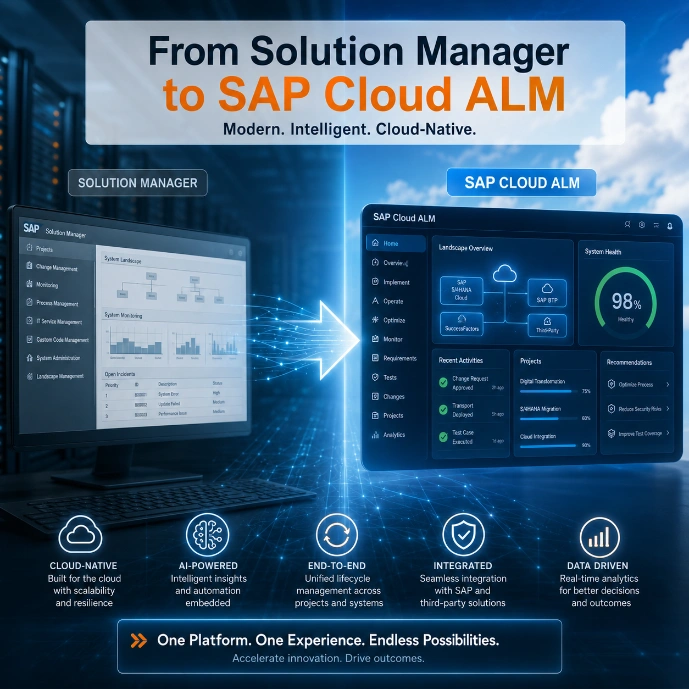
Mainstream maintenance for SAP Solution Manager 7.2 is scheduled to end on December 31, 2027. SAP recommends that customers complete their transition planning for SAP Cloud ALM before this deadline.
SAP Cloud ALM supports application lifecycle capabilities such as implementation, business process monitoring, integration monitoring, and system operations, while also incorporating migration and modernization assistants. SAP is also expanding the platform’s role in providing observability for AI agent operations.
Why is it strategic?
This is not simply a matter of replacing one monitoring tool with another. Customers using Solution Manager for ChaRM, testing, monitoring, project management, or operational processes need to reassess how those capabilities will be handled going forward.
At the same time, mainstream maintenance for core SAP Business Suite 7 applications also reaches a major milestone at the end of 2027, with optional extended maintenance for eligible releases continuing until 2030. The convergence of these timelines makes it increasingly important to assess ERP and ALM transformation roadmaps together.
Impact today and in the future
Organizations should inventory their current Solution Manager functions, integrations, and critical dependencies. A phased transition should be planned without assuming that every existing function has a direct one-to-one equivalent in Cloud ALM.
Key takeaway
A successful transition depends on determining which existing ALM processes should be retained, redesigned, or retired before Cloud ALM is fully adopted.
Official SAP Sources
Navigating the Transition from SAP Solution Manager to SAP Cloud ALM — June 18, 2026
Transition to SAP Cloud ALM — SAP Support Portal
End of Mainstream Maintenance of SAP Solution Manager and Transition to SAP Cloud ALM — SAP Knowledge Base

Further Reading
Take a look at our guide [TechEd 2025: What’s Next for the SAP Ecosystem?] to dive into the latest SAP developments and future industry trends.
5. A New Chapter in SAP’s Data and AI Strategy: Dremio, Reltio, and Prior Labs
In 2026, SAP completed three major acquisitions to strengthen its data and artificial intelligence strategy.
Reltio enhances SAP’s ability to unify, cleanse, and harmonize master data across SAP and non-SAP sources. Dremio expands access to distributed data through an open lakehouse architecture built around technologies such as Apache Iceberg, Apache Polaris, and Apache Arrow. Prior Labs specializes in Tabular Foundation Models, designed to work with tables, numerical data, and statistical relationships.
SAP also announced plans to invest more than €1 billion over four years to develop Prior Labs into an AI research lab focused on structured enterprise data.
Why is it strategic?
A core source of value in SAP systems is structured business data—from financial transactions to supplier performance and operational records. These investments suggest that SAP intends to build its AI advantage not only through general-purpose models, but also through the quality, business context, and accessibility of enterprise data.
The combination of Dremio and SAP Business Data Cloud may also increase the importance of zero-copy data sharing and federation, enabling data to be used across platforms without unnecessary replication or movement in suitable scenarios.
Impact today and in the future
Business Data Cloud, HANA Cloud, master data management, and third-party data platforms will increasingly need to be evaluated as parts of a connected data architecture. However, zero-copy approaches do not eliminate every need for ETL or data movement.
Strategic assessment
The reliability of enterprise AI will depend as much on the accuracy, context, and governance of the underlying data as on the AI model itself.
Official SAP Sources
SAP to Acquire Dremio to Unify SAP and Non-SAP Data to Power Agentic AI — May 4, 2026
SAP Completes Acquisition of Dremio — July 6, 2026
SAP Completes Acquisition of Reltio — May 7, 2026
SAP to Acquire Prior Labs to Establish a Globally Leading Frontier AI Lab in Europe — May 4, 2026
SAP Completes Acquisition of Prior Labs — July 17, 2026
6. Changes to On-Premise Maintenance and Support Following the European Commission Decision
Following an antitrust investigation into SAP’s maintenance and support practices for on-premise ERP software, the European Commission made SAP’s proposed commitments legally binding on July 8, 2026.
The Commission’s preliminary assessment raised concerns that certain practices could make it more difficult for customers to switch to alternative support providers and could restrict competition in the maintenance market. The decision does not constitute a final finding that SAP infringed EU competition law. Instead, it concludes the proceedings by making SAP’s commitments legally binding.
The commitments will apply globally for ten years and will be monitored by an independent monitoring trustee.
Why is it strategic?
The new framework introduces greater flexibility in several areas. Under specific conditions, customers may be able to separate SAP system landscapes into distinct commercial installations, choose different support arrangements for different installations, address certain unused licenses, and benefit from more predictable conditions when returning to SAP support.
Impact today and in the future
Customers will increasingly need to assess their license inventory, system topology, actual usage, and transformation roadmap together. At the same time, these changes should not be assumed to create an automatic commercial benefit for every organization. Contract terms and individual system landscapes still need to be assessed on a case-by-case basis.
Key takeaway
The main significance of the decision is that it gives on-premise customers greater scope to classify their maintenance and support requirements more granularly and to evaluate alternative support options more realistically.
Official Sources
Commission Accepts Binding Commitments by SAP to Address Competition Concerns — European Commission, July 8, 2026
On-Premise Maintenance and Support — SAP Support Portal

7. A New Collaboration Model for Cloud ERP Transformation: SAP, Palantir, and Accenture
SAP and Palantir expanded their partnership to accelerate complex data migration scenarios in SAP Cloud ERP transformations. Accenture was positioned as the initiative’s first global strategic services partner.
Palantir AIP for Data Migration provides AI-supported capabilities for analyzing data across SAP and non-SAP systems, identifying issues earlier, and planning migration activities. The solution is available through SAP Store as an SAP Endorsed App, while the SAP Solution Extension version is planned for general availability in the third quarter of 2026.
Why is it strategic?
This announcement represents more than the introduction of a new migration tool. It reflects a broader transformation model in which the enterprise software provider, a specialized technology company, and a global consulting organization work together to address complex Cloud ERP transformation challenges.
One of the biggest risks in Cloud ERP projects is often not the technical installation itself, but legacy data that is duplicated, incomplete, outdated, or no longer aligned with current business rules. AI-supported analysis can help make these issues visible earlier in the project lifecycle.
Impact today and in the future
Migration teams will increasingly be responsible for more than simply moving data from one system to another. Data scope, cleansing rules, reconciliation, business ownership, and acceptance criteria will become even more important.
Strategic assessment
AI and new collaboration models may accelerate migration, but they cannot replace business decisions about which data should be migrated, corrected, archived, or left behind.
Official SAP Announcement
SAP and Palantir Enhance Partnership with AI-Supported Data Migration Tooling to Accelerate Enterprise Cloud ERP Transformation — May 12, 2026
What Do These Seven Developments Tell Us About SAP’s Direction?
Viewed individually, SAP’s 2026 announcements may appear to be separate product updates, acquisitions, partnerships, and policy changes. Taken together, however, they reveal a more coherent strategic direction.
SAP is moving from a traditional application-centric ERP model toward a platform model that brings business processes, enterprise data, and AI agents together within a common governance framework.
This shift does not reduce the importance of existing SAP investments. It changes how those investments need to be positioned:
- Clean Core is becoming increasingly important for upgradeability and AI readiness.
- BTP is evolving from an integration platform into a broader AI and governance layer.
- Cloud ALM is expanding beyond project and operations management to include transformation assistants and agent observability capabilities.
- Data quality and master data management are becoming central to the reliability of enterprise AI.
- On-premise system inventories are becoming an important input not only for technical operations, but also for maintenance and support decisions.
- The boundaries between Basis, functional consulting, development, data, and security teams are becoming increasingly interconnected.
For SAP professionals, the key question is no longer simply:
“Which new product should we learn?”
A more important question is:
How ready are our current processes, data, custom developments, and governance models for the architecture SAP is building toward?
Frequently Asked Questions
The common theme is SAP’s effort to bring business applications, enterprise data, and artificial intelligence together within a shared platform and governance framework. Autonomous Enterprise represents the business vision behind this direction, while SAP Business AI Platform provides much of the underlying technology foundation.
No. SAP’s approach is based on collaboration between people and AI agents. Human responsibility remains essential for critical decisions, exceptions, authorization, governance, and oversight of outcomes.
No. Mainstream maintenance for SAP Solution Manager is scheduled to end on December 31, 2027. Customers are encouraged to assess their current Solution Manager usage and prepare their SAP Cloud ALM transition plans before that date.
Clean Core aims to preserve system upgradeability by reducing modifications to the standard core and managing extensions through controlled approaches. This can make it easier for organizations to adopt cloud innovations and AI-supported transformation capabilities.
No. The European Commission adopted a decision making SAP’s proposed commitments legally binding. It did not issue a final finding that SAP had infringed EU competition law. The commitments will apply globally for ten years and will be monitored through an independent oversight mechanism.
No. The decision concerns SAP’s maintenance and support practices for on-premise ERP software. SAP’s cloud products are outside the scope of these commitments.