
SAP TechEd 2026 has come to a close in Berlin. But the announcements made during the event point to a much bigger story about the future of enterprise technology. AI agents, autonomous systems, evolving developer roles, and automation extending into the physical world are all part of that story. What does SAP’s technology vision mean for businesses and SAP professionals over the next few years?
Held in Berlin from October 27–29, SAP TechEd 2026 marked a significant milestone in the event’s 30-year history. Over three days, SAP unveiled new technologies, shared product roadmaps, and explored the future of enterprise software architecture.
Opening the event, SAP Chief Technology Officer (CTO) Philipp Herzig described the current moment in striking terms:
“We are living through the biggest and fastest technology transformation of our lifetime.”
His message was about more than the pace of AI innovation. It pointed to a fundamental shift in how enterprise software is built, operated, and used.
The story, however, did not begin in Berlin. At SAP Sapphire in May 2026, SAP CEO Christian Klein introduced the company’s Autonomous Enterprise vision. At SAP Connect in October, SAP demonstrated some of the first practical applications of that vision.
TechEd 2026 brought the next question into focus: What technologies, architectures, and skills will be needed to build this new enterprise landscape?
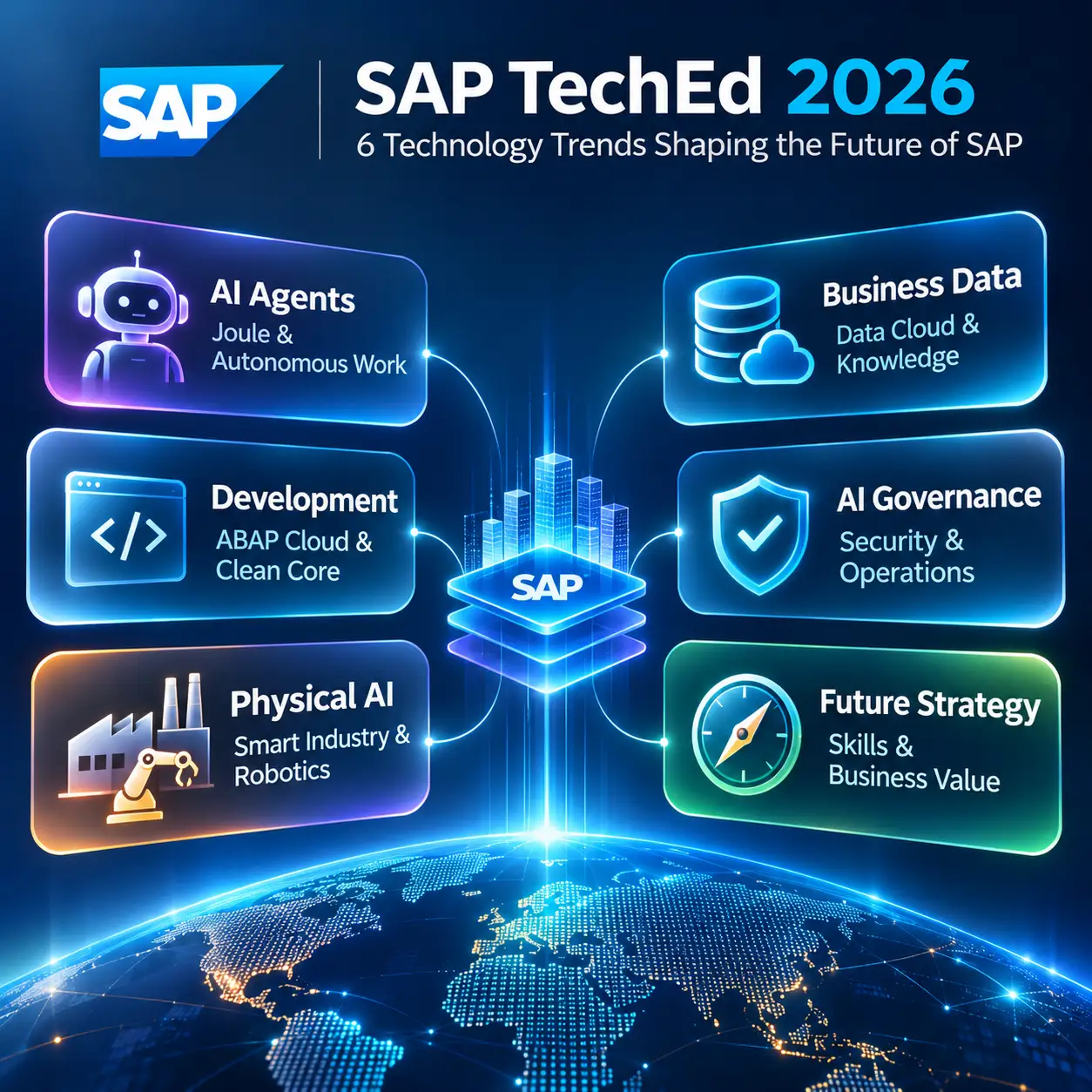
Looking beyond individual product announcements, SAP’s official statements, technical sessions, and early expert commentary reveal six technology trends that could shape the SAP ecosystem in the years ahead.
1. AI Agents: The Beginning of a New Operating Model for SAP
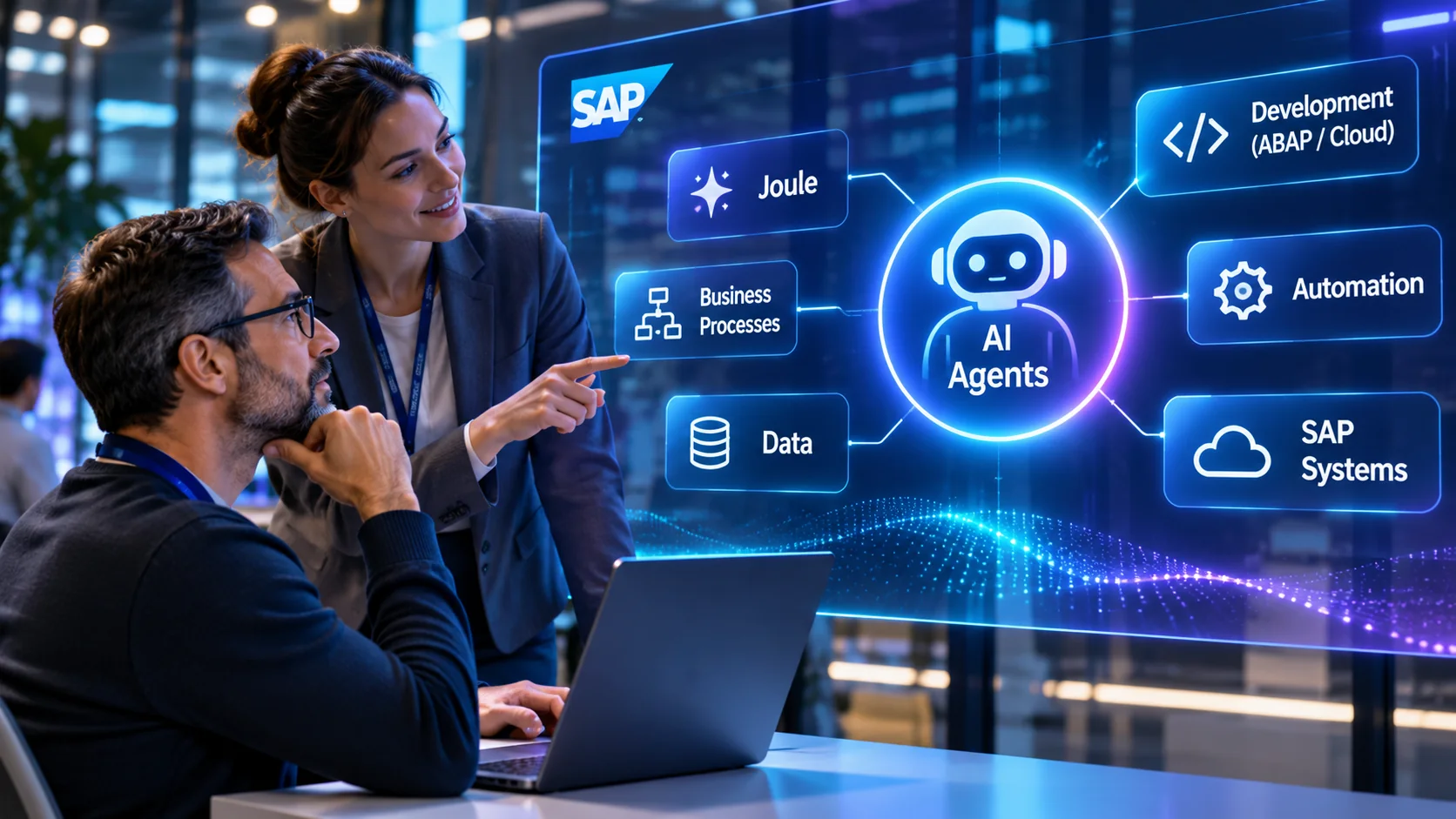
One of the strongest messages from SAP TechEd 2026 was the evolution of AI from an assistant that provides information into a technology capable of taking action and participating in business processes.
At SAP Connect, Christian Klein described the direction of this transformation: Historically, users had to learn how SAP worked. With Joule Work, SAP aims to adapt its technology to the way people work.
The innovations showcased in Berlin, including Joule Work, Joule Studio, and SAP Autonomous Suite, offered a clearer technical foundation for that vision.
Manoj Swaminathan, President and Chief Product Officer of SAP Autonomous Suite, announced a portfolio of 40 assistants and 300 AI agents across SAP and its partners.
These numbers are impressive. Yet the real transformation is not about how many agents are available. It is about how applications and business processes can work together.
Imagine a procurement manager asking an AI system to investigate delayed orders. Rather than navigating multiple applications, the system could evaluate supplier records, inventory levels, production requirements, and alternative sourcing options. With appropriate permissions and controls, it could also initiate specific actions.
One notable moment at the event came when Robert Mueller of Bosch Digital took the stage to discuss early work with Joule Work and Joule Studio. Mueller described encouraging initial user feedback and explained that the next objective was to integrate Joule into everyday workflows.
This example illustrates that the technology is moving beyond presentations and into real enterprise environments. However, it does not mean every agent is immediately available to every customer. SAP continues to introduce these capabilities in phases.
Future insight: Over the coming years, enterprise software may increasingly move away from screen-based, transaction-oriented interactions toward experiences centered on business goals and outcomes.
2. The Changing Role of Data: Can AI Truly Understand the Enterprise?
A second major takeaway from SAP TechEd 2026 was that successful enterprise AI requires more than powerful language models.
During his opening keynote, Philipp Herzig emphasized the importance of data quality in determining how effectively AI systems perform.
An AI model may understand general procurement or financial concepts. But without knowing a company’s supplier relationships, approval policies, business rules, and transaction history, it cannot reliably support business decisions.
SAP’s response to this challenge is taking shape through SAP Business Data Cloud (BDC) and SAP Knowledge Graph.
The newly announced Business Data Cloud Ontology Manager is designed to help organizations define their own business concepts and data relationships. Beta availability was planned for November 2026, while additional Knowledge Graph capabilities were expected in the first quarter of 2027.
In his TechEd commentary, Irfan Khan, President of SAP Data & Analytics, highlighted the importance of providing AI agents with business context rather than simply giving them access to data.
SAP’s investments in structured data models, including SAP-RPT and TabPFN, reinforce this strategy. The goal is to extend AI capabilities beyond text-based reasoning to prediction and decision support using structured enterprise data.
The essential shift is not simply about accessing information faster. It is about understanding what that information means within a business context.
Future insight: Competitive advantage in enterprise AI will increasingly depend not only on the sophistication of the underlying model, but also on an organization’s ability to make its data reliable, meaningful, and usable in business decisions.
3. The Future of SAP Developers: From Writing Code to Designing Solutions
SAP TechEd 2026 also offered important signals about the future of software development.
Joule Studio attracted significant attention for its capabilities to turn business requirements expressed in natural language into software components and AI agents.
In a live demonstration discussed by Thomas Jenewein on SAP Community, SAP Senior Development Consultant Luca Tallarita used Joule Studio to build a working agent prototype for a purchase requisition scenario.
There was, however, an important distinction: The prototype was tested using sample data. Connecting it to real SAP systems, configuring permissions, and preparing it for production would require additional work.
This example offers a useful perspective on the changing role of developers.
Faster code generation does not mean that every aspect of reliable software development can be automated.
Sonja Liénard, an executive responsible for SAP ABAP Platform, highlighted three agents in her post-TechEd technical assessment: ABAP Custom Code Migration Agent, ABAP Clean Core Adaptation Agent, and ABAP Application Modernization Agent.
These capabilities are intended to support modernization activities ranging from migrating legacy custom developments to SAP S/4HANA to adapting applications to the ABAP Cloud development model.
Meanwhile, SAP BTP, ABAP Cloud, Clean Core, and MCP-enabled development tools remain central to the broader architectural transformation.
The readiness of existing SAP landscapes is an important consideration. Joule Studio and related services depend on specific platform, licensing, and integration requirements. While integration with on-premises systems is possible through supported APIs and connectivity services, not every capability can be used directly in every environment.
AI-generated code must also undergo appropriate Clean Core compliance checks, security reviews, and testing, with human experts retaining responsibility for validation.
Future insight: The competitive advantage of SAP developers will increasingly come not from how quickly they write code, but from their ability to understand business processes, design AI-enabled solutions, and build sustainable enterprise architectures.
4. Managing Autonomous Systems: A New Era for SAP Basis
As AI agents begin executing real transactions within enterprise systems, an important question emerges:
Who remains in control when an AI agent makes an incorrect decision, exceeds its authority, or performs an unexpected action?
Several announcements at SAP TechEd 2026 addressed this challenge.
SAP AI Agent Hub is positioned as a key component for managing and monitoring agents, while SAP Enterprise AI Gateway aims to bring AI interactions under centralized security and governance policies.
Distinguishing current capabilities from future availability is essential. While certain agent gateway capabilities are being introduced in phases, broader availability of SAP Enterprise AI Gateway is planned for the first quarter of 2027.
SAP Cloud ALM is also gaining importance in the context of AI agent monitoring and operational observability. This development becomes particularly relevant as mainstream maintenance for SAP Solution Manager 7.2 approaches its scheduled end in December 2027.
In a technical assessment published on SAP Community on November 4, Jana Subramanian, from SAP Global Cloud Operations, emphasized that Joule does not replace existing security models. Instead, it must operate within established authorization boundaries.
Preserving these controls, however, is only part of the challenge.
Prompt injection, uncontrolled agent delegation, agent identity lifecycle management, and auditability introduce additional security and operational responsibilities.
Another increasingly important consideration is AI FinOps.
Depending on the services and pricing models involved, consumption of SAP AI Units, AI models, platform resources, and API transactions can create variable operating costs. Organizations therefore need to monitor not only technical performance, but also the economic sustainability of AI-enabled operations.
This concern was also reflected in the response from DSAG, the German-speaking SAP User Group.
Following TechEd, Stefan Nogly, DSAG Board Member responsible for Technology, emphasized that new technologies must be secure, production-ready, and economically viable. He also called for greater clarity around predictable consumption costs and integration with hybrid landscapes.
These concerns do not necessarily challenge SAP’s vision. Instead, they highlight the practical conditions required to turn that vision into enterprise reality.
Future insight: The role of SAP Basis teams may expand beyond traditional infrastructure and performance management to encompass the security, access controls, observability, and cost management of AI-driven operations.

Further Reading
To align your SAP investment strategy with emerging technology trends and explore key digital transformation priorities, read our analysis: 7 Strategic Developments Shaping the SAP Ecosystem in 2026.
5. From Digital Processes to the Physical World: SAP’s Longer-Term Vision
One of the most intriguing developments at SAP TechEd 2026 was the introduction of Physical AI by SAP.
SAP envisions a future in which AI operates not only within digital business processes, but also across manufacturing, warehousing, logistics, and field operations.
A particularly relevant example for the Turkish market came from Arçelik-LG.
In an application highlighted by SAP during TechEd, humanoid robots connected to SAP Extended Warehouse Management were used to perform and record warehouse goods-receipt activities.
Similarly, Intel demonstrated a proof of concept in Chengdu, China, in which tasks originating from SAP warehouse management were translated into actions performed by autonomous robots.
Another forward-looking initiative involved SAP and HPE, with plans to deploy SAP-RPT and TabPFN models aboard the International Space Station. The initiative, targeted for 2027, aims to explore real-time prediction and anomaly detection in a space-based computing environment.
These examples do not represent technologies that have already reached widespread maturity across industries. However, they reveal an important direction in SAP’s long-term strategy.
In a commentary published on November 3, Jörn Keller, Executive Vice President and Chief Product Officer of SAP Business Network, also explored how autonomous processes could increasingly extend beyond individual enterprises to connect suppliers and business partners.
Future insight: SAP’s Autonomous Enterprise vision could gradually evolve into a broader coordination architecture connecting digital applications, physical operations, and intercompany business networks.
6. Three Strategic Priorities for SAP Professionals and IT Leaders
The developments presented at SAP TechEd 2026 do not mean every organization should immediately begin deploying AI agents.
What matters is preparing for this transformation with the right priorities.
1. Prepare SAP architectures for the future. Review existing applications, custom developments, data sources, and integrations. Build a secure technology architecture aligned with Clean Core principles and capable of supporting emerging AI services.
2. Develop skills and rethink ways of working. Equip SAP developers, Basis professionals, and enterprise architects with new capabilities. At the same time, define how employees will interact with, evaluate, and oversee AI-supported decisions.
3. Focus on measurable business value. Begin with clearly defined use cases and evaluate return on investment (ROI), operating costs, security, human intervention, and process performance together.
The third priority is particularly important.
Adopting new technology and creating measurable business value are not the same thing.
Between 2027 and 2029, one of the central challenges for enterprises will be to treat AI not simply as another innovation initiative, but as part of a sustainable operating model that brings together people, processes, and technology.

Conclusion: A New Competitive Landscape for the SAP Ecosystem
The developments emerging from SAP TechEd 2026 suggest that enterprise software is entering a new phase of transformation.
Joule Work is poised to reshape user experiences, Joule Studio software development, SAP Business Data Cloud the use of enterprise data, ABAP Cloud and Clean Core application architecture, and SAP AI Agent Hub and Cloud ALM operational management.
It is too early to say exactly when these technologies will realize their full potential or how widely they will be adopted. Yet the direction of SAP’s strategy is becoming increasingly clear.
For SAP professionals, the central question is no longer whether AI will affect their areas of expertise, but how they will prepare for that change.
Perhaps the most important message from SAP TechEd 2026 is this: In the future SAP ecosystem, competitive advantage will come not simply from adopting new technologies, but from combining AI, enterprise data, security, and human expertise to deliver measurable business value.
Sources and Further Reading
Official SAP sources
- SAP TechEd 2026 – Innovation News Guide
- SAP TechEd 2026 – Philipp Herzig’s Opening Keynote and Technology Vision
- SAP Connect 2026 – Autonomous Enterprise Vision
- SAP Business Data Cloud – Technology Announcements
- SAP TechEd 2026 – AI Governance
- SAP Physical AI – Arçelik-LG and Other Applications
- SAP Business Network – Agentic Collaboration
SAP Community and independent perspectives
- Sonja Liénard – Agentic AI for ABAP Development
- Thomas Jenewein – Joule Studio Live Demo
- Jana Subramanian – Trust and Security Boundaries from Joule to SAP Cloud ERP Private
- DSAG – SAP TechEd 2026: Technology, Governance, and Cost Considerations
Research and editorial review: November 4, 2026. Product availability, regional access, and release schedules may vary. Forward-looking insights are analytical interpretations based on SAP announcements and expert perspectives, rather than official SAP product commitments.
Frequently Asked Questions
Key developments at SAP TechEd 2026 included Joule Work, Joule Studio, AI agents, SAP Business Data Cloud, ABAP Cloud, and AI governance technologies. The central message was SAP's ambition to move beyond AI as an assistant and toward AI-enabled systems capable of coordinating business processes and executing authorized tasks across applications.
Joule Work is an AI-powered work environment designed to help users accomplish tasks through natural-language interactions with applications and agents. Joule Studio, on the other hand, provides development capabilities for creating, customizing, and managing AI agents and automation solutions. In short, Joule Work focuses on the user experience, while Joule Studio focuses on building the capabilities behind that experience.
Yes, depending on their SAP products, system versions, and integration architecture. AI solutions may be connected to on-premises SAP systems through SAP BTP, supported APIs, and connectivity services. However, not every capability announced at TechEd 2026 is directly available for legacy environments. Organizations should therefore assess their architecture, licensing requirements, and technical prerequisites before implementation.
The responsibilities of SAP Basis professionals are likely to expand beyond traditional system administration to include AI agent security, identity and access management, observability, and AI FinOps. This evolution will increase the importance of SAP Cloud ALM and emerging AI governance technologies, while encouraging closer collaboration between Basis, cybersecurity, integration, and enterprise architecture teams.