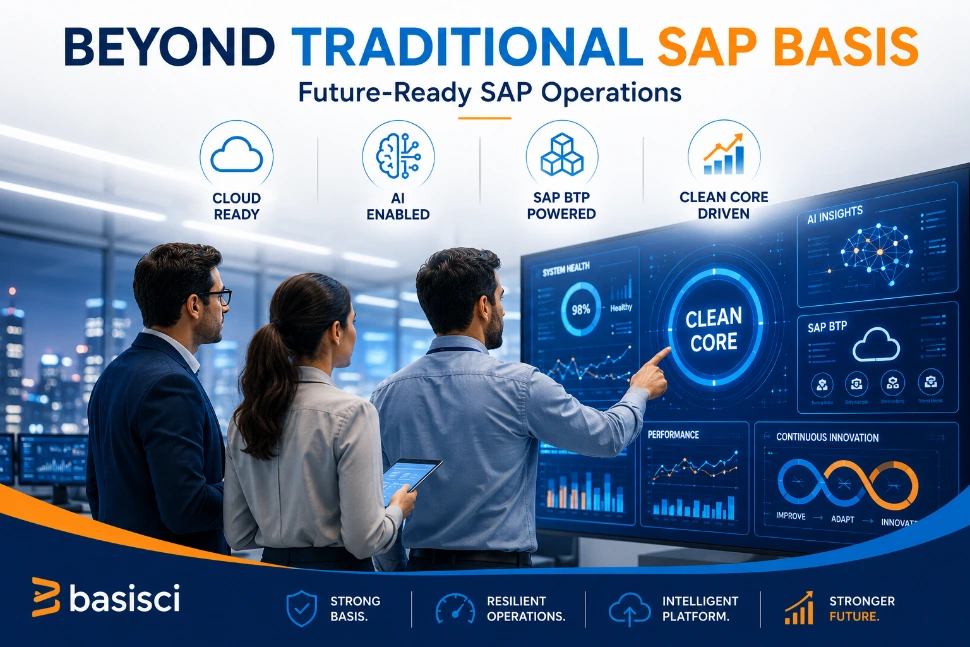
What Is SAP Clean Core? The Foundation of Next-Generation SAP Operations

One of the most frequently discussed topics in SAP communities, user groups, technology events, and transformation projects today is undoubtedly Clean Core.

The concept itself is not entirely new. For many years, SAP projects have emphasized the importance of adhering to standard processes and avoiding unnecessary customizations. However, over the past few years, Clean Core has evolved from a technical recommendation into a central pillar of SAP’s cloud, artificial intelligence, and continuous innovation strategy.

Today, the discussion among SAP professionals is no longer limited to:

“How do we migrate to S/4HANA?”

The more important question has become:

“Once we move to S/4HANA, how do we keep our SAP landscape open to future innovations?”

This is where the Clean Core approach emerges as one of the most important answers.

As SAP accelerates its investments in artificial intelligence, positions SAP BTP at the center of its technology strategy, and encourages organizations to adopt more standardized architectures, Clean Core has become more relevant than ever. Today, many SAP professionals view Clean Core not merely as a technical architecture preference, but as a foundational principle of next-generation SAP operations.


What Is SAP Clean Core?

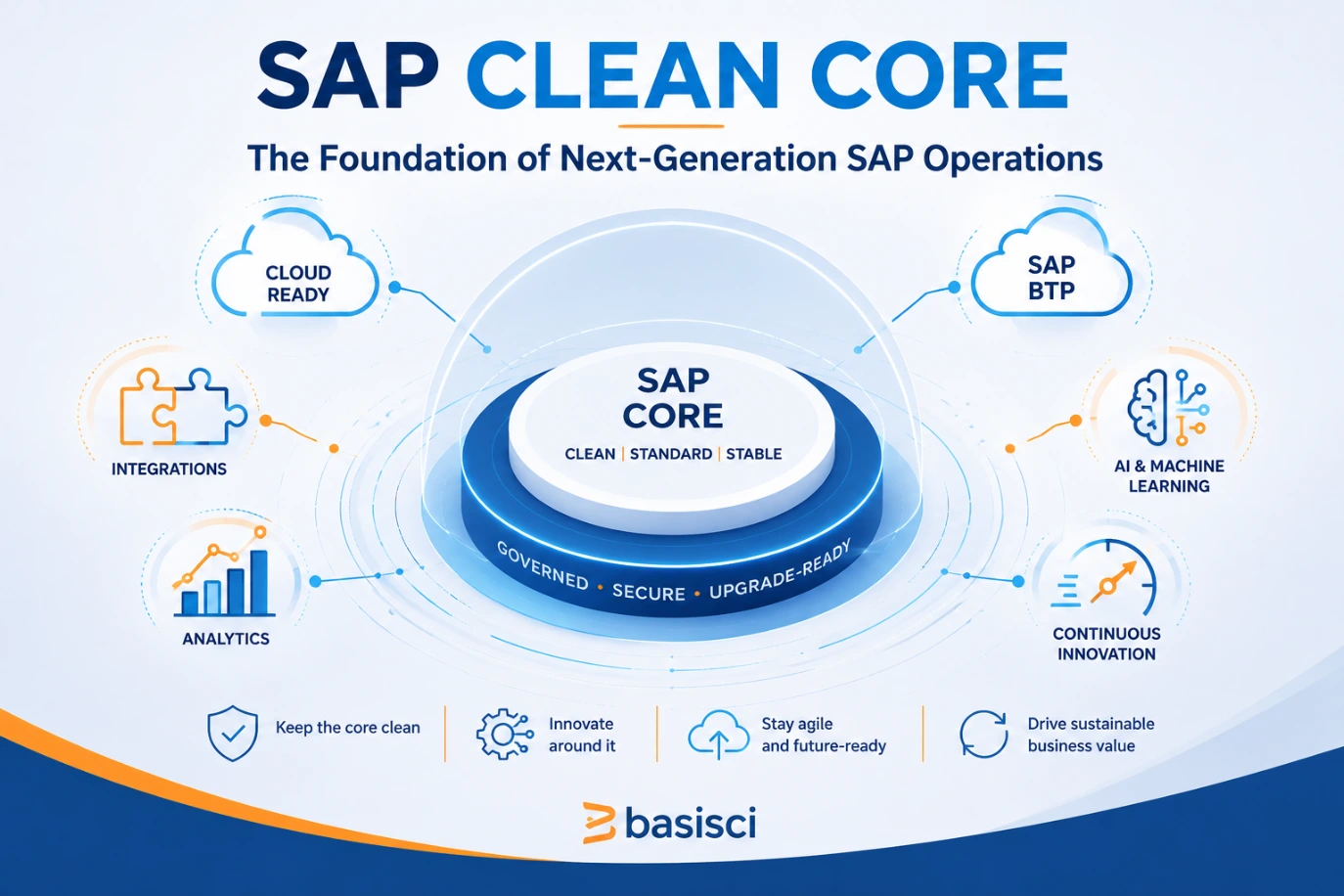
SAP Clean Core is an architectural approach that preserves the standard structure of the SAP S/4HANA core while ensuring that custom developments are implemented through appropriate extension models and platforms rather than directly within the system core.

In the past, many SAP projects relied on direct modifications and custom developments within the core system to address business requirements. While this approach often met short-term needs, it frequently resulted in increased system complexity, more challenging upgrade projects, and higher maintenance costs over time.

The Clean Core approach introduces a different perspective:

  • SAP standards are preserved.
  • The core system remains as unchanged as possible.
  • Custom developments are managed on appropriate extension platforms.
  • Updates and upgrade projects become easier to execute.
  • New technologies can be integrated more quickly.

The primary objective of this approach is to make SAP investments more sustainable and future-ready.

The Five Core Pillars of the Clean Core Approach

The Clean Core approach is not only about keeping SAP systems technically streamlined. It is also about managing them through a more sustainable, upgradeable, and future-ready architecture. At the heart of this approach are five key pillars:

Standard Processes: Adhering as closely as possible to SAP best practices and avoiding unnecessary customizations.

The Right Extension Model: Implementing custom developments on appropriate platforms such as SAP BTP rather than directly within the system core.

Clean Integration Architecture: Replacing complex point-to-point connections with integrations that are more manageable, traceable, and sustainable.

Data and Process Standardization: Simplifying fragmented data structures, department-specific practices, and repetitive workflows.

Upgrade-Ready Systems: Establishing a flexible architecture that enables upgrades, patches, and new SAP services to be deployed with lower risk.


Why Is SAP Promoting the Clean Core Approach So Strongly?

The answer lies in SAP’s strategic direction over the past several years.

In the past, ERP systems were primarily positioned as platforms for transaction processing and reporting. Today, however, organizations operate in a technology landscape that is evolving at an unprecedented pace.

Cloud technologies, artificial intelligence, automation platforms, and continuously updated service models are reshaping enterprise IT architectures.

In this environment, one of SAP’s primary objectives is clear:

Organizations should not be burdened by years of accumulated customizations while adapting their SAP landscapes to new technologies.

In highly customized environments, every upgrade project becomes more complex. New capabilities take longer to implement, and the system gradually loses flexibility as business requirements evolve.

This is precisely where the Clean Core approach comes into play.

Table: Key Differences Between the Traditional SAP Approach and the Clean Core Approach
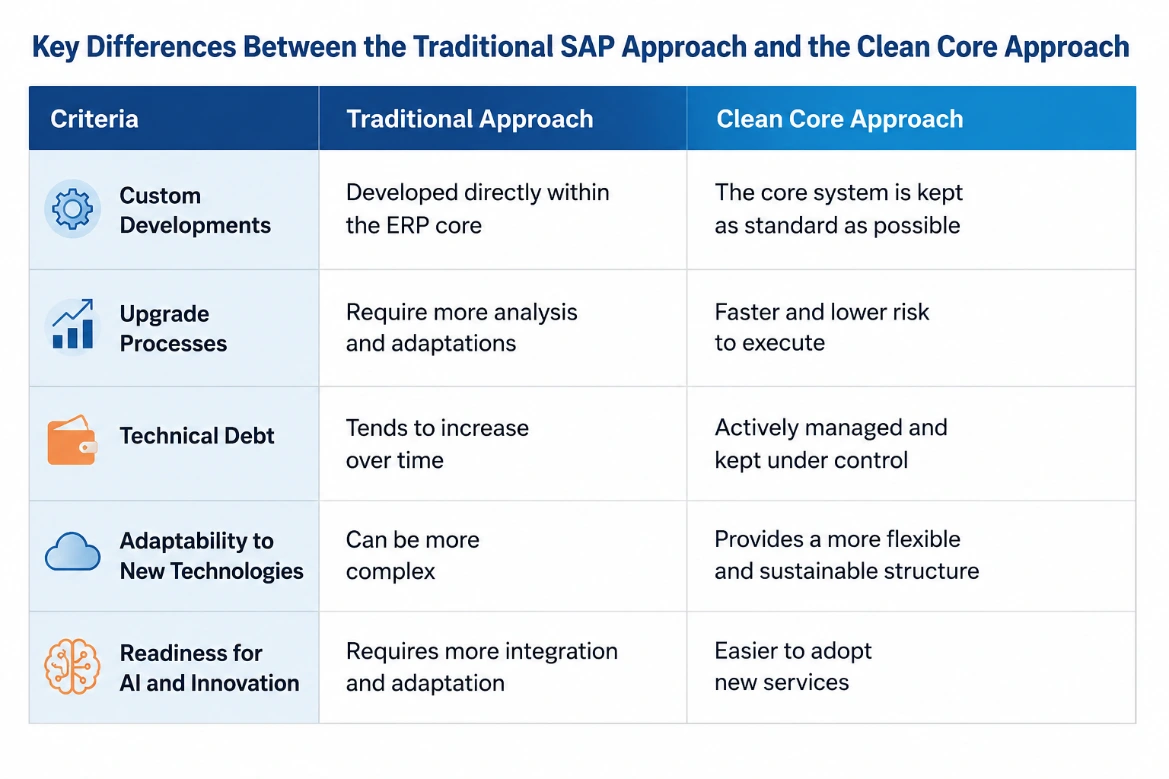
While the comparison may appear straightforward in theory, the reality is often more complex. Many SAP landscapes have evolved over the years through extensive custom developments, integrations, and business-specific enhancements that make transformation projects significantly more challenging.

Further Reading

The success of AI initiatives is often determined not by the model itself, but by the architecture it runs on. Discover why Clean Core is becoming a strategic prerequisite rather than an architectural preference in the era of Agentic AI, and how it is shaping the future of next-generation SAP operations.

A Common Reality in SAP Landscapes Across Türkiye

In theory, every organization wants to operate with standardized processes. In practice, however, the reality is often quite different.

Once an SAP system goes live, it naturally continues to evolve over the years. New reports are created, user exits are added, company-specific screens are developed, and new workflows are introduced to address the needs of different departments.

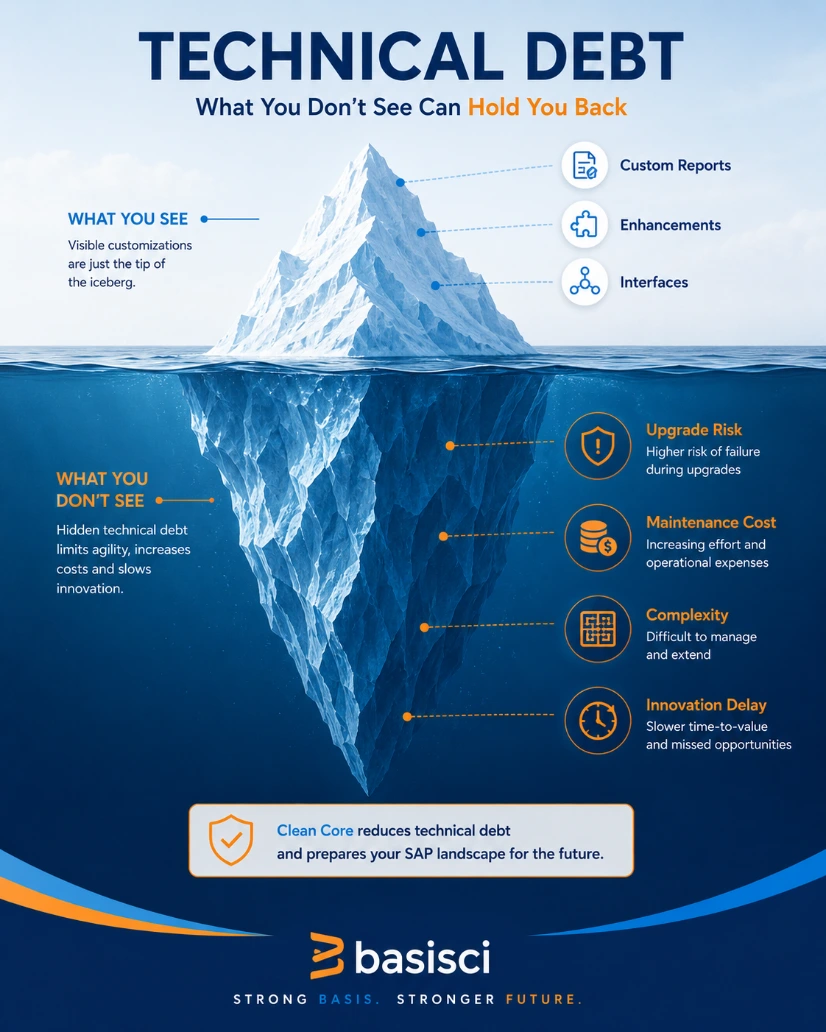
Each of these enhancements serves a legitimate business purpose at the time it is implemented. Over time, however, the accumulation of these structures can create an invisible layer of technical debt that becomes deeply embedded within the SAP landscape.

Technical debt does not necessarily prevent the system from functioning today. However, it often reappears as additional analysis, testing, adaptation efforts, and project risk during every major upgrade, integration initiative, performance optimization effort, or S/4HANA transformation project. Rather than ignoring this debt, the Clean Core approach aims to make it visible and reduce it to a manageable level.

As a result, when organizations eventually embark on an S/4HANA transformation, a cloud migration, or a large-scale upgrade initiative, they are often confronted with an important reality:

The real challenge is not moving to the new system—it is managing the years of accumulated custom developments and technical debt.

For many organizations, adopting a Clean Core approach is therefore not merely a technical initiative. It is a transformation journey that requires reassessing processes, custom developments, and long-established operational practices.


Why Is Clean Core Important for S/4HANA Transformations?

Many organizations still view S/4HANA projects primarily as technical version upgrades. In reality, one of the common characteristics of successful transformation programs is a willingness to re-evaluate and optimize business processes.

With S/4HANA, SAP is actively encouraging customers to adopt standard processes wherever possible.

The goal is not simply to simplify technology management.

It is also to achieve:

  • Faster innovation
  • Easier maintenance
  • Lower operational risk
  • Faster upgrade projects

This is why the Clean Core approach has become an increasingly important evaluation criterion in many S/4HANA transformation programs today.


The Relationship Between SAP BTP and Clean Core

SAP BTP plays a critical role in the widespread adoption of the Clean Core approach.

In the past, organizations implemented many of their custom developments directly within the ERP system itself.

Today, SAP promotes a different model.

While the SAP core remains standardized, company-specific applications, extensions, and innovations can be developed outside the ERP core using modern extension platforms.

This approach enables organizations to maintain flexibility while preserving the integrity of the core system.

As a result, SAP BTP is widely recognized as one of the most important enablers of the Clean Core strategy.

The Changing Role of SAP Basis Operations in the Clean Core Era

The Clean Core approach is often viewed primarily as a software development or functional consulting topic. In reality, however, it also directly reshapes the role of SAP Basis operations.

In the traditional SAP world, Basis teams were mostly associated with system installation, performance monitoring, patch management, transport processes, system copies, and upgrade projects. In the Clean Core era, a more strategic layer is being added to these responsibilities.

The key question for SAP Basis operations is no longer simply:

“Is the system running?”

A more critical question is now:

“How ready is this SAP architecture for future updates, cloud services, integrations, and AI-driven processes?”

This is why Clean Core moves Basis teams beyond the traditional role of system administration and toward a broader role in platform management and architectural governance. Monitoring unused custom developments, complex integrations, upgrade risks, and technical debt is becoming relevant not only for development teams, but also for the teams responsible for SAP operations.

From this perspective, Clean Core is not merely a technical compliance topic for SAP Basis services. It is a next-generation operations discipline focused on managing the sustainability, upgradeability, and future readiness of the SAP landscape.

The transformation taking place across the SAP ecosystem in recent years is also reshaping the responsibilities of Basis teams. Ensuring that systems are performant and continuously available is no longer sufficient on its own. Organizations are increasingly questioning how ready their SAP investments are for cloud services, artificial intelligence applications, and future transformation initiatives. As a result, the next-generation SAP operations approach goes beyond technical administration and now includes architectural sustainability, technology alignment, and continuous transformation readiness.


Why Has Clean Core Become More Critical in the Age of Artificial Intelligence?

One of the most important reasons Clean Core has become such a widely discussed topic is artificial intelligence.

SAP is no longer positioned only as a technology provider that develops ERP systems. AI-enabled processes, digital assistants, intelligent automation, and autonomous business processes are becoming increasingly central to SAP’s future vision.

In particular, SAP’s investments in Business AI and Joule make the Clean Core approach even more strategic. For AI-enabled processes to work effectively, systems need to be based on a standardized, understandable, and manageable architecture.

Fragmented processes, heavily customized structures, complex data models, and workflows that vary from department to department can make it more difficult to deploy AI services. This is why Clean Core is no longer only an approach that simplifies upgrade projects. It is increasingly seen as a strategic foundation that prepares organizations for tomorrow’s AI-enabled SAP operations.


Does Clean Core Mean the End of Custom Development?

At this point, it is important to clarify a common misconception.

The Clean Core approach does not aim to eliminate custom development entirely. Every organization has its own specific processes, competitive advantages, and ways of working.

The key question is:

Where and how should these developments be implemented?

Clean Core does not advocate removing all custom developments. Instead, it promotes implementing them in the right place and through sustainable methods. Therefore, the goal for organizations should not be “no development at all,” but rather making custom developments more manageable.

The 3 Most Common Mistakes Organizations Make on the Clean Core Journey

When understood correctly, the Clean Core approach can deliver significant advantages for organizations. However, several common mistakes during implementation can prevent this transformation from creating the expected impact.

1. Trying to preserve all existing custom developments

Not every Z report, custom screen, or company-specific workflow still delivers the same level of business value today. Some custom developments may support a real competitive advantage, while others may only be preserved because of long-standing user habits. For this reason, the business value of existing custom developments should be reassessed as part of the Clean Core journey.


2. Treating Clean Core as only a technical topic

Clean Core is not merely a technical topic owned by software development or Basis teams. The real decision is about which processes should be standardized, which custom developments should be retained, and which operational habits need to change. This is why business units must also be active participants in the process.


3. Assuming the transformation is complete after moving to S/4HANA

Clean Core is not a one-time project. It is an architectural discipline that must be managed continuously. An S/4HANA transformation can be an important starting point, but the Clean Core approach must continue operationally if the system is to remain upgradeable, sustainable, and open to innovation in the future.

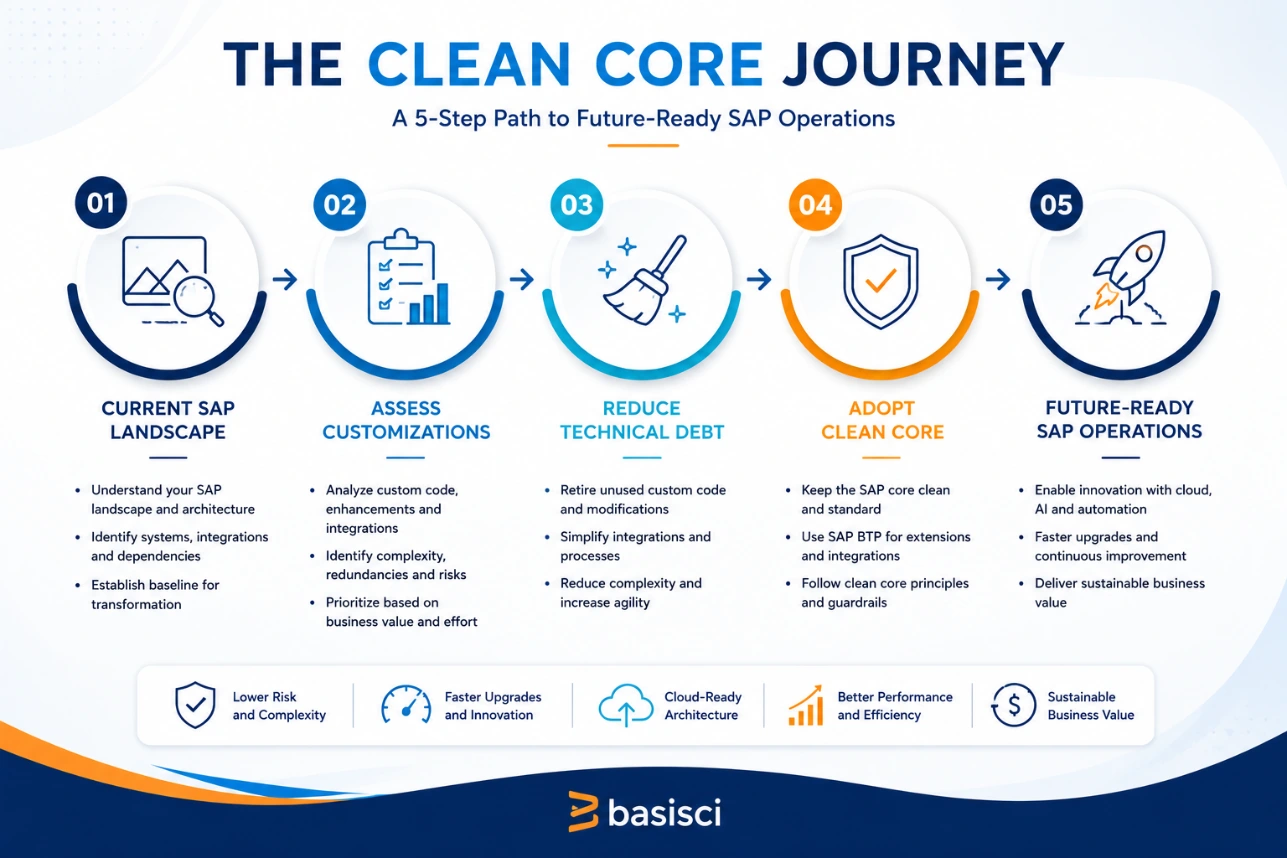
5 Steps to Start the Clean Core Journey

  • Inventory existing custom developments.
  • Identify developments that no longer create business value.
  • Assess the level of technical debt.
  • Define an extension strategy for new developments.
  • Treat Clean Core as a continuously managed architectural discipline.


Clean Core: An Operating Model for Preparing SAP Systems for the Future

There is a simple reason why Clean Core has become such an important topic across the SAP ecosystem.

Organizations no longer want to build systems that only meet today’s requirements. They also want SAP landscapes that can adapt to the technologies and business models of the coming years.

Cloud transformation, continuously updated service models, artificial intelligence applications, and growing integration needs are changing the way organizations think about SAP architecture.

This is why viewing Clean Core merely as a technical development approach would be incomplete.

In reality, Clean Core is an operating model designed to help organizations make their SAP systems more agile, more sustainable, and more future-ready.

That is exactly why it has become such a widely discussed topic in SAP communities and transformation projects today.

Frequently Asked Questions

SAP Clean Core is an architectural approach that aims to keep the core SAP system as standard as possible while managing company-specific developments outside the core system.

Clean Core is one of the key approaches that supports more sustainable and upgradeable SAP landscapes during S/4HANA transformation projects.

No. The goal is not to eliminate custom development, but to implement it through more manageable and sustainable methods.


SAP BTP enables company-specific applications and extensions to be developed separately from the core ERP system, helping organizations preserve the standard SAP core.

More standardized and manageable system architectures make it easier to deploy AI applications and new SAP technologies more quickly.


Yes. Organizations can begin their Clean Core journey before moving to S/4HANA by analyzing existing custom developments and assessing their technical debt.

You Must Also Like These

New SAP Technologies Explained: What They Mean for Your Business
How SAP’s Product Positioning and Market Narrative Are Changing
The Era of Speed, Security, and Automation in SAP System Refresh Operations