
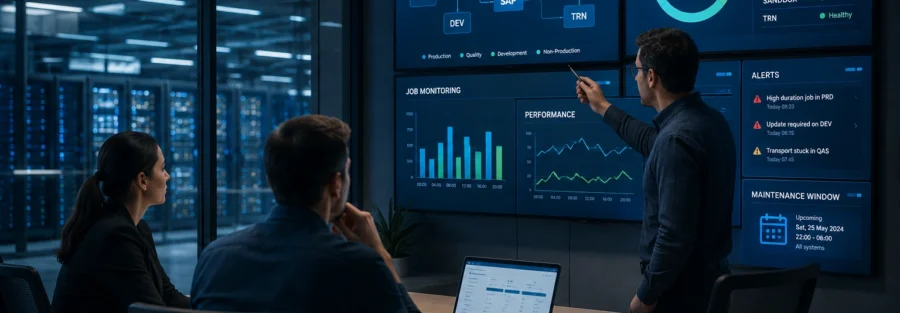
The Ongoing Tension Between Business Units and IT Teams
In enterprise organizations, requests coming from business units are increasingly driving the need for faster, more agile, and more realistic test environments.
For example:
- “We urgently need to run a performance test using live production data.”
- “We need to validate new e-invoicing and regulatory changes with up-to-date data.”
- “We must reproduce a specific issue that occurred in production using the exact same dataset.”
- “Realistic integration testing is required before the S/4HANA transformation.”
- Especially in large-scale organizations running SAP, these requests are no longer exceptional cases — they have become a natural part of daily operations.
However, from the IT operations perspective, the reality often looks very different.
Because traditional SAP System Refresh operations still create major operational challenges such as:
- Extended maintenance windows,
- Weekend operations,
- High levels of manual workload,
- Increased risk of human error,
- Data security concerns in non-production systems,
- Accidental connections to live production environments.
At a time when enterprise agility has become so critical, many organizations are still managing SAP system copy processes with operational habits designed years ago.
In this article, we focus specifically on SAP System Refresh operations from live production systems to test, quality assurance, or development environments. This is where critical topics such as speed, security, data masking, and integration isolation become significantly more important.
Why Is the Need for SAP System Refresh Increasing?
In the past, many organizations performed system refresh operations once or twice a year.
Today, however, the landscape has changed completely.
Modern SAP ecosystems have become significantly more dynamic due to factors such as:
- More frequent release and transport cycles,
- Agile development practices,
- DevOps-driven operations,
- SAP S/4HANA transformation projects,
- Increasing SAP integrations,
- Regulatory and e-transformation changes,
- AI and data analytics initiatives,
- The growing need for realistic test data.
As a result, organizations now require SAP system copy and refresh operations much more frequently than before.
Especially in SAP S/4HANA transformation projects, the quality of testing performed with realistic production data can directly impact project success.
For this reason, SAP System Refresh processes are no longer just technical SAP Basis operations; they have become a critical component of business continuity, project management, and operational agility.
In many organizations, refresh operations that were previously performed once or twice a year are now planned much more frequently due to transformation projects, regulatory updates, and increasing testing requirements.

The Most Common Risks in Manual SAP System Copy Processes
Traditional SAP system copy operations do not only create time loss; they also introduce serious operational and security risks.
Some of the most common critical issues encountered in SAP operations include:
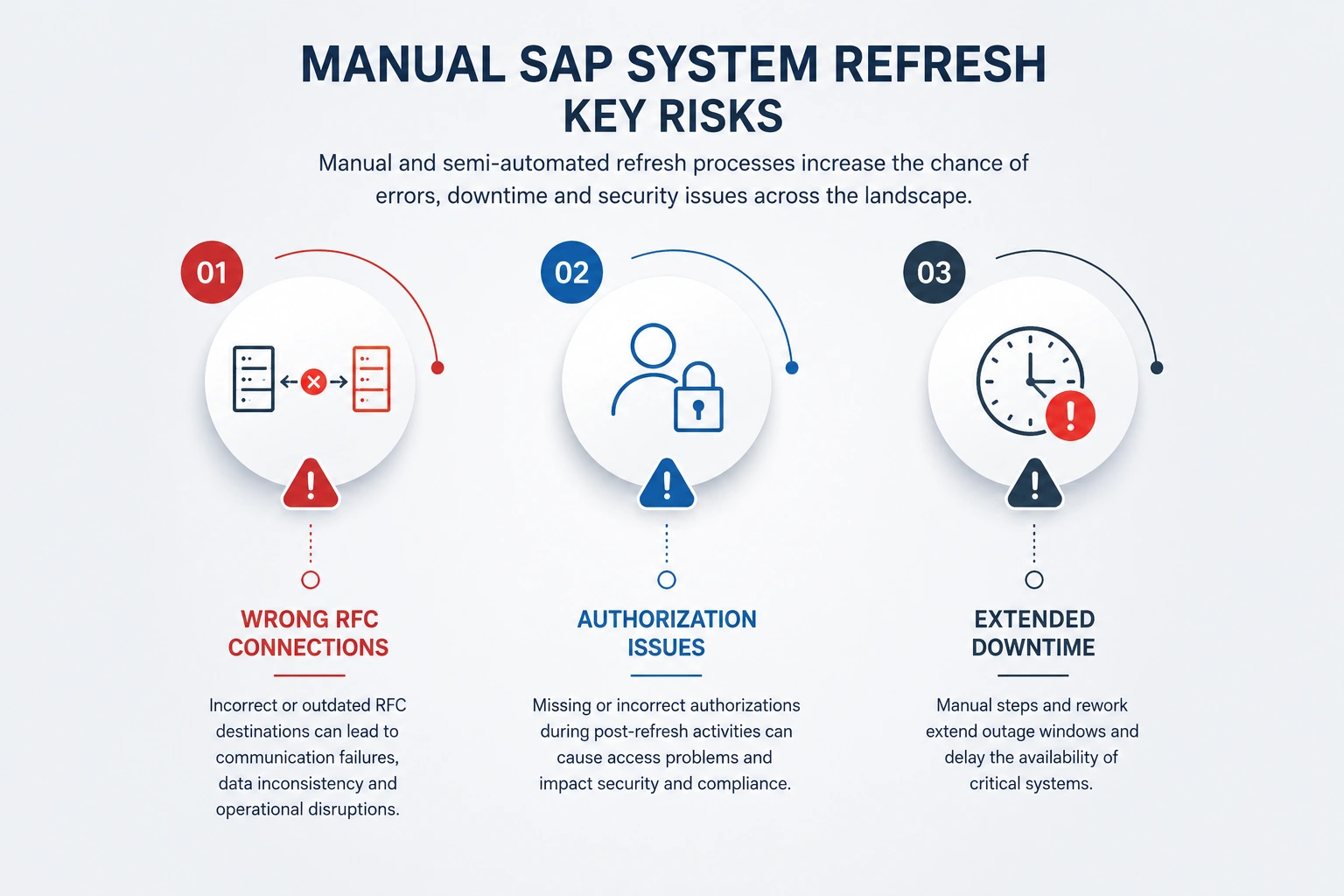
Accidental Connections to Live Production Systems
This is one of the highest-risk scenarios in SAP operations.
When a production database is copied into a test environment, RFC connections, integration settings, output management configurations, and certain technical definitions are often copied as well.
If these connections are not properly isolated before the system becomes active:
- Real emails may be sent to actual customers from the test system,
- Incorrect order flows may be triggered for suppliers,
- Live data transmissions to external systems may begin,
- Financial processes may accidentally execute.
These incidents are not merely technical problems; they create direct operational and reputational risks.
Authorization and User Management Issues
During manual operations, environment-specific passwords, roles, and authorization settings are frequently overwritten.
As a result:
- Test teams may lose system access,
- Development teams may become unable to continue working,
- Sensitive finance or HR authorizations from production systems may remain unintentionally exposed in test environments.
Especially in large SAP landscapes, these authorization issues can evolve into serious security vulnerabilities.
Extended Downtime and System Locking Issues
SAP logical system conversions — particularly BDLS operations that remap logical system names across the environment — along with HANA recovery processes and large table operations can become highly unpredictable when managed manually.
This may lead to:
- Maintenance windows exceeding planned schedules,
- Operations extending into Monday morning,
- Test teams being unable to work,
- Project timelines being delayed.
In SAP environments with large data volumes, managing operational duration efficiently has become increasingly critical.
How Modern Storage Technologies Are Changing SAP Refresh Processes
Traditional data transfer methods create significant operational overhead as data volumes grow.
However, modern storage and snapshot technologies are helping organizations significantly accelerate SAP system copy operations.
Some of the key advantages provided by modern snapshot architectures include:
Reducing Data Copy Time
Snapshot technologies used in SAP-certified storage infrastructures such as NetApp, Pure Storage, and Dell EMC can significantly reduce physical data copy times, especially in large SAP environments.
However, the total duration of SAP System Refresh operations is not determined solely by the data copy phase. BDLS conversions, RFC cleanup, post-processing tasks, data masking, and system validation steps can still represent a substantial portion of the overall operation time.
As a result:
- Even very large databases can be managed more efficiently,
- Long-running physical data transfer operations can be minimized,
- Operational workload for SAP Basis teams can be reduced,
- Maintenance windows can become more predictable.
Minimizing Impact on Production Systems
In properly designed modern infrastructures, the performance impact of snapshot operations on live production systems can be minimized.
This approach helps organizations:
- Preserve business continuity,
- Maintain uninterrupted critical SAP operations,
- Achieve greater operational flexibility, especially in 24/7 environments.

Further Reading
Along with S/4HANA and cloud technologies, the definition of operational excellence in the SAP world is being redefined. In this article, we examine the critical role of modern reliability engineering approaches and automation in next-generation SAP operations.
The Role of Automation in SAP System Copy Processes
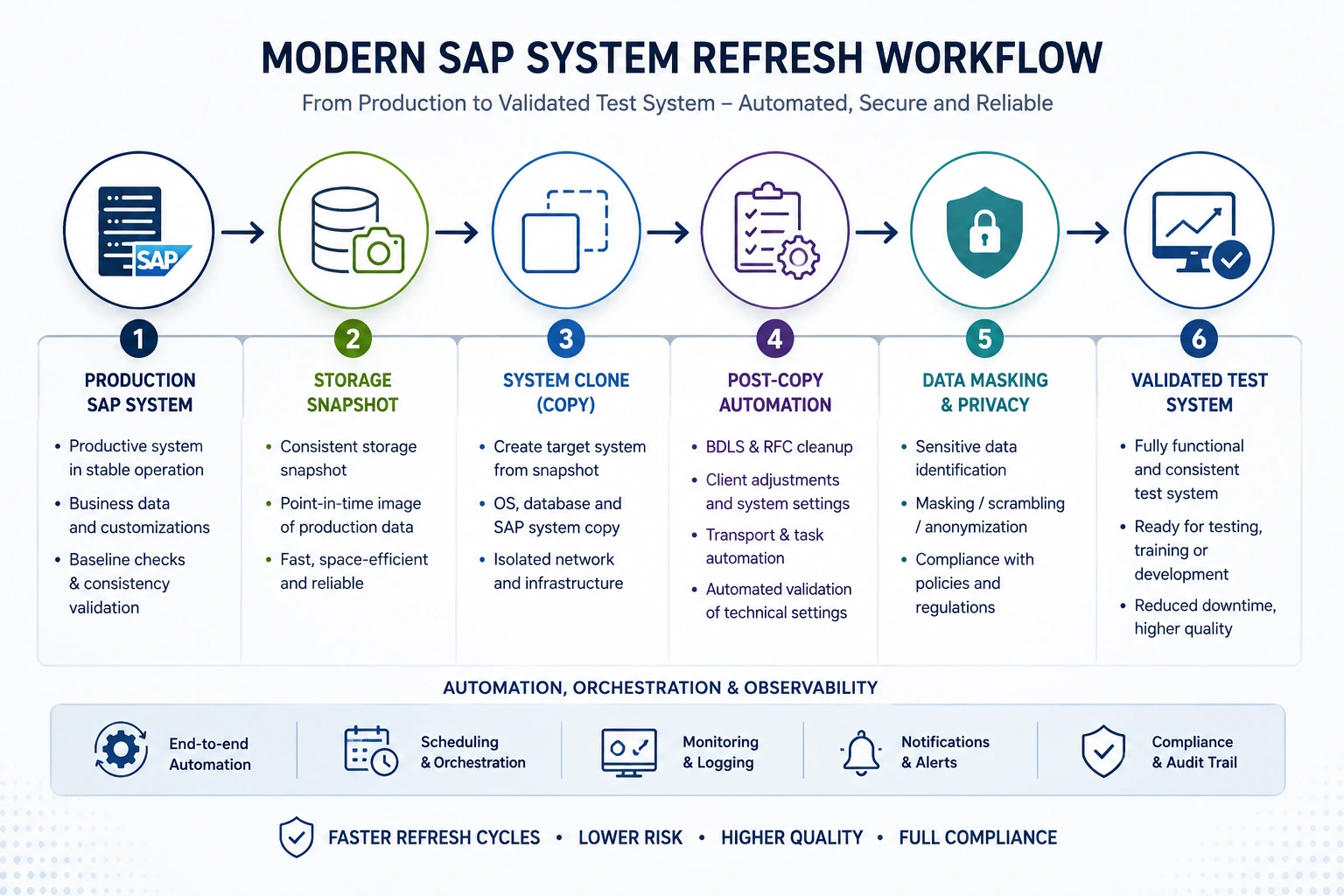
The most critical phase is not simply copying the data.
The real challenge is securely isolating the copied SAP system and preparing it properly for the target test environment.
In modern SAP operations, these processes are increasingly managed through automation platforms rather than manual procedures.
Some of the commonly used solutions in the SAP ecosystem include:
SAP LaMa (Landscape Management)
SAP LaMa is SAP’s own landscape management platform.
SAP LaMa can:
- Integrate with storage infrastructures,
- Orchestrate system copy operations,
- Centrally manage technical steps,
- Standardize SAP landscape operations.
It provides significant advantages in terms of operational standardization, especially in large and complex SAP environments.
Libelle SystemCopy
Libelle SystemCopy is one of the specialized solutions designed to highly automate SAP system copy operations.
It is commonly used in areas such as:
- Preserving RFC settings,
- Restoring test-system-specific configurations,
- Managing user and integration settings,
- Standardizing recurring operations.
Avantra
Avantra is a modern platform used for SAP operations visibility, observability, monitoring, and operational automation.
Although it does not directly perform system refresh operations, it can provide significant value in areas such as:
- Validating system health after a refresh,
- Improving SAP landscape visibility,
- Enabling proactive alert management,
- Supporting operational control processes.
In modern SAP operations, SAP System Refresh processes are no longer just about copying data. They are becoming multi-layered operational processes that require SAP Landscape Management, Post-Copy Automation, BDLS conversions, Data Masking, and SAP Basis Operations disciplines to be managed together.
KVKK, GDPR, and SAP Test Data Security
One of the biggest risks many organizations overlook is the presence of real production data in non-production environments.
When sensitive production data such as:
- Customer information,
- National identity numbers,
- Financial records,
- Payroll data,
- Health or personal information
is copied directly into lower-security test environments, it can create serious KVKK and GDPR compliance risks.
This challenge becomes even more critical for organizations that:
- Work with outsourced teams,
- Operate offshore development environments,
- Use AI-driven analytics tools,
- Manage distributed development operations across multiple locations.
In these environments, test data security is no longer just a technical IT concern — it has become a core component of enterprise risk management.
As a result, data masking and anonymization processes are becoming increasingly critical in modern SAP System Refresh operations.
With next-generation approaches, sensitive data can be:
- Automatically masked,
- Anonymized,
- Securely provided to testing and development teams.
This allows organizations to:
- Build realistic test environments,
- Maintain regulatory compliance,
- Reduce data security risks.
SAP System Copy Processes Are No Longer Just Technical Operations
In modern SAP operations, the challenge is no longer simply keeping systems up and running.
The real priorities are:
- Reducing operational risk,
- Standardizing processes,
- Minimizing human error,
- Making maintenance windows more predictable,
- Allowing senior engineers to focus on higher-value strategic initiatives.
Today, organizations that successfully manage SAP landscapes are increasingly:
- Operating with an automation-first mindset,
- Investing in operational observability,
- Standardizing system copy processes,
- Treating data security as a built-in part of refresh operations.
Because in modern SAP environments, agility is no longer just a development team objective — it has also become a core performance indicator for SAP Basis operations.
A New Standard in SAP Operations: Faster, Safer, and More Controlled Processes
For many years, SAP System Refresh operations were viewed as inherently painful and time-consuming processes.
Today, however, modern storage architectures, SAP automation platforms, observability solutions, and data security approaches are enabling organizations to manage these operations in a far more controlled, faster, and safer way.
Especially in large-scale SAP landscapes, making system copy processes faster, more predictable, and more secure has become critical not only for IT operations, but also for project continuity and business agility.
At Basisci, we help organizations build more secure, agile, and sustainable operational models in areas such as SAP landscape management, system copy operations, and SAP operations automation.