
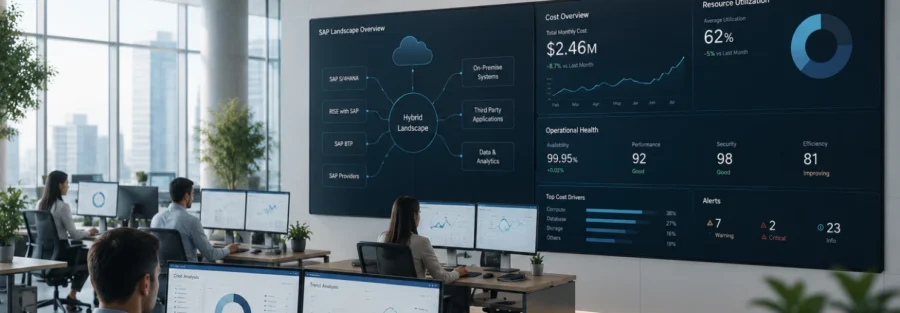
As the end of the month approaches, a familiar scene unfolds in many companies.
Cloud operations reports are opened. SAP consumption metrics are reviewed. Finance teams try to understand changing cost patterns.
And sometimes, the same question comes up in the meeting room:
“Why did this consumption increase so much compared to last month?”
What makes this interesting is that, in most cases, there is no visible problem within the systems.
SAP systems are running. Users continue their daily operations. Batch jobs complete successfully. From a technical perspective, everything appears normal.
However, a different reality may be forming in the background:
- overprovisioned resources,
- unused systems running continuously,
- uncontrolled storage growth,
- unoptimized workloads,
- invisible data transfer costs,
- steadily increasing cloud consumption.
In modern SAP operations, the critical issue is no longer simply whether systems are running. The real challenge is how efficiently and how visibly those systems are being managed. Because invisible operational costs can sometimes create greater risks than visible performance problems.
With the growing adoption of SAP S/4HANA, RISE with SAP, hyperscaler infrastructures, SAP Business Technology Platform (SAP BTP), SAP Datasphere, and AI-driven services, operational consumption dynamics are changing significantly.
This is exactly where the FinOps approach is emerging as a new strategic operating model for SAP operations.
What Is FinOps?
FinOps (Financial Operations) is a modern operational framework that brings together technology, finance, and business teams to manage financial visibility, operational efficiency, and consumption optimization across cloud and digital infrastructure environments.
However, viewing FinOps in the SAP world solely as a way to “reduce cloud costs” would be an incomplete perspective.
Because in modern SAP operations, FinOps is evolving into a broader operational model that combines:
- capacity management,
- observability processes,
- resource optimization,
- automation strategies,
- system lifecycle management,
- cloud consumption visibility,
- operational sustainability.
As consumption-based services become more widespread, cost management in SAP environments is no longer solely the responsibility of procurement or finance teams.
Similarly, cloud-based SAP operations are shifting from fixed infrastructure investments toward variable, consumption-driven cost models. This transformation makes not only cost levels but also cost predictability increasingly critical. For many CFOs, the main concern is not simply high spending, but uncontrolled and unpredictable consumption behaviors.
Modern SAP operations teams are now expected to manage consumption behavior as carefully as they manage technical performance.
Why Is FinOps Becoming More Important in Modern SAP Architectures?
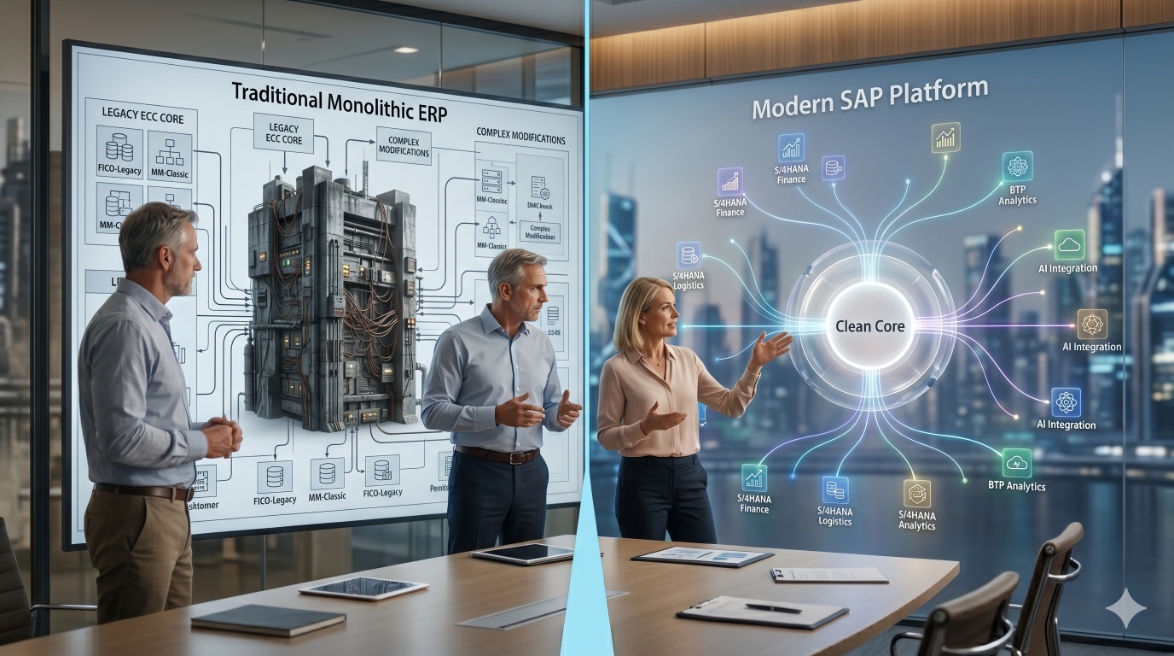
The growing importance of the FinOps approach in recent years is largely driven by the architectural transformation taking place across the SAP ecosystem.
With the rise of SAP S/4HANA transformations, next-generation operational and service models such as RISE with SAP, SAP Business Technology Platform (SAP BTP), hyperscaler infrastructures, SAP Datasphere, and AI-driven services, SAP landscapes have become significantly more dynamic and consumption-oriented.
In the past, many SAP environments operated on relatively static infrastructures. Capacity planning cycles were longer, and cost behavior changed more gradually.
Today, the landscape is fundamentally different.
Resources can scale instantly. Consumption-based services are becoming standard. AI workloads increase infrastructure utilization. Data growth accelerates. While cloud services provide operational flexibility, they also make cost behavior far more variable and dynamic.
At this point, inaccurate capacity planning in hyperscaler-based SAP architectures can create substantial differences in total cost of ownership (TCO).
Based on our field experience, many organizations initially allocate higher resource capacities to remain on the “safe side.” However, when systems are not continuously optimized according to actual usage patterns, significant operational inefficiencies begin to emerge over time.
Instead of operating every system continuously at peak-load capacity, modern cloud architectures increasingly rely on more flexible capacity management and auto-scaling approaches based on variable workloads. In SAP HANA environments, the memory-centric cost structure makes this impact even more visible.
At this stage, it is worth addressing an important question together.
Is FinOps Irrelevant in the ECC World?
Absolutely not.
FinOps is often discussed primarily in the context of cloud transformation. However, the need for operational efficiency in SAP environments is not a new concept.
Even during the ECC era, organizations faced major operational costs caused by:
- oversized system planning,
- idle servers,
- growing backup volumes,
- uncontrolled storage usage,
- inefficient batch processes,
- unoptimized archiving structures.
The difference today is this:
In cloud environments, these inefficiencies have become far more visible.
In the past, the impact of poor capacity planning could remain hidden within long-term hardware investments spread across years. Today, the same inefficiencies are directly reflected in monthly cloud invoices.
For this reason, the FinOps approach is strategically important not only for SAP S/4HANA Cloud or RISE with SAP projects, but also for all SAP landscapes — including ECC environments.
In fact, for many organizations, FinOps is becoming an important preparation layer for building operational awareness even before starting an SAP S/4HANA transformation journey.
What Is Observability and Why Does It Matter in SAP Operations?
In modern SAP operations, observability and FinOps can no longer be considered separately.
Observability goes beyond simply monitoring whether a system is running. It is an operational visibility approach that helps organizations understand why systems behave the way they do.
Because it is impossible to optimize a system that cannot be properly measured and understood.
Traditional monitoring approaches typically focus on generating alerts after a problem occurs. Observability, on the other hand, aims to provide end-to-end visibility into system behavior.
Today, SAP observability is no longer limited to monitoring:
- CPU,
- memory,
- availability,
- response time.
It also focuses on analyzing:
- capacity behavior,
- cost trends,
- abnormal consumption patterns,
- performance anomalies,
- operational bottlenecks,
- resource utilization trends.
Within the SAP ecosystem, the growing visibility of platforms such as SAP Cloud ALM and SAP Focused Run is also making observability a far more central component of modern SAP operations.
As a result, SAP Cloud ALM, SAP Focused Run, telemetry platforms, AIOps solutions, and advanced monitoring tools are no longer used solely for technical alert generation. They are increasingly becoming critical data sources for operational efficiency and FinOps visibility.
In large SAP landscapes, building an effective FinOps model without a mature observability approach is becoming increasingly difficult. In many organizations, monitoring infrastructures may exist, yet true operational visibility still remains limited.

Further Reading
The SAP world is no longer limited to ERP alone; it is evolving into a much broader ecosystem shaped by cloud, AI, data, and platform technologies. In this article, we explore what next-generation SAP technologies mean for businesses through a clear and practical perspective.
Hidden Cost Layers in SAP Operations
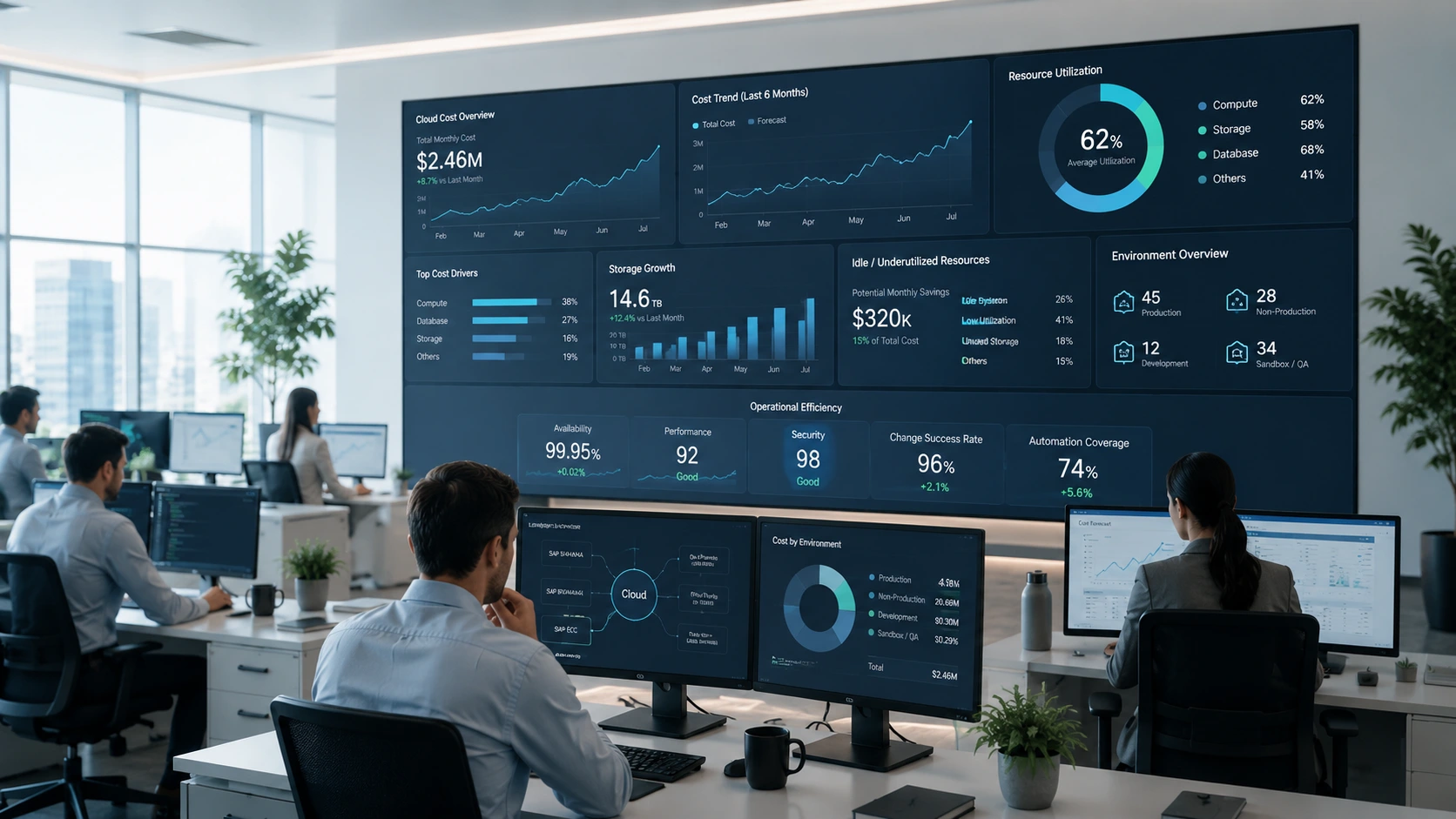
In many organizations, cost management in SAP environments is still evaluated primarily from a licensing perspective. However, in modern SAP landscapes, the operational consumption layer is becoming increasingly critical.
Some of the most common operational patterns observed in the field include:
Oversized SAP HANA Resources
Many SAP systems are initially provisioned with high resource allocations during implementation phases. Over time, however, a significant gap can emerge between actual usage behavior and allocated capacity.
Continuously Running QA and Sandbox Systems
It is very common to see QA, development, or sandbox environments continue operating for long periods despite no longer being actively used after project completion.
Storage and Backup Growth
Backup policies, legacy log structures, insufficient archiving strategies, and weak data lifecycle management can gradually create substantial storage-related operational costs.
Uncontrolled Data Transfers
In many organizations, especially within hybrid architectures and multi-platform integration environments, data transfer operations and cloud egress costs can create unexpectedly high operational consumption.
AI and Analytics Workloads
As SAP BTP, SAP Datasphere, and AI-driven services become more widespread, next-generation workloads can significantly increase infrastructure consumption patterns.
SAP’s New Consumption and Licensing Models Are Making FinOps More Critical
Licensing and consumption models across the SAP ecosystem are also undergoing a major transformation.
With the growing adoption of consumption-based models in areas such as:
- SAP BTP,
- SAP Datasphere,
- Integration Suite,
- AI services,
- Automation platforms,
organizations are no longer asking only:
“Which systems are we using?”
They are increasingly asking:
“How efficiently are we consuming these systems?”
This transformation is making the FinOps approach a natural component of modern SAP operations.
As AI-driven services continue to expand across modern SAP landscapes, operational consumption visibility is expected to become significantly more important in the coming years. In other words, organizations will increasingly analyze not only total infrastructure consumption, but also the operational cost impact of specific business processes and workloads.
5 Strategic Steps for FinOps in the SAP World
Centralize Cloud Visibility
When SAP, cloud, and finance teams operate with disconnected datasets, operational blind spots inevitably emerge. A mature FinOps approach requires shared visibility across teams.
Classify Systems Based on Operational Criticality
Managing production, QA, sandbox, and project systems with the same operational and capacity model can create major inefficiencies. In many cases, QA and sandbox environments continue consuming resources at production-level capacity despite having significantly lower operational importance.
Make Capacity Management a Continuous Process
Capacity planning is no longer a static annual exercise. Modern SAP operations require continuous measurement, visibility, and optimization.
Build Automation and Shutdown Policies
Controlled shutdown strategies for unused systems and automated resource management approaches can create significant operational optimization opportunities.
Bring CIOs, CFOs, and SAP Operations Teams to the Same Table
One of the most critical aspects of FinOps is enabling finance and technical teams to develop a shared operational language.
Because modern SAP operations are no longer only a technical management domain — they are increasingly becoming a financial management discipline as well.
The Role of SAP Basis Teams Is Changing
The role of SAP Basis teams has evolved significantly in recent years.
In traditional SAP Basis operations, the primary focus areas typically included:
- system availability,
- kernel and patch management,
- transport operations,
- backup processes,
- monitoring,
- performance troubleshooting,
- user and authorization management.
Today, however, modern SAP operations require a much broader operational scope.
In next-generation SAP Basis environments, the following capabilities are becoming increasingly critical:
- SAP observability,
- capacity intelligence (capacity visibility and forecasting),
- cloud cost visibility,
- automation governance,
- predictive monitoring,
- SAP automation,
- operational sustainability,
- SAP infrastructure optimization.
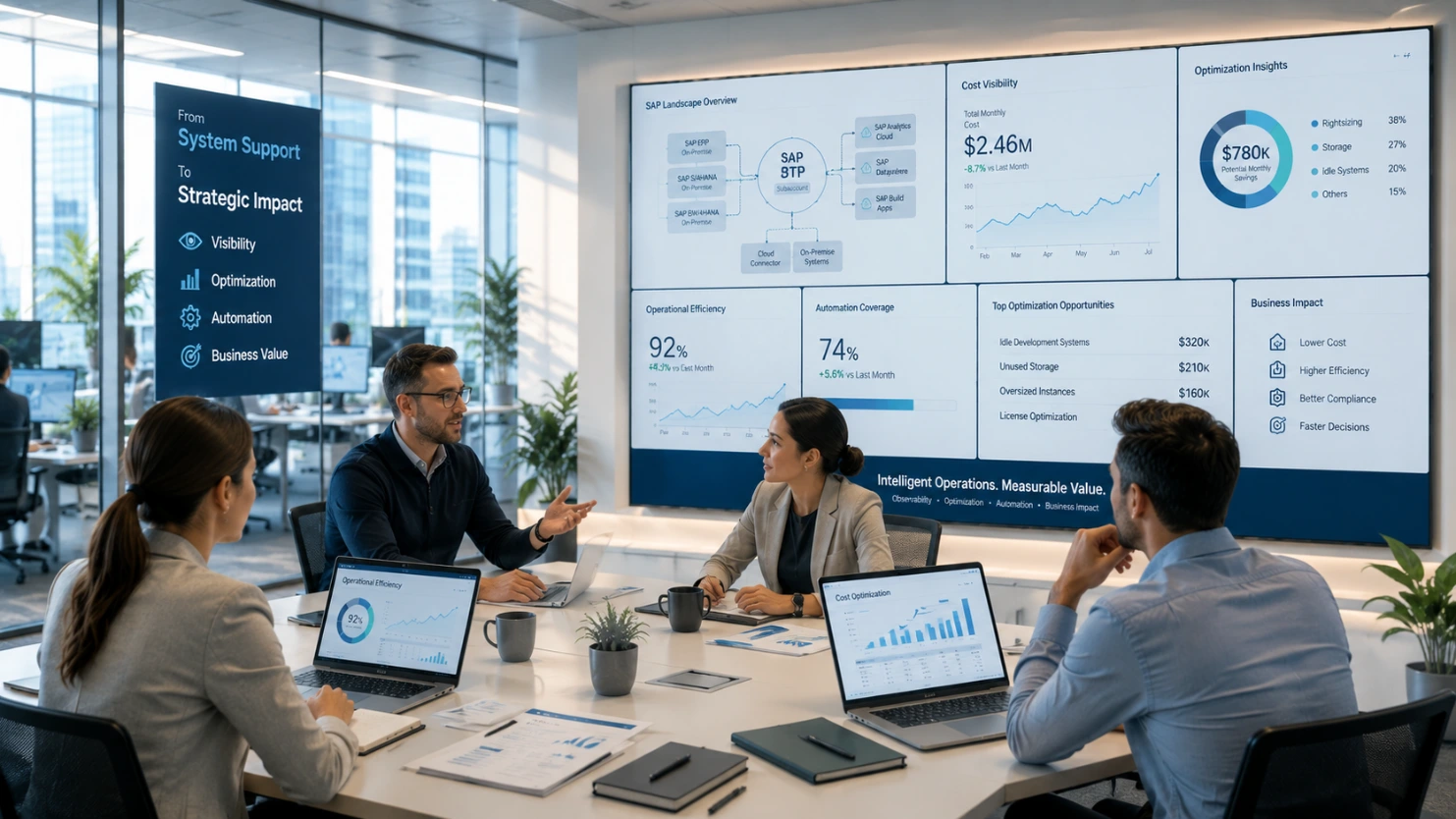
In other words, modern SAP Basis teams are no longer simply technical teams responsible for system administration. They are increasingly evolving into strategic operational teams that provide operational efficiency, visibility, and cost intelligence.
As SAP continues to place greater emphasis on platforms such as SAP Cloud ALM and SAP Focused Run within its long-term roadmap, observability is becoming a far more strategic capability in modern SAP operations.
The critical question is no longer simply:
“Is the system running?”
The real question has become:
“How efficiently is the system operating?”
The FinOps approach is transforming SAP Basis teams from traditional cost centers into strategic operational functions that directly contribute to business value.
This transformation is not only changing technical responsibilities — it is also reshaping how SAP Basis teams are perceived within organizations.
For many years, Basis operations in numerous companies were evaluated primarily through a “keep the systems running” mindset. Successful operations often remained invisible, while the value of teams was typically recognized only during crisis situations.
However, with the rise of the FinOps approach, this perspective is beginning to change.
Because in modern SAP operations, Basis teams are no longer only responsible for operational continuity. They are increasingly becoming strategic operational units that:
- optimize resource utilization,
- manage cloud consumption,
- improve operational efficiency,
- provide cost visibility,
- contribute to the financial sustainability of the organization.
This transformation is moving SAP Basis operations beyond the traditional “cost center” perception and turning them into direct operational value generators.
Visibility and Efficiency Are Becoming Core Priorities in Modern SAP Operations
In the coming years, the focus of SAP operations teams will extend far beyond system availability alone.
Operational visibility, cloud consumption management, observability, automation, and the FinOps approach are becoming core management disciplines within modern SAP landscapes.
Because in today’s SAP world, the real competitive advantage is no longer simply having powerful systems — it is the ability to manage those systems in a sustainable, visible, and optimized way.
Especially with the growing adoption of SAP S/4HANA, RISE with SAP, and hybrid cloud transformation models, organizations increasingly need more proactive and operationally intelligent SAP operating models.
At Basisci, our field experience across SAP operations, SAP Basis management, observability, cloud operations, and next-generation SAP infrastructure management continues to support organizations in building more sustainable, visible, and optimized SAP operational environments.