
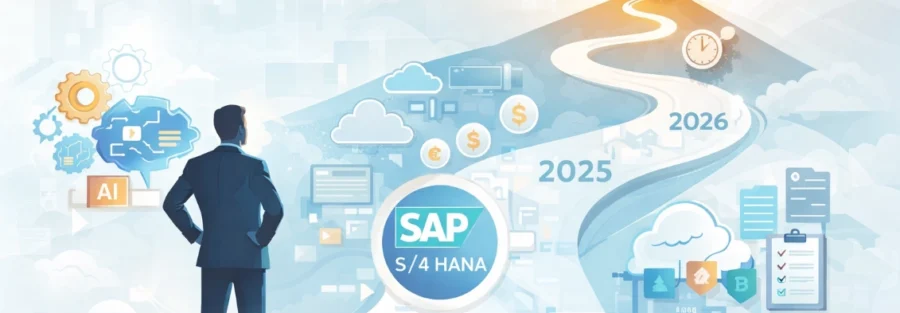
SAP has not only evolved its technology in recent years—it has fundamentally redefined the nature of the value it delivers. This shift, from ERP to a platform-centric approach, is reshaping what companies should expect from SAP.
In the past, SAP was primarily a system designed to standardize processes and bring operational control. Today, that same system has transformed into a structure that enables organizations to understand data, continuously optimize processes, and accelerate decision-making.
This change represents a deeper shift than it may initially appear. The challenge is no longer simply “using the system,” but rather how effectively value is created through it. At this point, a critical distinction emerges: companies that correctly interpret this transformation begin to unlock real value from SAP, while others—despite using the same system—fall behind in an increasingly competitive landscape.
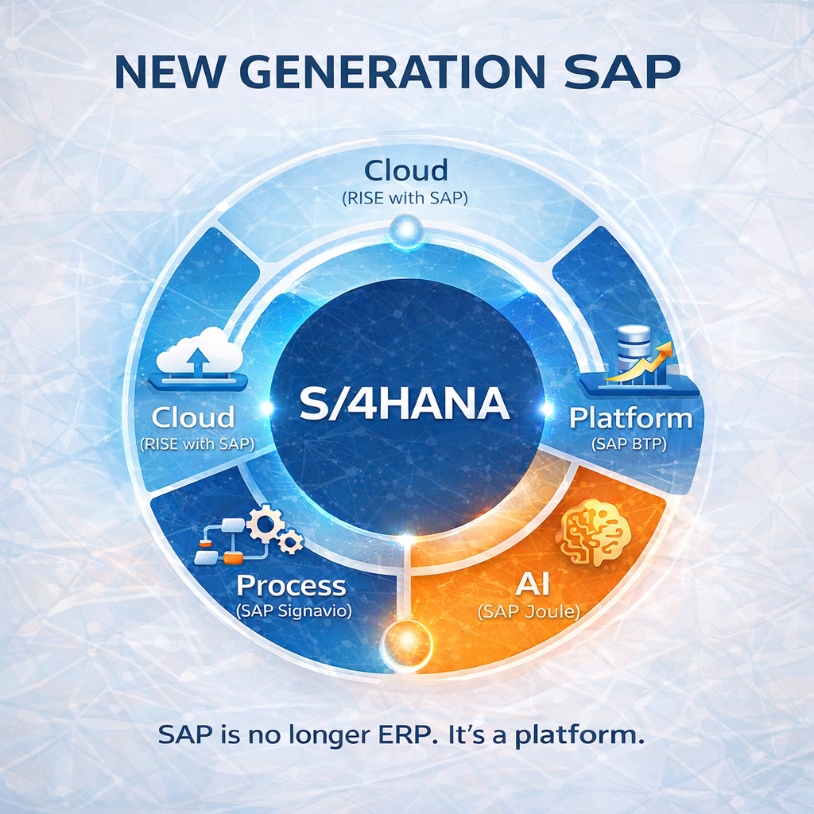
This transformation spans across multiple layers: from the redefined digital core built on SAP S/4HANA, to the cloud operating model shaped by RISE with SAP, the platform approach enabled by SAP Business Technology Platform, and the AI capabilities integrated through solutions like SAP Joule.
In this article, we provide a clear and structured perspective on this transformation and what it truly means for businesses today.
From ERP to Platform: The Real Turning Point in SAP
For many years, SAP was positioned within the traditional ERP paradigm. SAP ECC was the strongest representation of this era. Systems were implemented, processes were defined, reports were generated, and the landscape remained relatively stable over time.
Today, that model is being replaced by a fundamentally different approach.
The next-generation ERP, SAP S/4HANA, is not simply a faster system—it represents SAP’s reimagined digital core. Its in-memory data architecture enables real-time processing, while a simplified data model reduces operational complexity.
However, the real shift is not about performance—it is about perspective:
SAP is no longer just a system that reports on the past; it is a system that supports real-time decision-making.
This transformation marks the beginning of a new era—one where ERP alone is no longer sufficient.
SAP as an Ecosystem
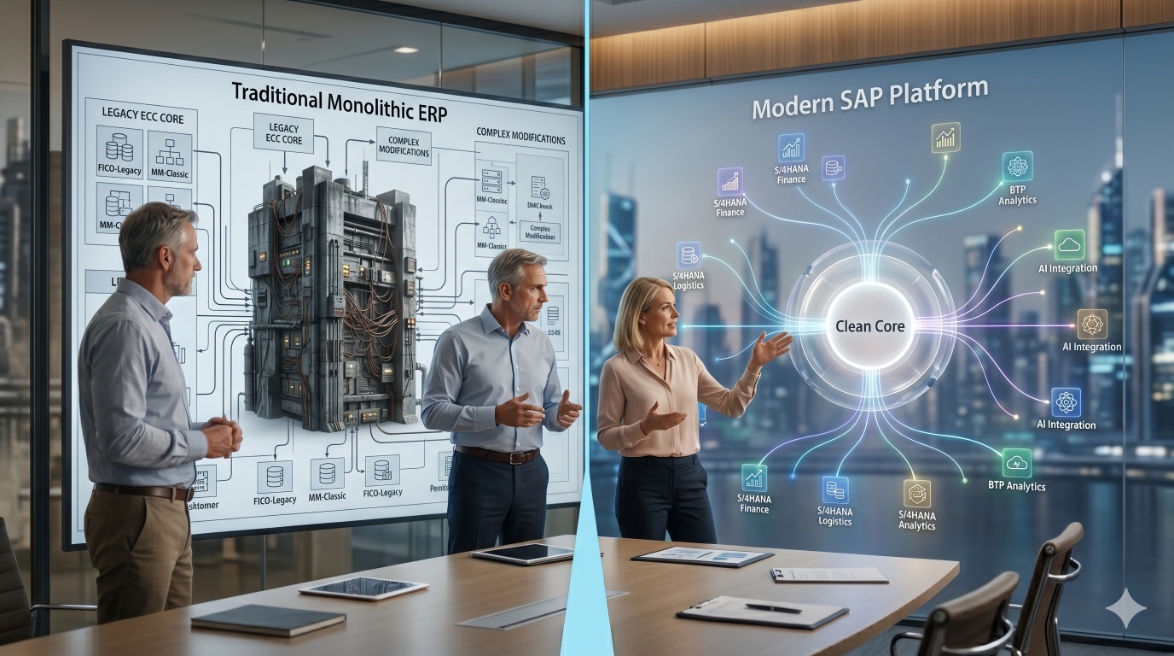
To truly understand SAP today, it is no longer enough to look at a single product—you need to look at the entire architecture. At the center of this architecture are three critical layers:
The first is the digital core: SAP S/4HANA
The second is the platform layer: SAP Business Technology Platform (BTP)
The third is process and data intelligence: SAP Signavio
This structure represents the most fundamental difference between SAP today and the traditional ERP approach.
In the past, all requirements were expected to be solved within the ERP system. Today, the approach is fundamentally different:
- The core is kept clean
- Extensions are built on the platform layer
- Processes are continuously optimized through data-driven insights
This approach is commonly referred to as “Clean Core.” However, it is not just a technical preference—it is a strategic decision directly linked to business agility.
In earlier SAP implementations, systems were heavily customized. While this provided short-term flexibility, it often resulted in long-term complexity and made upgrades increasingly difficult. Today, a more standardized yet extensible approach is preferred.
The reason is clear:
If you keep the core clean, you can adopt SAP innovations—such as AI capabilities, new functionalities, and continuous updates—quickly and seamlessly. Otherwise, every upgrade becomes a project on its own.
Cloud and the New Operating Model
One of the most significant shifts in SAP is happening on the cloud side. RISE with SAP is the most tangible representation of this transformation.
SAP projects are no longer just about implementing software—they are about adopting a service-based operating model. Infrastructure, technical maintenance, and certain operational responsibilities are now handled by SAP and cloud providers.
This shift leads to an important outcome for IT organizations:
As the technical operational burden decreases, the focus of IT within the organization begins to change.
The goal is no longer just cost reduction. The real benefit lies elsewhere:
IT teams can now spend less time managing infrastructure and more time contributing to business value creation—whether through analyzing sales data, optimizing processes, or enabling AI-driven initiatives.
This introduces a perspective that goes beyond traditional cost thinking and brings opportunity cost into focus.

Further Reading
Discover how SAP Basis is being redefined by cloud, RISE with SAP, and artificial intelligence—and explore its evolving role and new operating model in this article.

Process-Driven Transformation: SAP Signavio
One of the least discussed yet most critical components of the next-generation SAP approach is process management—and this is where SAP Signavio comes into play.
In traditional projects, processes are typically designed based on user statements. However, real life often does not validate these assumptions.
You may think a process in your organization is completed in five days. Yet the data might reveal that it actually takes three days—and the remaining two days are spent “waiting for approval.”
This level of visibility is the key to efficiency.
It also brings a fundamental shift in mindset:
“This is how we work” becomes
“Data shows how we actually work”
Application Lifecycle: The New Role of ALM
As SAP systems grow and become more complex, simply implementing and running them is no longer enough. Changes must be managed, systems must be monitored, and operations must be sustained in a structured way.
This is where SAP Cloud ALM stands out.
Unlike the traditional SAP Solution Manager approach, Cloud ALM offers a more agile, faster, and cloud-native structure.
But the real difference is not the tool—it’s the mindset:
SAP operations must now be proactive and measurable, not reactive.
A New Era in SAP Operations: Visibility and Reliability
SAP’s evolution into a platform is transforming not only technology but also how these systems are managed.
For years, SAP systems were operated with a simple mindset:
“If it’s running, there’s no problem.”
But as systems move to the cloud, integrations increase, and business processes become more critical, this approach is no longer sufficient.
Today, two key concepts define modern SAP operations:
observability and reliability engineering.
The question is no longer:
“Is the system running?”
The real question is:
“How healthy, sustainable, and predictable is the system?”
This shift elevates SAP operations from a purely technical activity to a core component of business continuity and performance management.
Artificial Intelligence: A New Layer in SAP
One of SAP’s biggest investment areas in recent years is artificial intelligence. SAP Joule is a strong representation of this direction.
However, AI in SAP is not a standalone product—it is a layer embedded into existing processes.
SAP AI is not just a chatbot. When designed correctly, it becomes a system that can detect financial anomalies early, anticipate demand shifts, and provide actionable recommendations to decision-makers.
In other words, SAP is evolving beyond a system that merely stores data—into a structure that generates insights and triggers action based on that data.
ECC 2027: A Deadline or an Opportunity?
One of the most discussed topics in SAP transformation is the end of mainstream maintenance for SAP ECC systems by 2027.
This date is often perceived as a “mandatory deadline.” But a more accurate perspective might be this:
It is not an end—it is a modernization opportunity.
For companies, this milestone offers a critical chance to reassess years of accumulated technical and operational burden and transition to a more modern architecture.
Yes, systems can technically continue to run. Support periods can even be extended with additional costs. However, this approach usually means preserving the current structure—not transforming it.
The real question SAP leaders should ask is:
Will we maintain the existing system—or prepare for the future?
What Are SAP Users Doing—and What Are They Missing?
Today, many companies use SAP. However, a significant portion:
Continues to run existing processes
Does not leverage new platform capabilities
Underinvests in data and process analytics
Has not yet embraced the AI layer
As a result, the business value derived from SAP remains limited.
Many organizations are simply not unlocking the full potential that SAP offers.
Where Should New SAP Adopters Start?
For companies adopting SAP for the first time, the most common mistake is applying old approaches to new technology.
In the new era, the right starting point is shaped by asking the right questions:
Are we implementing just an ERP—or building a platform?
Are our processes truly optimized—or just habits?
Is our data and integration strategy ready?
Is our cloud approach clearly defined?
Are we laying the groundwork for future AI capabilities?
The answers to these questions directly determine the success of the project.
Conclusion: The Difference Is Not Technology—It’s the Approach
Today, many companies use SAP—but very few manage it as a platform.
Next-generation SAP technologies such as SAP S/4HANA, SAP Business Technology Platform, artificial intelligence, or process analytics do not create value on their own. They only become meaningful when combined with the right architectural mindset and strategic perspective.
At this point, the real differentiator is not the technology—it is the approach.
Two companies using the same SAP system can follow entirely different paths:
one merely sustains operations, while the other evolves into a structure that continuously learns, optimizes, and creates competitive advantage.
The difference lies not in the tools—but in how those tools are positioned and utilized.