

ERP’s Transformation: From Static Records to Dynamic Action
The SAP ecosystem stands at the edge of one of the most significant architectural and functional shifts in its history. For decades, ERP systems have served as the “memory” and “ledger” of enterprises. Today, they are evolving beyond passive data repositories into active decision systems—capable of interpreting data, reasoning over it, and initiating business processes with a degree of autonomy.
Agentic AI represents the most concrete and irreversible phase of this transformation. Technical constraints, licensing models, and data quality challenges do not signal a slowdown; rather, they indicate a transition toward a more disciplined and strategic adoption phase. The reality is clear: the speed of modern business processes has already surpassed the limits of human-only intervention. Moving toward this new “autonomous layer” is no longer a choice—it is becoming a new standard for modern enterprises.
Agentic AI in the SAP ecosystem refers to AI agents that can plan and execute tasks by orchestrating multiple skills toward a defined goal, while operating under human oversight.
From Prediction to Decision Support: The Uneven Evolution of SAP AI
Artificial intelligence in the SAP world has not followed a linear success path. Instead, it has evolved through experimentation, setbacks, and critical learnings. Understanding this journey is essential to properly position Agentic AI today.
The Leonardo Era (Predictive Phase)
Around a decade ago, SAP Leonardo introduced predictive capabilities—focused on answering the question: “What might happen next?” However, data silos and organizational unpreparedness limited its impact. The key lesson SAP learned was fundamental:
AI cannot remain an external add-on—it must be embedded within the core ERP architecture.
Joule and Copilot (Interaction Phase)
The next phase embedded AI directly into business processes. Tools like SAP Joule act as copilots—summarizing data and assisting users in context. What differentiates Joule from earlier approaches is its reliance on structures such as SAP Knowledge Graph and Business Data Cloud, enabling it to interpret data within business context rather than as isolated inputs.
Today: Agentic AI (Controlled Action Phase)
We are now entering a phase where AI moves beyond recommendations to multi-step planning and controlled execution. However, this is not full autonomy.
In most enterprise scenarios, human-in-the-loop mechanisms remain essential to ensure governance, trust, and compliance.
SAP AI Adoption: 3 Key Barriers to Production-Scale Implementation
While SAP’s AI capabilities are expanding rapidly in marketing narratives, real-world adoption is progressing more cautiously. According to the 2026 Investment Report published by the Deutschsprachige SAP-Anwendergruppe (DSAG), companies are increasingly exploring AI—but continue to evaluate its economic value, feasibility, and operational impact carefully.
So, if AI is widely discussed, why is production usage still limited?
The three primary barriers to Agentic AI adoption in the SAP ecosystem are:
1. Licensing Model
Many advanced AI capabilities remain largely inaccessible to on-premise SAP S/4HANA customers.
Access is typically tied to cloud-based offerings such as RISE with SAP or GROW with SAP, making the transition to cloud not just a technical decision—but a prerequisite for AI enablement.
2. Data Quality
In real-world implementations, one pattern consistently emerges:
AI systems built on poor data do not create value—they amplify risk.
From our field experience, organizations with low data quality often see AI solutions produce inconsistent or even misleading outcomes.
If data is flawed, AI simply generates errors faster.
The value of AI lies not in its algorithms, but in the quality of the data it is trained on.
3. Competitive Pressure
Even within its own ecosystem, SAP must prove that its AI capabilities deliver deeper business value than general-purpose AI tools.
To remain competitive, SAP AI must go beyond generic automation and demonstrate domain-specific intelligence tightly integrated with enterprise processes.
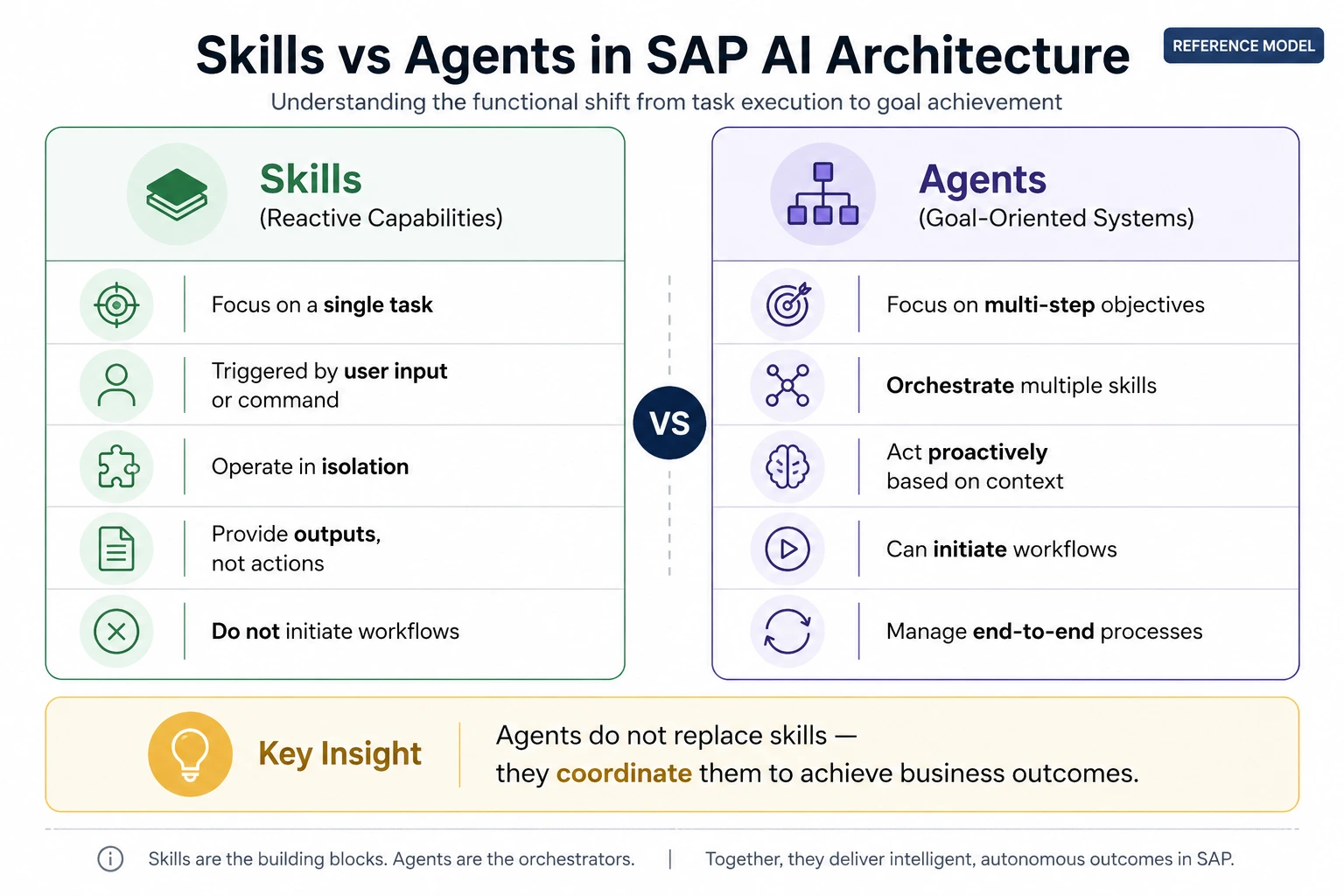
Skills or Agents? The Functional Divide in SAP AI Architecture
One of the most common mistakes when integrating AI into SAP systems is treating SAP Joule as a single, monolithic capability. According to SAP’s official positioning, Joule is an AI copilot embedded within SAP processes—designed to interpret business data in context and provide actionable recommendations.
However, real efficiency in practice is not driven by Joule alone, but by a clear functional distinction between skills and agents. In SAP architecture, this distinction becomes especially evident in custom AI scenarios built on SAP BTP, where orchestration and execution are separated by design.
Skills (Reactive, Command-Driven)
Skills are atomic, task-specific capabilities designed to perform a single function.
For example, a Basis administrator asking the system to “summarize dump logs” or a sales representative requesting “customer credit limit details” is invoking a skill.
In this model, AI remains reactive:
- A command is given
- Data is processed
- A result is returned
The interaction is complete once the output is delivered. No further action is taken.
Agents (Proactive, Goal-Oriented)
Agents, on the other hand, are goal-driven systems that orchestrate multiple skills to achieve a defined outcome.
For instance, when instructed to “resolve a credit limit bottleneck,” an agent does not stop at analysis. It:
- evaluates stock availability
- analyzes customer risk scores
- and initiates the appropriate approval workflow
Here, AI becomes active:
- it plans
- it executes
- and it manages the process end-to-end
In SAP architecture, a “skill” refers to a reactive function designed to perform a single task, while an “agent” represents a goal-oriented system that orchestrates multiple skills to take action.

Further Reading
To explore how artificial intelligence enables proactive monitoring, predictive insights, and automation in SAP Basis operations—and to gain perspective on emerging trends—you can take a look at this article.
Agentic AI Maturity Model: Real-World Scenarios Across Three Levels
The distinction between skills and agents becomes clearer when examined through a maturity model. In SAP environments, this evolution can be observed across three practical levels of implementation:
Level 1: Assistive (High Maturity)
Scenario: Dispute Resolution
Skill Level: The user opens a disputed invoice, and the AI summarizes inconsistencies within the document.
Agentic Level: The agent detects the incoming dispute email, analyzes historical cases in the system, and prepares a resolution proposal as a draft. This draft is then presented to the Accounts Receivable (AR) specialist as “pending approval.”
In many cases, the process is already 80% complete before the specialist even reviews the invoice.
Level 2: Augmented (Moderate Maturity)
Scenario: Intelligent Supplier Reconciliation
Skill Level: The system attempts to match a bank statement entry with a corresponding SAP invoice.
Agentic Level: For unmatched records, the agent accesses the supplier portal, checks pending delivery notes, identifies the root cause of discrepancies (e.g., missing items), and triggers a partial payment proposal by initiating the appropriate accounting entry.
Level 3: Agentic (Emerging Autonomy)
Scenario: Asset Management and Maintenance (PM/EAM)
Skill Level: The system explains the meaning of an error code received from a device.
Agentic Level: The agent detects anomalies via SAP Asset Intelligence Network, reviews the maintenance schedule, reserves the required spare parts from inventory, and assigns a “critical failure prevention” task to the relevant technical team.
At this stage, AI moves beyond providing information—it acts as a proactive safeguard, ensuring system continuity through coordinated and autonomous intervention.
Beyond the Hype: Production-Validated Use Cases
In the SAP ecosystem, “next-generation technology” is often associated with idealized scenarios presented in launch materials. However, Agentic AI has moved beyond vision statements.
The following examples represent real-world implementations where technical barriers have been overcome, error margins minimized, and—most importantly—measurable value has been achieved in production environments.
The focus here is not on what is theoretically possible, but on what has already been delivered:
Bosch (Operational Speed in Customer Service): By integrating Joule agents into SAP Service Cloud, Bosch reduced workflow configuration time for new products from weeks to minutes.
Wieland Group (Autonomy in Financial Reconciliation): By applying AI-driven processes to cash management and bank statement reconciliation, Wieland reduced manual workload by 70–80% and accelerated international financial closing cycles.
Smart Press Shop (Visual Inspection): By leveraging AI-powered visual inspection agents, the company reduced defect detection response time on production lines from hours to seconds.

CFO Perspective: The Reality of FinOps and ROI
For a CFO, Agentic AI is not just about efficiency—it marks the beginning of a new financial discipline: FinOps. In many organizations, the return on AI investments is determined less by technical implementation and more by data readiness and organizational adaptation.
Hidden Costs:
AI investments extend beyond licensing. Costs such as data transfer, model inference, and token consumption introduce new and often underestimated budget items.
Payback Period:
When considering RISE with SAP transition costs and data preparation efforts, the return on investment typically ranges between 18 months and 4 years, depending on organizational maturity. Strategic value is realized only when operational improvements directly impact cash conversion cycles and working capital efficiency.
The “Orchestration” Shift for SAP Basis Professionals
For SAP Basis experts, operational focus is shifting. The “dust of the field” is no longer in log analysis—it is now in managing platforms such as SAP AI Launchpad and SAP LeanIX AI Agent Hub. As the role evolves toward platform architecture, several disciplines become critical:
Observability:
The ability to monitor AI agent decisions and provide explainability in case of anomalies or failures.
Agent Lifecycle Management:
Managing the full lifecycle of AI agents, including versioning, deployment, and rollback mechanisms.
Integration and Data Flow Complexity:
In real-world environments, the accuracy of data flows—especially across non-SAP systems—directly impacts the quality of AI-driven decisions.
Roadmap for ECC Professionals:
For organizations still operating in SAP ECC environments, the most practical starting point is to explore SAP BTP services and understand the principles of Clean Core architecture.
Clean Core is not merely a technical simplification—it is an organizational transformation. In practice, heavily customized systems tend to slow down AI initiatives significantly, as non-standard processes require additional effort to be interpreted by AI models.
Risk, Governance, and Regulation (AI Act & KVKK)
AI agents involved in financial decision support processes may fall under the “High-Risk Systems” category defined by the EU AI Act, particularly in areas such as finance, HR, and decision-making workflows. This introduces strict requirements around transparency, human oversight, and logging.
In Türkiye, compliance with KVKK (Personal Data Protection Law) plays a critical role—especially in scenarios involving data processing and cloud data transfers. Regulatory alignment is not optional; it is a key determinant of project success.
Organizational Agility: Clean Core Is Not a Choice—It Is a Prerequisite for AI
The Clean Core approach is not only a technical strategy—it is an organizational commitment to standardized processes.
In markets like Türkiye, where heavily customized ECC systems are still common, achieving a Clean Core can take 3 to 5 years of disciplined effort. However, the relationship is clear:
The simpler the system, the smarter the AI—and the more agile the organization.
From field experience, one recurring pattern stands out:
AI initiatives in heavily customized environments take significantly longer to implement. The primary reason is the additional effort required for AI systems to interpret non-standard processes.

From Vision to Execution: Turning Strategy into Operations
This visionary framework and global success stories inevitably lead to a practical question: Where should we start?
The transition to Agentic AI is not a one-time IT deployment. It is a gradual architectural evolution combined with a cultural transformation. Turning strategy into measurable outcomes begins with acknowledging current system constraints while building toward future standards.
To navigate this journey effectively, organizations should focus on a set of foundational steps:
Roadmap: 3 Practical Steps to Take Today
Make SAP BTP the Center of AI Orchestration:
SAP BTP serves as the central platform where skills, workflows, and AI orchestration are defined and managed. In Agentic AI scenarios, this is where agents operate and coordinate actions.
However, it is important to note that advanced capabilities—such as Joule and full agent functionality—typically require a transition to cloud models like RISE with SAP or GROW with SAP.
Reduce Technical Debt Through RICEF Analysis:
Conduct a comprehensive analysis to determine which custom developments should be standardized and which should be re-platformed on BTP.
Excessive customization reduces AI effectiveness.
In real-world projects, the primary barrier to AI transformation is not the lack of new technology—but the accumulation of technical debt over time.
Define an Agentic Maturity Path:
Identify pilot areas that can evolve step by step—from assistive to augmented, and ultimately to agentic (controlled autonomy) levels.
From field experience, one consistent pattern emerges:
Organizations that succeed do not attempt to transform everything at once. Instead, they start with focused, measurable pilot areas and scale from there.
Conclusion: The New Reality of ERP
In the SAP ecosystem, Agentic AI is transforming ERP systems from passive record-keeping platforms into active decision support systems—capable of planning, acting, and accelerating processes under human supervision.
In the near future, SAP ERP environments will evolve into systems that:
- monitor themselves
- provide proactive recommendations
- and take controlled action when needed
However, the true competitive advantage will not belong to those who simply adopt AI—but to those who build systems that are clean, structured, and reliable enough for AI to make accurate decisions.
Organizations that transition to S/4HANA Cloud architectures and invest in data quality will lead this transformation. Those that rely on heavily customized systems and adopt a “move first, fix later” approach risk facing high licensing costs with limited AI-driven value.