

In recent years, not only SAP technologies but also the way these technologies are presented to customers has undergone a significant transformation. The once-prominent RISE with SAP narrative is now becoming part of a broader story centered on Cloud ERP, Business AI, and an integrated platform ecosystem. SAP’s evolving product language signals a more holistic positioning that goes beyond ERP modernization, placing AI-driven, cloud-based, and data-centric business operations at the heart of enterprise transformation.
From RISE with SAP to Cloud ERP, and from Business Suite to an AI-native platform approach, SAP’s new narrative is reshaping not only its product architecture but also its customer messaging and market positioning.
Why Does Product Language Matter So Much in the SAP Ecosystem?
The concepts used throughout the SAP ecosystem often represent more than existing products. In many cases, they also reflect the future operating models SAP aims to establish. As a result, SAP’s marketing language is not merely a communication tool. It has become a powerful mechanism that influences CIO agendas, investment decisions, partner strategies, and technology roadmaps.
For example, SAP HANA was never just a new database technology. It was positioned as the foundation of SAP’s vision for high-performance computing, real-time data processing, and modern ERP architecture. Similarly, SAP S/4HANA was introduced not simply as a new ERP generation, but as a key component of digital transformation, process simplification, and cloud adoption strategies.
A similar transformation is taking place today. However, this time the focus extends beyond ERP itself. Data platforms, AI agents, automation, observability, and platform-centric operating models are increasingly becoming the core elements of SAP’s evolving enterprise narrative.
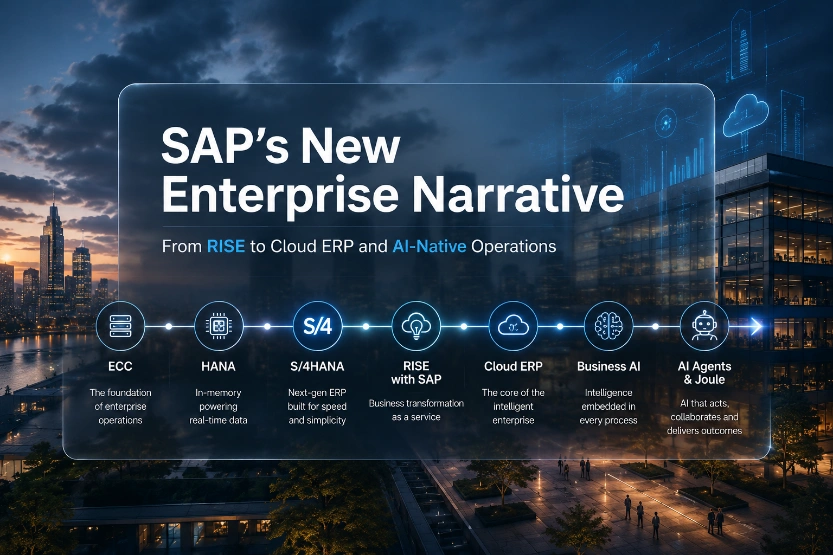
From the ECC Era to the AI-Native Enterprise
For many years, the primary focus of the SAP ecosystem revolved around the traditional ERP model. During the SAP ECC era, organizations typically prioritized financial management, supply chain operations, human resources processes, operational stability, process standardization, and the creation of a reliable system of record.
During this period, SAP was primarily positioned as the backbone of enterprise operations.
Over time, however, the narrative began to evolve.
First came SAP HANA. Then the transition to SAP S/4HANA gained momentum. Later, concepts such as Intelligent Enterprise, Experience Economy, Industry Cloud, RISE with SAP, Clean Core, and Business Transformation as a Service became increasingly prominent within SAP’s strategic messaging.
Today, SAP’s evolving narrative is centered around a new set of concepts, including Cloud ERP, SAP Business Suite, Joule, Business AI, AI Agents, Business Data Cloud, SAP BTP, Clean Core, and platform-centric operating models.
What is particularly notable is that SAP is no longer positioning itself solely as an ERP software provider. Instead, it is presenting a broader operational ecosystem designed to bring together business processes, enterprise data, AI capabilities, and automation mechanisms under a unified architecture.
An AI-native approach means that artificial intelligence is not added later as a supplementary feature. Instead, AI is embedded from the beginning into process design, data architecture, user experience, and automation models.
At the same time, it is becoming increasingly evident that not only SAP technologies but also SAP’s conceptual frameworks are evolving at an unprecedented pace. Concepts such as Intelligent Enterprise, Experience Economy, Industry Cloud, RISE with SAP, Clean Core, Business AI, Joule, AI Agents, Business Data Cloud, and Cloud ERP have been introduced to the market within relatively short periods of time.
While this reflects SAP’s ability to innovate and redefine enterprise technology conversations, it also creates a significant cognitive burden for professionals working within the SAP ecosystem. Even experienced SAP practitioners sometimes struggle to fully understand the real operational implications behind newly introduced concepts. In many cases, the conceptual narrative evolves faster than the technology’s actual level of maturity in production environments.
What Did RISE with SAP Actually Represent?
For many organizations, RISE with SAP has occasionally been perceived as a complex concept. The main reason is simple: RISE was never a single product.
In practical terms, RISE with SAP combined several strategic components, including the SAP S/4HANA transformation model, a cloud migration framework, a single-contract service structure, an SAP-managed operational model, a Cloud ERP approach running on hyperscaler infrastructure, and a methodology that addressed both technical modernization and business process transformation.
In other words, RISE was not merely a technical migration project. It represented SAP’s attempt to redefine how it engages with customers throughout their transformation journey.
For many organizations, this approach delivered meaningful benefits, including faster cloud adoption, reduced operational burden, greater standardization, and closer alignment with SAP’s product roadmap.
At the same time, several important discussions emerged around topics such as vendor lock-in risk, reduced architectural flexibility, long-term cost visibility, changing levels of operational control, and the often unclear boundaries between public and private cloud models.
These discussions remain highly relevant today, particularly within large and complex SAP landscapes.
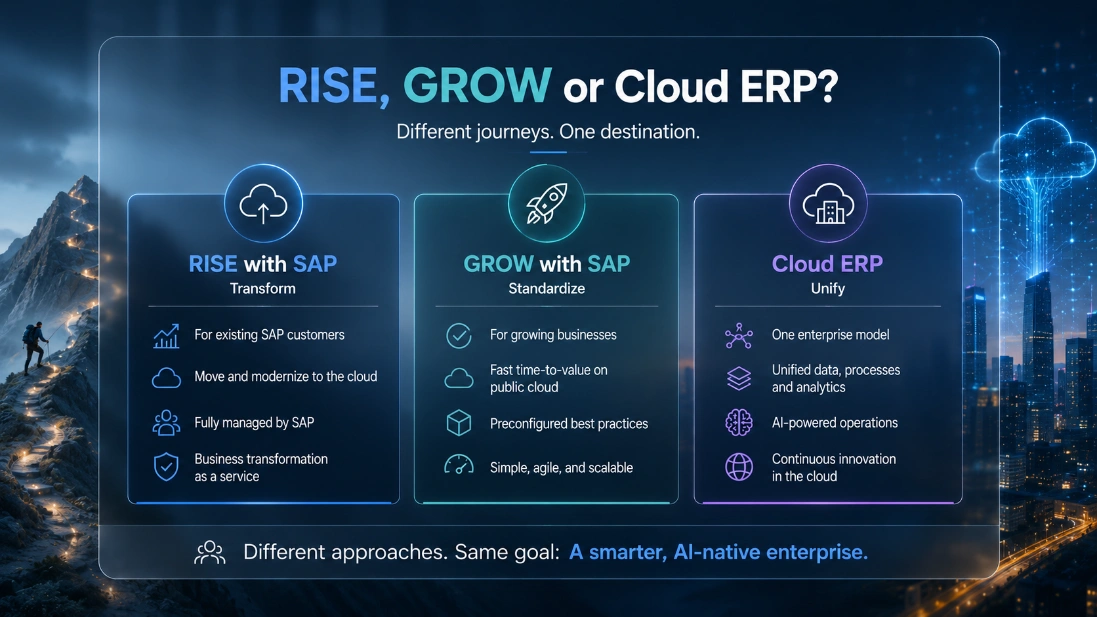
Within this broader picture, GROW with SAP should also be considered separately. While RISE with SAP primarily addresses existing SAP customers pursuing a Cloud ERP transformation journey, GROW with SAP focuses on a more standardized, public-cloud-oriented ERP model designed for organizations seeking rapid deployment and lower complexity.
This distinction demonstrates that SAP is no longer delivering a single cloud message to the market. Instead, it is creating different transformation narratives tailored to varying levels of organizational maturity and business complexity.

Further Reading
Explore our article for the details of the next-generation intelligent platform model that will go beyond traditional ERP boundaries and take your company into the future.
Why Is “Cloud ERP” Becoming the Dominant Message?
As of 2026, a clear simplification can be observed in SAP’s product language.
Concepts that were previously emphasized more heavily, such as RISE with SAP, SAP S/4HANA Cloud Extended Edition, and various transformation packages, are increasingly being replaced by a broader and more accessible SAP Cloud ERP narrative.
There are several possible reasons behind this shift.
First, SAP appears to be simplifying its messaging. For many customers, the concept of RISE with SAP often raised questions such as:
“Is this a product?”
“Is it a licensing model?”
“Is it a consulting package?”
“Is it a managed service offering?”
The Cloud ERP narrative provides a clearer and more straightforward framework that is easier for business and technology leaders to understand.
Second, SAP is no longer focused solely on ERP transformation. It is increasingly promoting the idea of a continuously evolving operational model running in the cloud.
The objective is no longer simply moving from ECC to SAP S/4HANA.
Instead, the goal is to establish a business architecture that is continuously updated, AI-enabled, data-centric, automation-driven, and platform-based.
Third, competitive market dynamics are also influencing this simplification. As vendors such as Salesforce, Workday, and Oracle communicate increasingly clear cloud-native value propositions, SAP is also moving toward a more direct and accessible market narrative.
Finally, this shift cannot be explained solely by SAP’s internal product strategy. Higher interest rates, growing sensitivity to cloud costs, cloud transformation fatigue, and the first wave of disappointment surrounding generative AI projects have all contributed to a growing demand for simpler, more measurable, and business-outcome-driven technology messaging.
Why Is SAP Business Suite Back in the Spotlight?
The term Business Suite is not new to the SAP ecosystem. However, the version being promoted today is fundamentally different from the classic SAP Business Suite model of the past.
Historically, Business Suite primarily referred to a collection of business applications such as ERP, CRM, SRM, and SCM.
Today, the concept represents a much broader vision.
What Do SAP’s Key Concepts Actually Mean?
RISE with SAP represents a transformation framework that combines SAP S/4HANA adoption, cloud migration, a single-contract model, and SAP-managed operations into a unified transformation journey.
SAP Cloud ERP refers to a continuously updated ERP model running on public or private cloud infrastructure and aligned with modern cloud operating principles.
SAP Business Suite represents SAP’s effort to bring ERP, enterprise data, artificial intelligence, integration capabilities, and automation technologies together within a unified business application ecosystem.
Joule is SAP’s AI assistant layer, designed to help users interact with business processes, receive recommendations, and initiate actions across SAP applications.
AI Agents are AI-powered digital workers capable of performing semi-autonomous tasks across procurement, finance, supply chain, operations, and support functions.
SAP BTP (Business Technology Platform) serves as the foundation for integration, application development, workflow management, data services, and extensibility across the SAP ecosystem.
Business Data Cloud represents SAP’s next-generation data platform vision, combining the evolution of Datasphere with the Databricks partnership to manage SAP and non-SAP data through business context, semantic models, and AI-ready data products.
Clean Core is the principle of keeping the ERP core as standard as possible while managing custom developments and extensions on surrounding platforms to support a sustainable cloud architecture.
Ultimately, SAP’s objective is not simply to connect applications. The broader goal is to bring together enterprise data, business processes, automation, and artificial intelligence within a shared operational model.
It is also important to recognize that today’s SAP Business Suite is not a direct return to the classic Business Suite model of the ECC era. While the original concept primarily referred to a portfolio of applications such as ERP, CRM, SRM, and SCM, the modern interpretation positions Cloud ERP, enterprise data, AI, integration, and automation capabilities within a single business architecture.
What Do Joule and AI Agents Actually Mean?
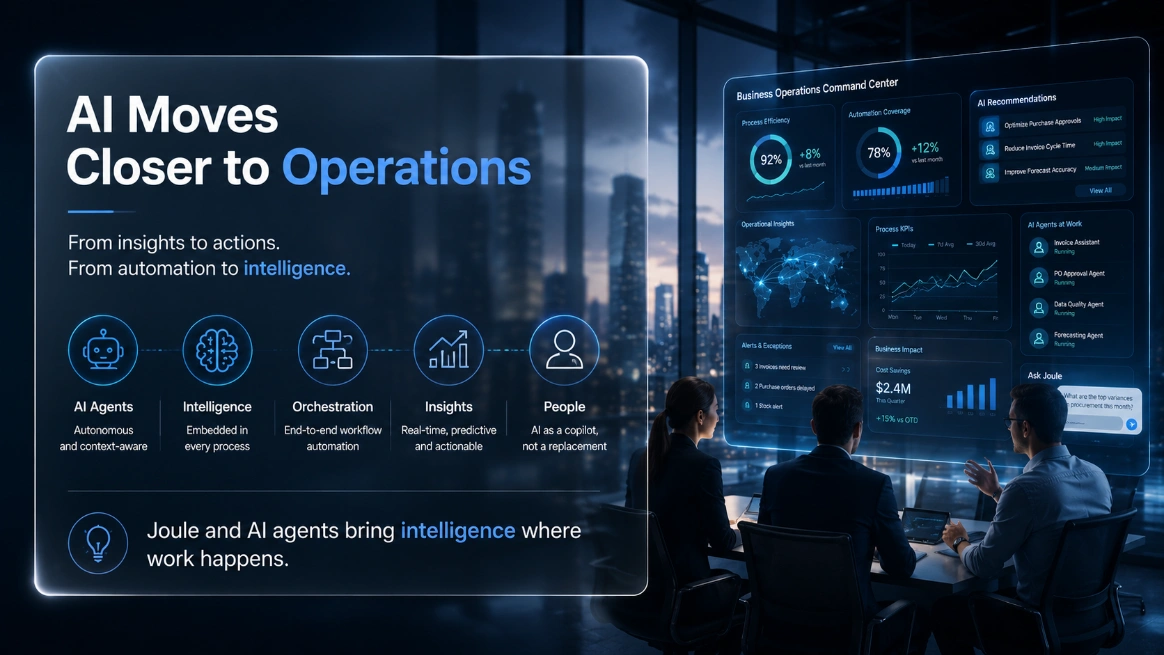
One of the areas SAP has been emphasizing most heavily in recent years is the combination of Joule and AI Agents.
In simple terms, Joule can be seen as SAP’s AI-powered digital assistant layer. However, SAP’s ambition goes beyond a traditional assistant experience.
In SAP’s emerging narrative, Joule is expected to work across SAP applications, understand business processes, provide contextual recommendations, initiate certain actions, and interact with different enterprise systems.
The AI Agents concept represents a more advanced stage of this vision.
The goal is not merely to create chatbot-like structures that respond to user questions. Instead, SAP’s agentic AI direction points toward systems that can take semi-autonomous actions around specific business objectives.
In the future, AI agents may increasingly support scenarios such as optimizing procurement processes, analyzing supply chain risks, detecting financial anomalies, assisting incident management in SAP operations, and improving capacity and cost optimization.
However, the Joule and AI Agents narrative should not be confused with today’s production reality. SAP’s vision is strong, but the business value of these scenarios will depend heavily on each organization’s data quality, process standardization, integration maturity, authorization model, and governance discipline.
One of SAP’s Strengths: Shaping the Market Language Before the Technology Fully Matures
SAP has long been more than a software vendor. It is also one of the key players shaping the conceptual framework of enterprise technology.
In many cases, SAP first defines a new concept, aligns the ecosystem, shapes the language used by partners, places the topic on CIO agendas, and only then do the products and capabilities gradually mature.
This pattern has been visible in previous narratives such as SAP HANA, Intelligent Enterprise, Industry Cloud, RISE with SAP, Clean Core, and Business AI.
Today, similar concepts such as AI-native enterprise, agentic AI, Business AI, and Cloud ERP are not only technical roadmap items. They are also being positioned as the conceptual foundation of the future enterprise operating model.
For this reason, SAP’s marketing language often points beyond existing products and signals the direction of the enterprise IT architecture SAP wants the market to adopt in the coming years.
How Should Companies Interpret This New SAP Language?
For organizations, the critical challenge is not to treat every new concept either as pure hype or as an immediate transformation mandate. The real task is to understand the operational meaning behind each concept.
This shift affects not only customers but also the broader SAP partner ecosystem. System integrators, consulting firms, and managed service providers now need to move beyond purely technical migration projects. They are increasingly expected to build more integrated value propositions around Cloud ERP, Clean Core, SAP BTP, Business AI, and enterprise data architecture.
Several areas are likely to become standard components of the SAP landscape in the coming years. These include cloud operating models, observability, automation governance, Business AI, data platforms, process mining, and AI-assisted operations management.
SAP’s new product language points to a broader business architecture that goes beyond ERP modernization. It places Cloud ERP, Business AI, data platforms, and the AI-native operating model at the center of enterprise transformation.
At the same time, not every new concept is at the same level of maturity. In some areas, technology is rapidly moving into production. In others, marketing language still runs ahead of operational reality.
Therefore, the most important requirement for companies will not be simply following new SAP terminology. It will be the ability to distinguish which technologies are already creating real operational value and which ones still remain part of a future-oriented strategic narrative.
For SAP customers, three questions will become increasingly important: How compatible is our current architecture with Clean Core principles? Are our data quality and integration maturity sufficient to support AI Agents scenarios? And among RISE with SAP, GROW with SAP, and Cloud ERP options, which path best fits our scale, complexity, and operating model?
Frequently Asked Questions
SAP’s recent product strategy is not only about developing new technologies. Concepts such as Cloud ERP, Business AI, Joule, Business Data Cloud, and Clean Core are designed to describe enterprise transformation in a more holistic way. However, the pace of this conceptual change can sometimes move faster than the operational transformation taking place in the field.
RISE with SAP primarily focuses on helping existing SAP customers move toward a Cloud ERP transformation journey. GROW with SAP, on the other hand, is more focused on a standardized, public-cloud-oriented ERP model designed for faster deployment and lower complexity.
SAP is increasingly using the Cloud ERP narrative because it provides a simpler, clearer, and more accessible way to describe a continuously evolving, AI-enabled operating model in the cloud.
An AI-native enterprise is an organization where artificial intelligence is not treated as an add-on feature. Instead, AI is embedded into process design, data architecture, user experience, and the overall operating model from the beginning.
The new SAP Business Suite narrative brings together ERP, enterprise data, AI, integration, and automation capabilities within a more unified platform approach.