Anyone who has been following the SAP ecosystem over the past few years has likely noticed the same shift. About a decade ago, ERP was at the center of SAP’s technology strategy. Today, however, the focus is no longer on a single product. Instead, SAP Business Technology Platform (SAP BTP) has become the common foundation that brings together data, integration, artificial intelligence, and application development.
Business AI, Joule, Business Data Cloud, SAP Build, Integration Suite, Clean Core, and next-generation development approaches may appear to address different areas at first glance. In reality, they represent different components of the same technology strategy. Most of these innovations are built on SAP Business Technology Platform (SAP BTP), reflecting a deliberate and long-term architectural vision.
Perhaps the most significant transformation is not taking place at the product level, but at the architectural level. Rather than embedding every new capability directly into the ERP system, SAP is bringing them together on a shared platform. This is precisely where the strategic importance of SAP BTP comes from.
Today, the real question is no longer what SAP BTP is.
The real question is: Why is SAP building its future on SAP BTP?
The answer is important not only for understanding SAP’s technology roadmap, but also for helping organizations evaluate how to prepare their own SAP strategies for the future.
What Is SAP BTP?
SAP Business Technology Platform (SAP BTP) is a unified technology platform that enables organizations to integrate SAP and non-SAP systems, manage enterprise data, develop custom applications, and build AI-powered business processes.
At first glance, this definition may make SAP BTP sound like a traditional application development platform. In reality, SAP envisions a much broader role for BTP.
In the past, capabilities such as integration, application development, data management, analytics, and automation were often delivered through separate products or independent technologies across the SAP ecosystem.
Today, SAP has adopted a different approach. Most of its new technologies are designed to work together on a common platform. As a result, organizations are not simply investing in another SAP product—they are building an integrated technology ecosystem that can evolve with future business requirements.
That is what makes SAP BTP strategically important.
Why Has SAP Placed SAP BTP at the Center of Its Technology Strategy?
The answer lies in the profound transformation that enterprise technology has undergone over the past few years.
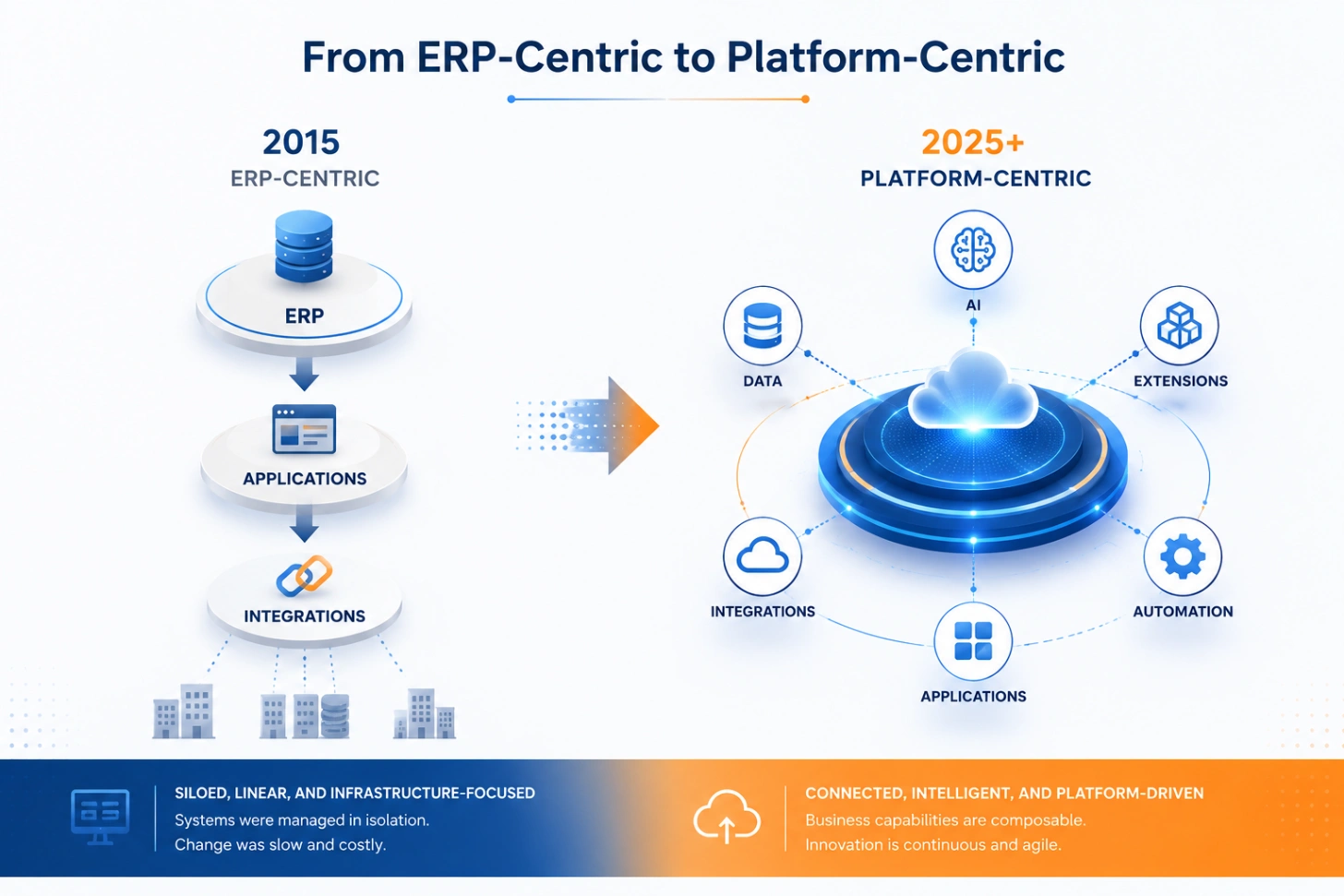
In the past, ERP systems were designed to serve as central platforms capable of addressing virtually every business requirement. Whenever a new need emerged, the solution was typically developed directly within the ERP system. Integrations were built point-to-point, and over time, these environments became increasingly complex.
Today, however, the technology landscape has fundamentally changed.
- Cloud services have become mainstream.
- Artificial intelligence is rapidly becoming part of everyday business processes.
- Enterprise data volumes have grown exponentially.
- Organizations must respond to changing business requirements faster than ever before.
These changes have reshaped not only ERP systems but enterprise IT architecture as a whole. SAP’s response was not simply to introduce new products—it was to rethink its architectural approach. Rather than embedding every new capability into the ERP core, SAP is delivering new technologies through a common technology platform.
This approach provides several important advantages for organizations:
- New technologies can be adopted more quickly without disrupting the existing ERP system.
- SAP and non-SAP solutions can be integrated more efficiently through a common platform.
- New applications can be developed without modifying the ERP core.
- Artificial intelligence, analytics, automation, and integration services can operate together within a unified architecture.
This is precisely why SAP BTP has become the center of SAP’s technology strategy.
From an organizational perspective, this represents a shift away from continuously reshaping the ERP system whenever new business requirements arise. Instead, new capabilities can be introduced through a common platform, creating a far more flexible and sustainable technology landscape.
What Do SAP’s Latest Technologies Have in Common?
When viewed individually, SAP’s latest innovations may appear to address completely different challenges.
- Business AI
- Joule
- Business Data Cloud
- SAP Build
- Integration Suite
- Clean Core
Although each serves a distinct purpose, they all share the same strategic objective: helping organizations build SAP landscapes that are more flexible, better integrated, and ready for future technologies.
This is why most of SAP’s recent strategic innovations are being built on a common technology foundation—SAP Business Technology Platform (SAP BTP).
This decision is as strategic as it is technical.
Today, it is no longer sufficient for AI services, integration solutions, data platforms, automation tools, and custom applications to operate independently. The real value comes from enabling all of these capabilities to work together within a unified architecture.
The objective is not simply to host new technologies on a single platform. SAP’s broader vision is to establish a sustainable technology architecture where every new service benefits from shared security, centralized data management, standardized integration, and a common lifecycle management approach.
This is where the strategic importance of SAP BTP truly becomes evident.
For this reason, describing SAP BTP solely as an application development platform significantly understates its role. Today, SAP BTP serves as the technological foundation that connects SAP’s innovation, data, integration, artificial intelligence, and application development strategies.
Understanding SAP’s latest innovations therefore begins with understanding the role SAP BTP plays within the broader SAP ecosystem.
For SAP decision-makers, this also represents an important mindset shift—from making product-centric decisions to adopting a long-term platform strategy.
Table 1. SAP’s Strategic Technologies and Their Relationship with SAP BTP


Further Reading
Discover the key to keeping your SAP systems agile and permanently upgradeable by eliminating technical debt. To learn how the Clean Core approach standardizes sustainability in next-generation SAP operations, explore our guide: What is SAP Clean Core?
Why Do Clean Core, Business AI, and Business Data Cloud Converge on SAP BTP?
There is an important misconception that needs to be addressed.
SAP BTP is often viewed simply as a platform for developing new applications. However, SAP’s strategic direction over the past few years suggests a much broader role. Today, many of SAP’s strategic innovations deliver their greatest value when they work together as part of a connected ecosystem.
Take Clean Core, for example. Its objective is to keep the ERP core as standard as possible. But where should custom applications and company-specific extensions run? This is where SAP BTP comes into play.
The same applies to Business AI. Bringing artificial intelligence into business processes requires reliable data, standardized business processes, and well-managed integrations. SAP BTP provides the technological foundation that makes these capabilities possible.
In fact, many of the latest services introduced as part of SAP’s Business AI vision leverage the AI Foundation capabilities available on SAP BTP. This demonstrates that SAP BTP is not merely a platform for applications—it is also the common foundation for SAP’s AI services.
A similar pattern can be seen with Business Data Cloud. Collecting enterprise data securely from multiple systems, transforming it into meaningful business information, and making it available to applications and AI services requires more than a powerful data platform. It also requires a common technology layer that connects data, applications, and intelligence.
Data services such as SAP Datasphere, one of the core components of SAP Business Data Cloud, complement this approach by enabling organizations to manage enterprise data on a common platform. As a result, data, analytics, and AI services can work together within the same architectural framework.
This is the key point.
Clean Core, Business AI, and Business Data Cloud are not independent initiatives. They represent different components of the same technology strategy, unified through SAP Business Technology Platform.
This is precisely where the strategic importance of SAP BTP becomes clear. New technologies will continue to emerge. New services will be introduced. AI capabilities will continue to evolve. What is unlikely to change, however, is SAP’s commitment to a common platform architecture that enables all these innovations to work together.
Understanding SAP BTP today therefore means more than understanding SAP’s current product portfolio. It means understanding the direction of SAP’s technology strategy for the years ahead.
In short, SAP BTP is no longer just another SAP product—it has become the technology foundation on which SAP’s future innovations will be built.
How Is SAP BTP Transforming SAP Basis Operations?
One of the most significant impacts of SAP BTP is the way it is redefining the role of SAP Basis teams.
For many years, SAP Basis operations were primarily associated with system installation, performance monitoring, kernel and patch management, transport administration, system copies, and ensuring technical system availability. These responsibilities remain essential today.
However, as SAP’s technology strategy evolves, so do the expectations placed on Basis teams.
Keeping the ERP system running is no longer enough. Organizations must also ensure that ERP systems work securely, sustainably, and efficiently alongside cloud services, AI solutions, enterprise data platforms, and custom-built applications.
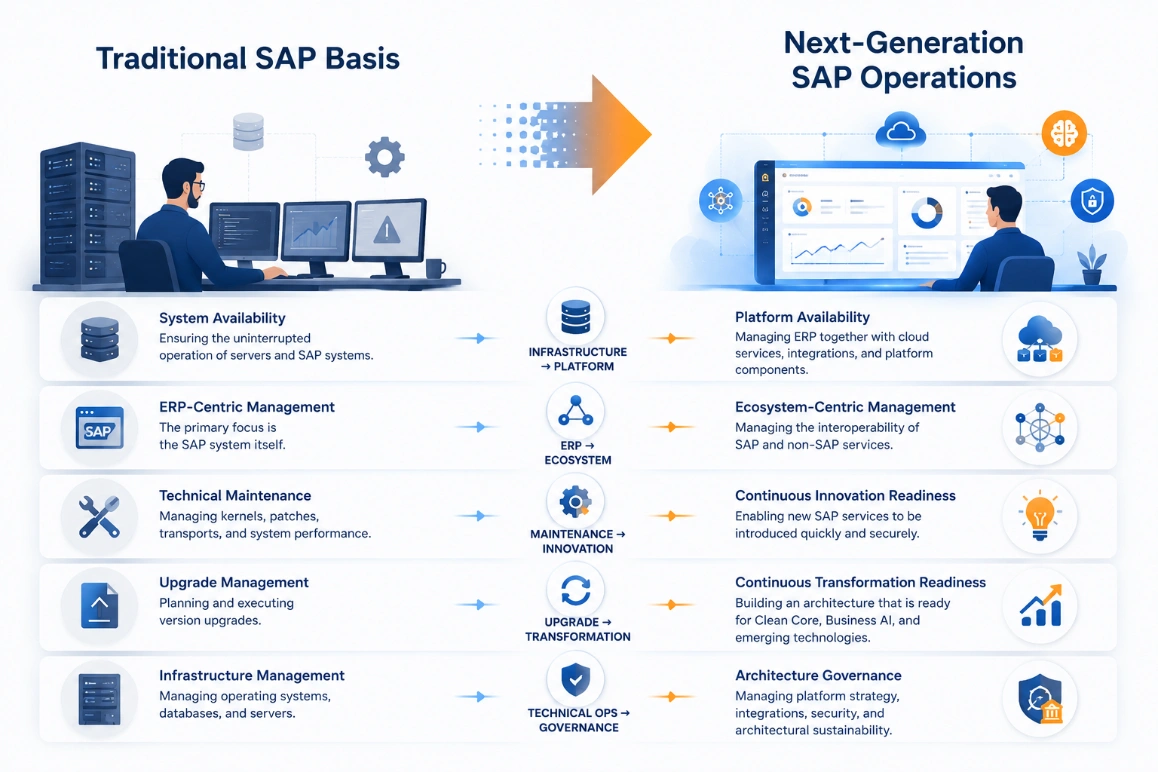
In short, SAP Basis is evolving from traditional system administration toward platform governance and architectural sustainability.
For IT teams, this transformation is about more than learning new technologies—it requires adopting a platform-first operational mindset.
The critical questions are no longer limited to:
- Is the system available?
- Is performance acceptable?
- Are backups successful?
Today’s SAP operations must also address questions such as:
- How quickly can we adopt new SAP services?
- How well does our landscape support a Clean Core strategy?
- Is our architecture ready for AI-enabled business processes?
- Are our integrations sustainable over the long term?
- Can we introduce new technologies without disrupting existing business operations?
As a result, the SAP Basis teams of the future will do far more than manage systems. They will serve as technical advisors and platform architects, helping organizations prepare their SAP landscapes for continuous transformation.
This is exactly the direction in which the SAP ecosystem is moving.
Understanding SAP’s technology strategy is no longer simply about following new products. It is about understanding the platform architecture that connects them—and adapting operations accordingly.
Table 2. The Changing Role of SAP Basis Operations
Traditional SAP Basis | Next-Generation SAP Operations |
System Availability Ensuring the uninterrupted operation of servers and SAP systems. | Platform Availability Managing ERP together with cloud services, integrations, and platform components. |
ERP-Centric Management The primary focus is the SAP system itself. | Ecosystem-Centric Management Managing the interoperability of SAP and non-SAP services. |
Technical Maintenance Managing kernels, patches, transports, and system performance. | Continuous Innovation Readiness Enabling new SAP services to be introduced quickly and securely.
|
Upgrade Management Planning and executing version upgrades.
| Continuous Transformation Readiness Building an architecture that is ready for Clean Core, Business AI, and emerging technologies. |
Infrastructure Management Managing operating systems, databases, and servers.
| Architecture Governance Managing platform strategy, integrations, security, and architectural sustainability. |
Three Common Misconceptions Organizations Have About SAP BTP
SAP BTP has become one of the most widely discussed technologies in the SAP ecosystem in recent years. Yet many organizations still underestimate its role or misunderstand what it is designed to achieve. We encounter these misconceptions frequently in customer engagements.
1. “SAP BTP Is Only for Developers”
This is perhaps the most common misconception.
While SAP BTP certainly enables organizations to develop custom applications, its role extends far beyond application development.
Today, SAP BTP brings together integration, data management, automation, artificial intelligence, analytics, and application extension capabilities within a unified architecture. As a result, it has become a strategic platform not only for developers, but also for SAP architects, Basis teams, integration specialists, and IT decision-makers.
2. “SAP BTP Is Only Relevant for Cloud Projects”
Many organizations associate SAP BTP exclusively with SAP S/4HANA Cloud or RISE with SAP initiatives.
In reality, organizations running on-premise SAP landscapes can also leverage SAP BTP for integration, application extensions, data services, and AI-enabled business scenarios.
SAP BTP should therefore be viewed not only as an enabler of cloud transformation, but also as a platform for extending and future-proofing existing SAP investments.
3. “Our ERP Works Fine. We Don’t Need SAP BTP.”
At first glance, this assumption may seem reasonable.
However, many of today’s business requirements can no longer be addressed by the ERP system alone.
New integrations.
AI-powered business processes.
Mobile applications.
External data sources.
Digital workflows.
Most of these capabilities are built around the ERP system rather than inside it.
This is exactly where SAP BTP creates value—allowing organizations to introduce new technologies without disrupting their existing ERP investment.
The question is no longer:
“Is our ERP system working?”
The more important question is:
“Is our ERP landscape ready for the technologies we will need tomorrow?”
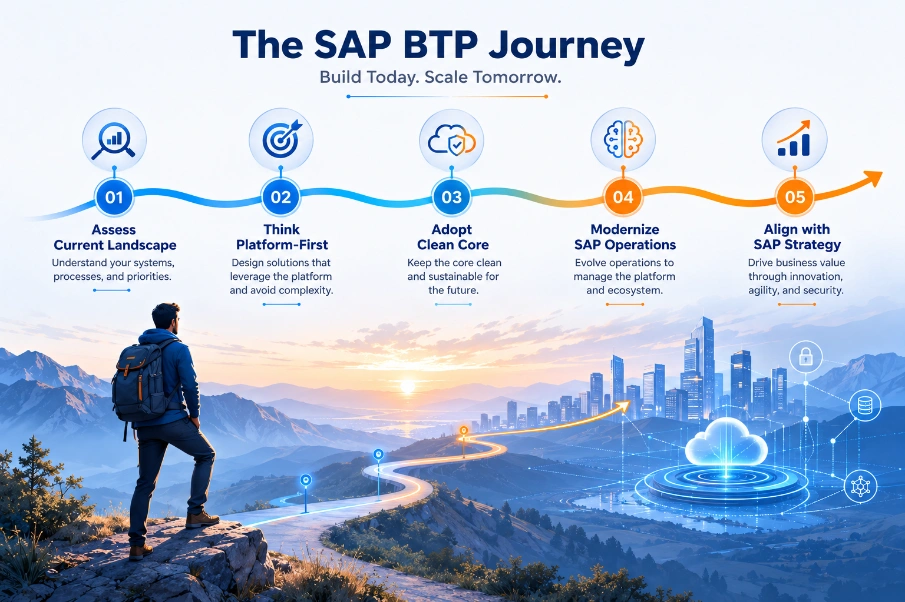
Five Strategic Steps to Begin Your SAP BTP Journey
Adopting SAP BTP does not mean replacing your existing SAP landscape.
On the contrary, it provides a gradual transformation path that allows organizations to protect their current investments while becoming better prepared for future technologies.
The following five steps provide a practical starting point.
1. Assess Your SAP Landscape Holistically
Look beyond the ERP system itself. Evaluate integrations, custom developments, data flows, and external connections as part of a single technology ecosystem. Many future business requirements will emerge across this broader landscape rather than within ERP alone.
2. Think Platform-First for New Business Requirements
The assumption that every new requirement should be developed directly inside ERP is rapidly becoming outdated. Consider SAP BTP as the preferred platform for custom applications, integrations, and digital business processes.
3. Embrace Clean Core as a Long-Term Architectural Goal
SAP BTP and Clean Core complement one another. Keeping the ERP core as standard as possible while moving innovation to the platform significantly simplifies future upgrades and technology adoption.
4. Modernize SAP Basis Operations
The future of SAP operations extends well beyond traditional system administration. Platform governance, integration architecture, security, and continuous transformation readiness are becoming equally important. As a result, SAP operations teams must evolve their skills accordingly.
5. View SAP’s Roadmap Through a Platform Strategy
Business AI.
Joule.
Business Data Cloud.
SAP Build.
And whatever comes next.
Rather than evaluating these as isolated products, organizations should view them as components of SAP’s broader platform strategy. This perspective leads to stronger long-term architectural decisions.
Table 3. Strategic Priorities for the SAP BTP Journey
Current Approach | Future-Ready Approach |
Developing every new requirement directly within the ERP system
| Adopting a platform-based approach for new requirements |
Building point-to-point integrations | Establishing a centralized integration architecture
|
Evaluating the ERP system in isolation | Assessing the entire SAP ecosystem holistically
|
Viewing SAP Basis solely as a technical operations function | Adopting platform governance and architectural sustainability
|
Making decisions based on individual products | Using the broader platform strategy as the basis for decision-making
|
SAP BTP: Understanding the Future of SAP
Much of the discussion around SAP BTP still focuses on its technical capabilities. Yet its true significance goes far beyond the services it provides. Today, SAP BTP represents the foundation of SAP’s long-term technology strategy.
Clean Core, Business AI, Joule, Business Data Cloud, SAP Build, and many of SAP’s latest strategic initiatives are not isolated products. They are complementary components of a unified technology vision built around SAP BTP.
Understanding SAP BTP therefore means more than understanding another SAP platform. It means understanding where SAP’s technology strategy is heading, how organizations should prepare for that future, and how SAP operations will continue to evolve.
For business and technology leaders, the challenge is no longer simply deciding which SAP products to implement. It is designing the platform architecture that will enable those products to work together over the long term.
That said, this transformation is not without its challenges. A platform-centric approach introduces new operational models, new responsibilities, and new skill requirements.
Nevertheless, SAP’s long-term direction is becoming increasingly clear.
The question is no longer whether SAP BTP will play a central role.
The real question is how organizations will build the capabilities to manage it successfully.
Frequently Asked Question
SAP Business Technology Platform (SAP BTP) is a unified technology platform that enables organizations to integrate SAP and non-SAP systems, manage enterprise data, develop custom applications, and build AI-powered business processes. Today, many of SAP's strategic innovations are built on SAP BTP.
Rather than developing new technologies as standalone products, SAP is bringing them together on a common platform. Strategic initiatives such as Clean Core, Business AI, Joule, Business Data Cloud, and SAP Build all rely on a shared technology foundation, making SAP BTP a central pillar of SAP's long-term technology vision.
Yes. SAP BTP is not limited to organizations using SAP S/4HANA Cloud or other cloud ERP solutions. Companies running on-premise SAP systems can also leverage SAP BTP for integration, custom application development, data management, and AI-powered capabilities while extending the value of their existing SAP investments.
Clean Core aims to keep the ERP core as standard as possible. Company-specific extensions and new applications, however, can be developed on SAP BTP instead of modifying the ERP core. This makes SAP BTP one of the key enablers of a successful Clean Core strategy.
No. SAP BTP fully supports hybrid architectures. Organizations can continue running their ERP core on-premise while adopting cloud-native services such as AI capabilities, modern integrations, and custom applications through SAP BTP.
Clean Core aims to keep the ERP core as standard as possible. Company-specific extensions and new applications, however, can be developed on SAP BTP instead of modifying the ERP core. This makes SAP BTP one of the key enablers of a successful Clean Core strategy.