SAP Business Data Cloud: Reshaping SAP’s Data Strategy for the AI Era

The Role of Data Is Changing in the AI Era

For many years, the primary role of data in enterprise systems was to explain the past. Organizations generated month-end reports, compared sales results, measured operational performance, and provided executives with a clear picture of what had already happened.

In the age of AI, however, the role of data is fundamentally changing.

Data is no longer just a historical record used for reporting. It has become the foundation for systems that generate predictions, provide recommendations, and in some cases, trigger business processes autonomously. In other words, enterprise data is evolving from the fuel behind reports into the fuel powering AI-driven operations.

This is exactly where SAP Business Data Cloud comes into play.

SAP’s technology strategy—built around Clean Core, SAP BTP, Business AI, Joule, and Agentic AI—depends on a trusted data foundation that preserves business context and delivers meaningful, reliable information. No matter how advanced AI becomes, its business value will always depend on the quality, consistency, and context of the data it is built upon.

This is where the core idea behind SAP Business Data Cloud begins:

In the AI era, competitive advantage will no longer come from simply having more data. It will come from using trusted, contextual, and business-ready data at the right time.


What Is SAP Business Data Cloud?

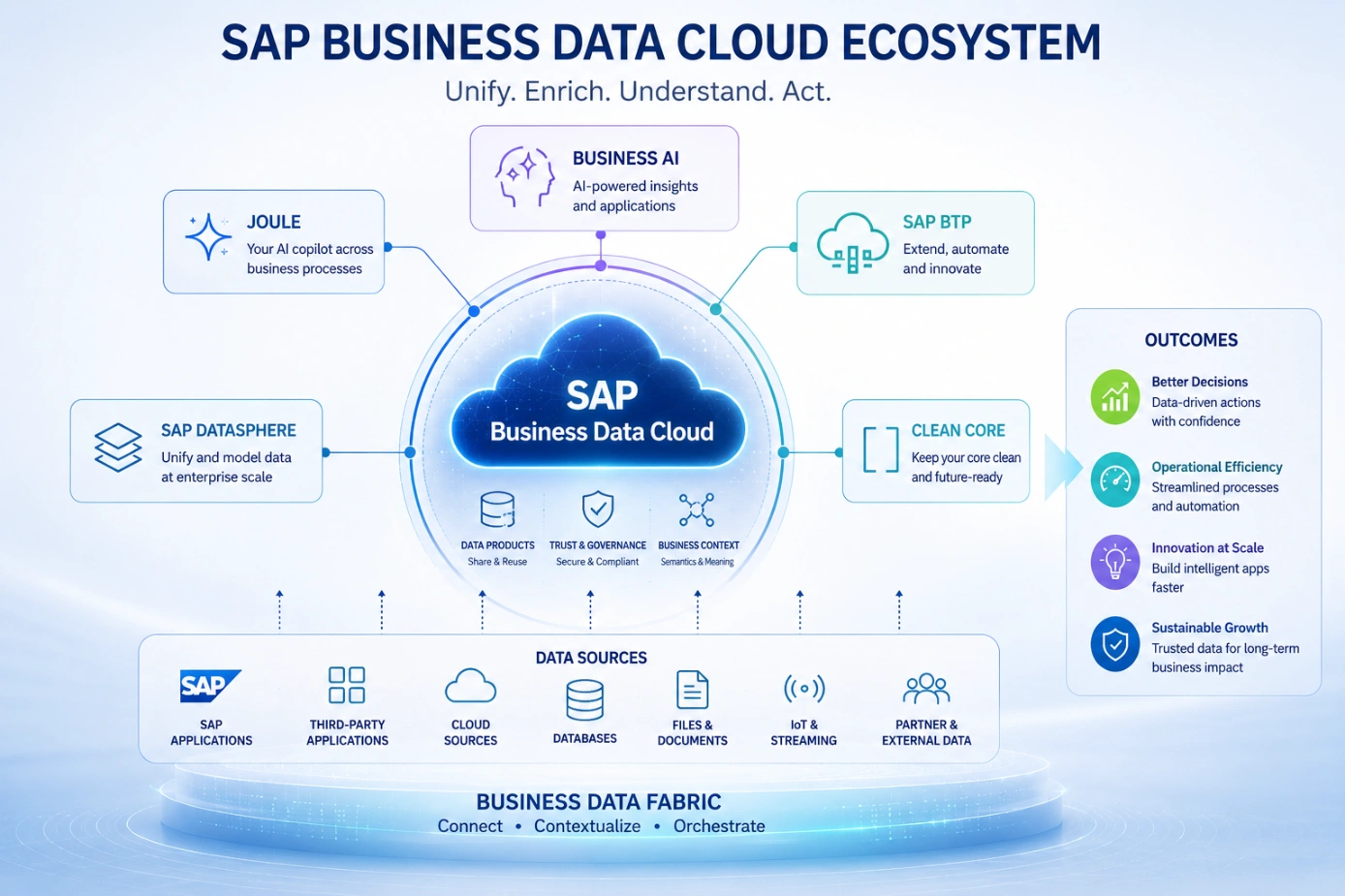
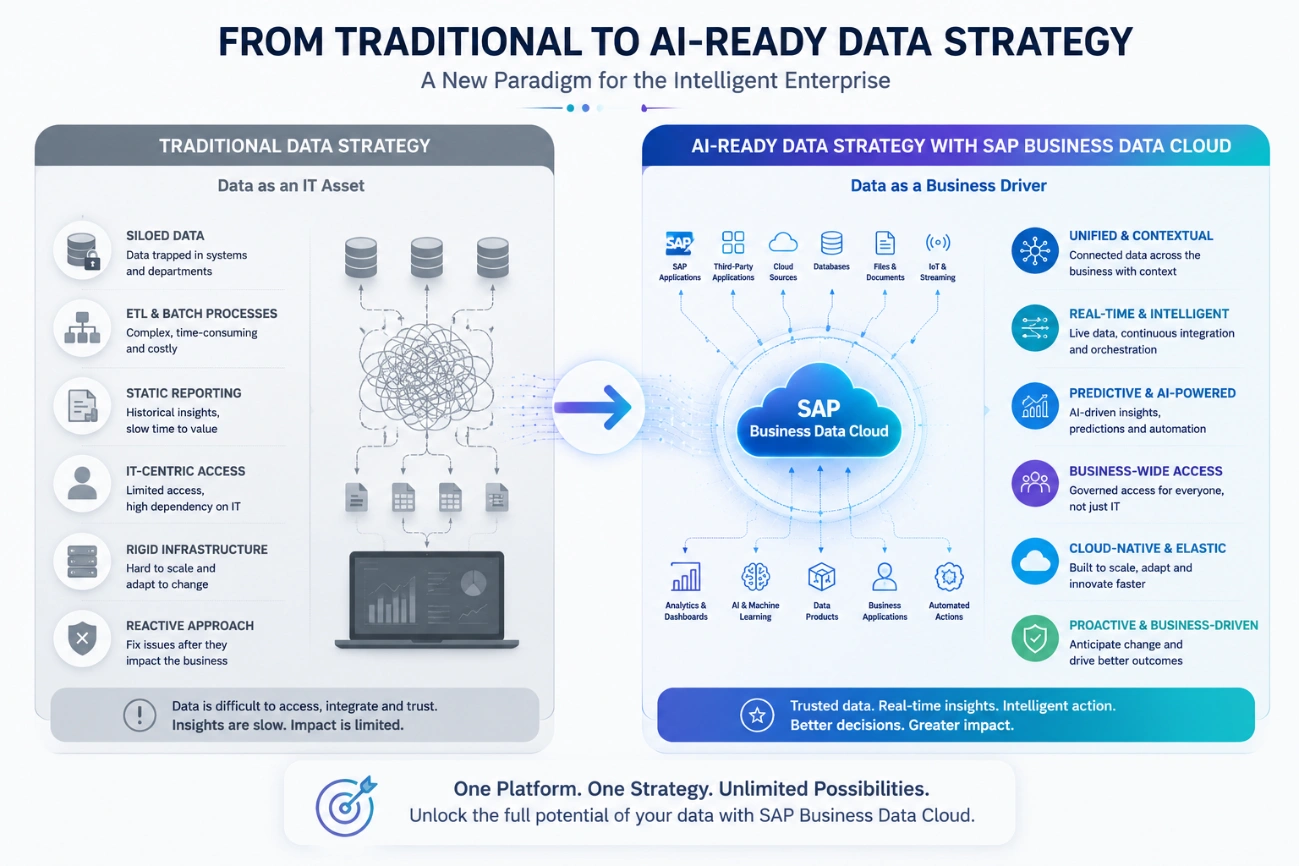
SAP Business Data Cloud is a managed cloud-based data platform designed to unify enterprise data from both SAP and non-SAP sources, enabling organizations to manage their data and make it readily available for analytics and AI-powered business applications.

However, viewing Business Data Cloud simply as a new data warehouse or analytics solution would miss the bigger picture.

SAP’s objective is not merely to consolidate data into a single location. The real goal is to establish a shared data foundation that preserves business context, can be securely consumed by different applications, and provides a trusted layer on which AI systems can operate.

This approach is built around three fundamental principles:

  • Open Data Ecosystem — enabling SAP and third-party data to work together seamlessly.
  • Business Semantics — transforming enterprise data into business-ready data products that preserve business meaning and context.
  • Data Federation — allowing data to be accessed and utilized across multiple platforms without unnecessary replication or movement.

Technologies such as SAP Datasphere, SAP Analytics Cloud, SAP BW capabilities, SAP Databricks, intelligent applications, and data products each play a different role within this ecosystem.

SAP Business Data Cloud represents SAP’s next-generation data platform, bringing together data, analytics, and AI within a unified enterprise data architecture.

Table 1. The Evolution of SAP’s Data Strategy

YesterdayTodayTomorrow
ERP-centric architecturePlatform-centric architectureData & AI-centric architecture
System integrationPlatform integrationIntelligent ecosystem
ReportingAnalyticsAutonomous decision support
Data storageData sharingData products
Human-driven analysisAI-assisted analysisAgentic AI

How Mature Is SAP Business Data Cloud Today?

SAP’s transformation in data strategy is no longer just a vision for the future. Looking at the SAP Sapphire conferences over the past two years, it is clear that SAP has been bringing together its data, AI, and platform technologies under an increasingly unified strategy. The announcement of SAP Business Data Cloud at SAP Sapphire 2025 marked one of the most significant milestones in this transformation.

That said, it would be misleading to evaluate Business Data Cloud in the same way as long-established enterprise solutions such as SAP ERP or SAP BW. Making this distinction from the outset is essential.

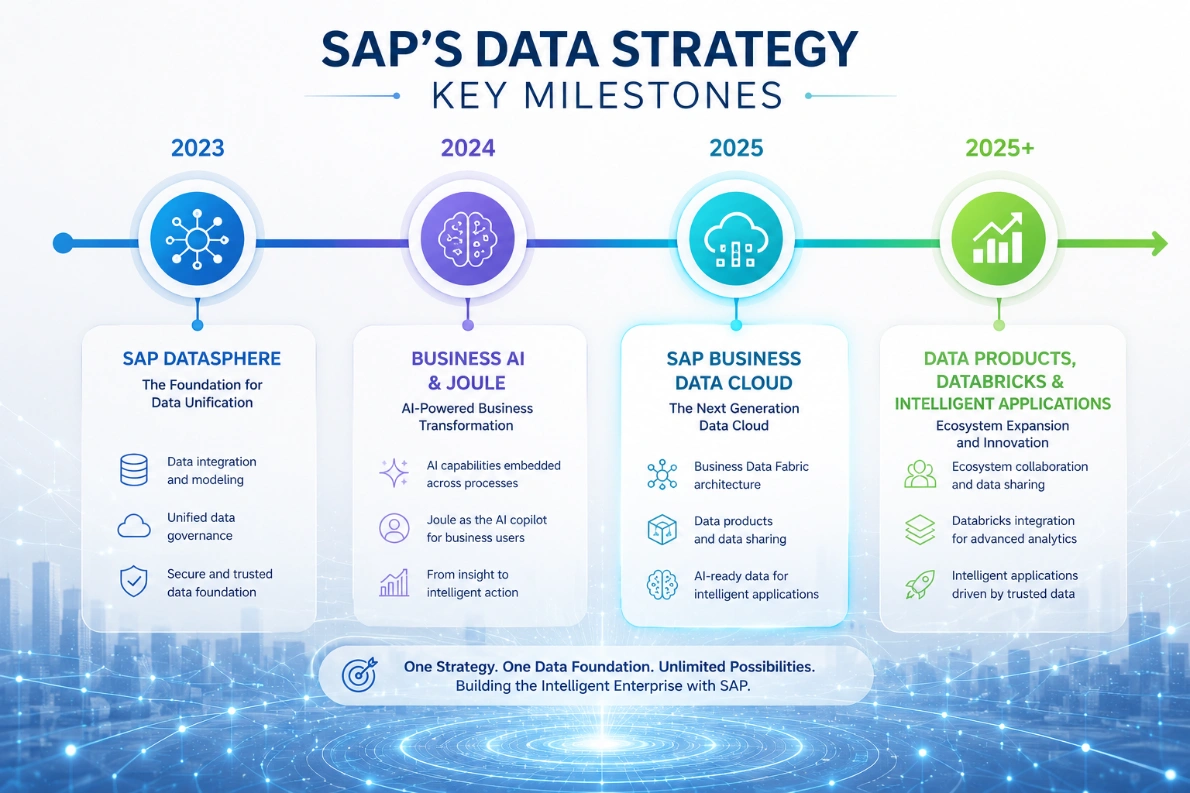
To understand Business Data Cloud, it is important to view it as part of SAP’s broader data journey rather than as a standalone product. SAP’s current data strategy is not a sudden shift in direction; it is the natural continuation of an architectural evolution that has developed gradually over many years. The evolution of SAP’s data technologies provides perhaps the clearest example of this journey.


Key Milestones in the Evolution of SAP’s Data Strategy

Business Data Cloud Is the Next Step in SAP’s Data Strategy

Business Data Cloud is not a sudden shift in SAP’s data strategy. It is the latest milestone in an architectural transformation that SAP has been building step by step across data, analytics, and artificial intelligence for many years.

For many years, SAP established a strong market position in enterprise reporting and analytics through solutions such as SAP BW and SAP Business Objects. This journey continued with SAP HANA, BW/4HANA, and SAP Datasphere, each representing a significant step toward a more modern data architecture.

Business Data Cloud represents the latest stage of that evolution. Rather than replacing previous technologies, it introduces a new architectural approach that brings together SAP’s data, analytics, and AI strategy on a unified data foundation.


From Vision to Real-World Adoption

Following the announcement of Business Data Cloud, SAP’s partnership with Databricks, the introduction of data products, intelligent applications, and integrations with leading data platforms have demonstrated that this strategy extends well beyond a product vision.

Support for platforms such as Google BigQuery, Microsoft Fabric, and Snowflake further highlights SAP’s commitment to an open and interoperable data architecture rather than a closed ecosystem.

In short, Business Data Cloud is no longer just a concept presented in keynote sessions or product roadmaps. Its technical capabilities, customer use cases, ecosystem partnerships, and implementation scenarios are becoming increasingly tangible.

That said, it is still too early to consider Business Data Cloud a fully mature platform. Organizations are continuing to evaluate its licensing model, migration paths from existing SAP data architectures, governance responsibilities, and long-term operating model.

The current landscape can best be summarized as follows:

SAP Business Data Cloud is not yet an established industry standard adopted by every organization. However, it has evolved into a strategic platform that enterprises can no longer afford to ignore if they want to understand SAP’s future direction in data and artificial intelligence.
Further Reading

Discover our article [ The Era of Agentic AI in the SAP Ecosystem: Navigating the Shift to Controlled Autonomy ] to explore the transition from static records to autonomous actions and the era of controlled autonomy brought by Agentic AI architecture.

Why Is SAP’s Data Strategy Changing in the AI Era?

In traditional analytics architectures, data was typically extracted from source systems, copied into separate environments, transformed, and prepared for reporting.

Over time, this process evolved into a complex data pipeline for many organizations. Multiple copies of the same data emerged, business definitions varied across departments, and the question “Which number is correct?” became less of a technical issue and more of an organizational challenge.

Artificial intelligence does not eliminate these problems—it can amplify them.

Incorrect data in a report may eventually be identified by a user. However, when the same data becomes the foundation for an AI agent’s decisions, predictions, or automated actions, the impact can spread much further across the business.

That is why, in the AI era, data management is no longer just about collecting data. It is about:

  • Understanding where the data comes from
  • Preserving its business context
  • Managing governance and access
  • Continuously monitoring its quality and freshness
  • Enabling the same trusted data to support multiple analytics and AI scenarios

SAP Business Data Cloud represents SAP’s strategic response to these challenges.

Table 2. The Simplest Way to Understand SAP Business Data Cloud

Traditional Data ApproachSAP Business Data Cloud Approach
Data is primarily used for reportingData becomes the shared foundation for AI and business processes
Data is scattered across multiple systemsData is managed through a unified architecture
The same data is copied multiple timesData products and shared business semantics are used
Analytics and operations are separatedAnalytics, AI, and operations work together
Decisions rely on historical reportingAI-enabled, real-time decision support becomes possible


Why Do Data Products Matter?

One of the most important concepts introduced by SAP Business Data Cloud is data products.

A data product is far more than a collection of raw database tables. It is a curated, governed, reusable data asset designed around a specific business context.

For example, simply storing customer, order, or employee information in technical tables is no longer sufficient. Organizations also need to preserve the business meaning of that data—its relationships, ownership, governance rules, and intended usage.

This approach transforms data from a raw technical asset into a managed business product.

From an AI perspective, the difference is significant. AI systems do not simply require data—they also need the business context that explains what the data actually means.


Where Does SAP Datasphere Fit?

SAP Datasphere and SAP Business Data Cloud are not the same thing.

SAP Datasphere is one of the core components of Business Data Cloud, providing capabilities for data modeling, integration, and the preservation of business semantics. Business Data Cloud, on the other hand, delivers a broader strategic framework that combines Datasphere with analytics, data engineering, artificial intelligence, data products, and intelligent applications.

A simple analogy may help.

If SAP Datasphere is the engine, SAP Business Data Cloud is the entire vehicle—bringing together the engine, the roads, the control systems, and every other component required to move the business forward.

For that reason, it would be inaccurate to think of Business Data Cloud simply as “the new name for Datasphere.”


How Do SAP BTP, Clean Core, and Business Data Cloud Work Together?

Clean Core aims to keep the ERP core as standard as possible.

SAP Business Technology Platform (SAP BTP) provides the common platform for integrations, extensions, and new digital services.

SAP Business Data Cloud strengthens the trusted data layer that enables analytics and AI applications to consume enterprise data with confidence.

Although these initiatives may appear to be separate projects, they all support the same architectural objective: a simpler ERP core, a more manageable platform, and a trusted data foundation.

Without that foundation, solutions such as Business AI and Joule will struggle to deliver sustainable business value at enterprise scale.

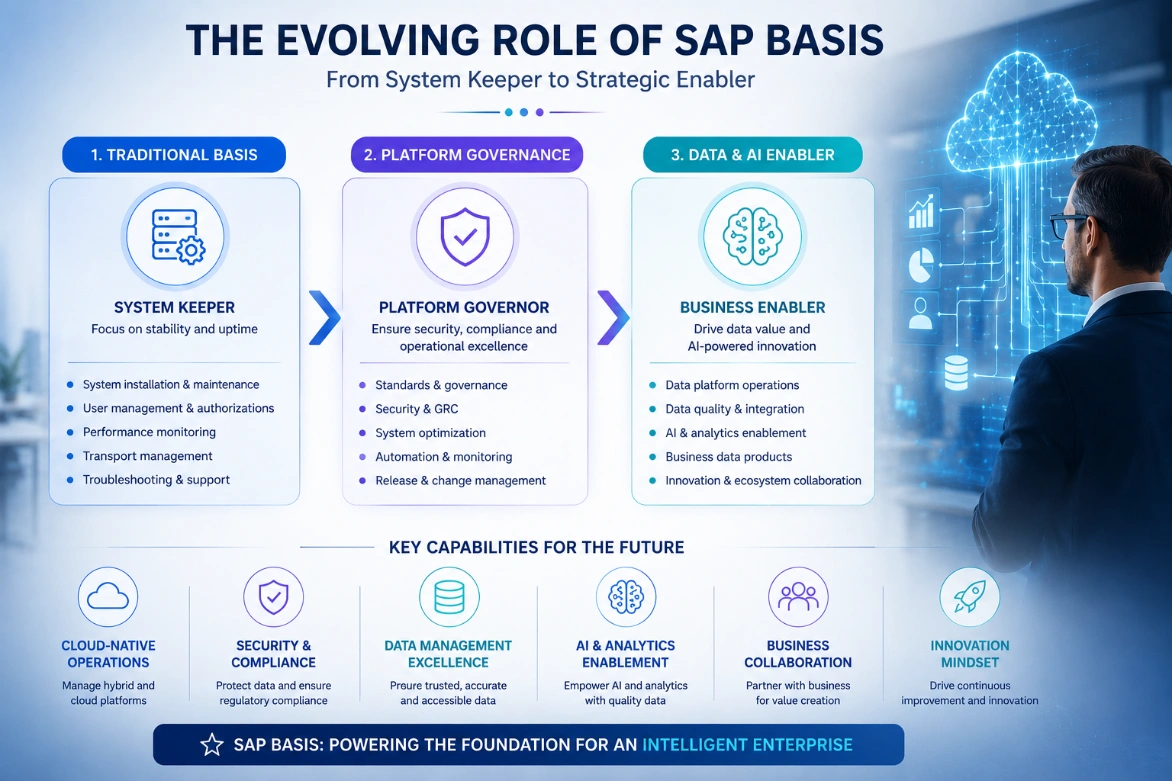
What Changes for SAP Basis Operations?

Business Data Cloud is not only relevant for data teams.

This new architecture also introduces new responsibilities for SAP operations teams in areas such as connectivity, identity and access management, security, monitoring, service continuity, data pipelines, and hybrid architectures.

Traditionally, the primary question for SAP Basis teams was simply:

“Is the system running?”

Today, that question is expanding to include others, such as:

  • Are our data services operating securely?
  • Can integrations between SAP and third-party platforms be monitored effectively?
  • Does our authorization model extend to data products?
  • Can new data and AI services be integrated into our architecture in a controlled and sustainable way?

This transformation does not replace the traditional responsibilities of SAP Basis teams. Instead, it expands their role, making them an increasingly important part of platform governance, data governance, and integration architecture.


Where Should Organizations Begin?

The journey toward Business Data Cloud should not begin with purchasing a new platform. It should begin with understanding the reality of an organization’s existing data landscape.

Organizations should first gain visibility into their data sources, duplicate datasets, integrations, reporting environments, and data ownership. From there, they can identify the business scenarios that truly require trusted, shared enterprise data.

The initial objective should not be to migrate everything at once. Instead, organizations should focus on a measurable use case within a specific business domain—such as finance, supply chain, customer management, or human resources—that can demonstrate tangible business value.

Because while data transformations often begin with ambitious visions, successful implementations are built through small, well-defined, and trusted steps.

What Business Challenges Does SAP Business Data Cloud Address?

  • Different reports producing different versions of the same data
  • Data inconsistencies between SAP and non-SAP systems
  • A lack of trusted data foundations for AI initiatives
  • Different teams defining the same business data differently
  • Disconnected analytics and operational processes


A New Chapter in SAP’s Data Strategy

SAP Business Data Cloud is not yet a fully mature solution or a one-size-fits-all answer for every organization.

The cost of adopting a new platform, the required skills, governance responsibilities, and architectural complexity all need to be evaluated carefully. Likewise, every organization will need to determine how Business Data Cloud fits alongside existing investments in SAP BW, SAP Datasphere, enterprise data warehouses, and cloud platforms.

However, the overall direction is becoming increasingly clear.

SAP no longer views data as a passive layer sitting behind enterprise applications. Instead, it is positioning data as a strategic business asset that powers artificial intelligence, analytics, and next-generation business processes.

That is where the true significance of Business Data Cloud lies.

Much of today’s AI conversation focuses on increasingly powerful models. In reality, however, competitive advantage will often depend less on the sophistication of the model itself and more on the quality, trustworthiness, and business context of the data that powers it.

The intelligent SAP systems of the future will not be defined solely by how much data they collect, but by how effectively they can transform that data into trusted, meaningful, and well-governed business intelligence.

Frequently Asked Questions

SAP Business Data Cloud is a next-generation enterprise data platform designed to unify data from both SAP and non-SAP systems while preserving business context for analytics and AI-driven applications. It represents a key pillar of SAP's data, analytics, and artificial intelligence strategy. SAP's Business Data Fabric approach further supports this vision by enabling organizations to use data from multiple sources in a more integrated, trusted, and business-aware way.

SAP Datasphere is one of the core components of the Business Data Cloud architecture. Business Data Cloud, however, represents a broader data and AI strategy that combines Datasphere with data products, analytics, AI services, and an open data ecosystem. The Business Data Fabric approach provides the architectural principles that allow these capabilities to work together across a unified enterprise data landscape.

SAP Business Data Cloud is particularly valuable for organizations that manage both SAP and non-SAP data, plan to implement AI initiatives, strengthen data governance, or modernize their analytics architecture. It is especially relevant for medium-sized and large enterprises seeking to build a trusted data foundation for future digital transformation.

No. SAP Business Data Cloud is not a direct replacement for SAP BW or SAP BusinessObjects. Instead, it represents the next stage in SAP's long-term data and AI strategy, building upon the capabilities of existing SAP data technologies. The appropriate migration path will vary depending on each organization's current architecture and business requirements.

With SAP Business Data Cloud, the role of SAP Basis teams extends well beyond traditional system administration. Managing SAP BTP integrations, securing enterprise data platforms, supporting platform governance, and building data architectures aligned with Clean Core principles are becoming key responsibilities. As a result, SAP Basis teams are evolving from technical operations specialists into strategic technology partners who help orga

The success of AI initiatives depends heavily on the quality, consistency, and business context of the underlying data. SAP Business Data Cloud provides a trusted data foundation through data governance, shared business semantics, and data products, enabling technologies such as Business AI, Joule, and future Agentic AI scenarios to deliver meaningful business value.

You Might Also Like These

New SAP Technologies Explained: What They Mean for Your Business
Why SAP BTP Has Become the Center of SAP’s Technology Strategy
What Is SAP Clean Core? The Foundation of Next-Generation SAP Operations
Basisci
Privacy Overview

This website uses cookies so that we can provide you with the best user experience possible. Cookie information is stored in your browser and performs functions such as recognising you when you return to our website and helping our team to understand which sections of the website you find most interesting and useful.