

Starting a company in the technology sector is not necessarily the hardest part. With a solid idea, a few talented engineers, and a high-velocity pace, acquiring customers can happen relatively quickly. The real challenge, however, isn’t just growing the company; it’s maintaining control while scaling.
Technology firms often struggle at the same inflection point: after a certain stage, growth stops feeling like success and starts feeling like a loss of control. Revenue climbs, the team expands, but certain questions begin to surface quietly:
- Why are we working harder but earning less?
- Why does everything stall unless we are personally consulted?
- Why does complexity increase exponentially as the company grows?
At this stage, many tech companies unknowingly reach a critical threshold: The company has grown, but the management model has remained stagnant. This is the most dangerous form of growth.
The Invisible Problem: Successful but Unsustainable
For technology companies in the scaling phase, the greatest risk is not failure—it is becoming “successfully unsustainable.” From the outside, new clients are being signed, the team is expanding, and projects are moving forward. However, internally, operations are overly dependent on individuals, decision-making is bottlenecked at the center, and most importantly, no one truly knows the definitive “final destination.”
When an organization grows without a clear strategy and loses its sense of direction, it typically falls into one of three pathologies:
Three Typical Scenarios in the Strategy Journey: Where Do You Stand?
The Drifters: These firms lack a true strategic roadmap. Their “strategy” is simply not missing any incoming opportunity. Because specialization and market positioning are sacrificed to “do everything for everyone,” margins erode and the team burns out. The company grows in size but fails to develop a distinct identity.
The Intentional but Paralyzed: They understand the importance of strategy and create brilliant plans on paper. However, by Monday morning, the “adrenaline addiction” of daily operations takes over. Strategic documents end up gathering digital dust on servers.
The Execution-Weary: Leadership is committed, and strategic goals have been defined. However, these objectives have not been translated for the technical staff, and a participatory culture has not been established. Cultural resistance eventually eats the strategy on paper for breakfast.
Operational Intensity: The Archenemy of Strategy
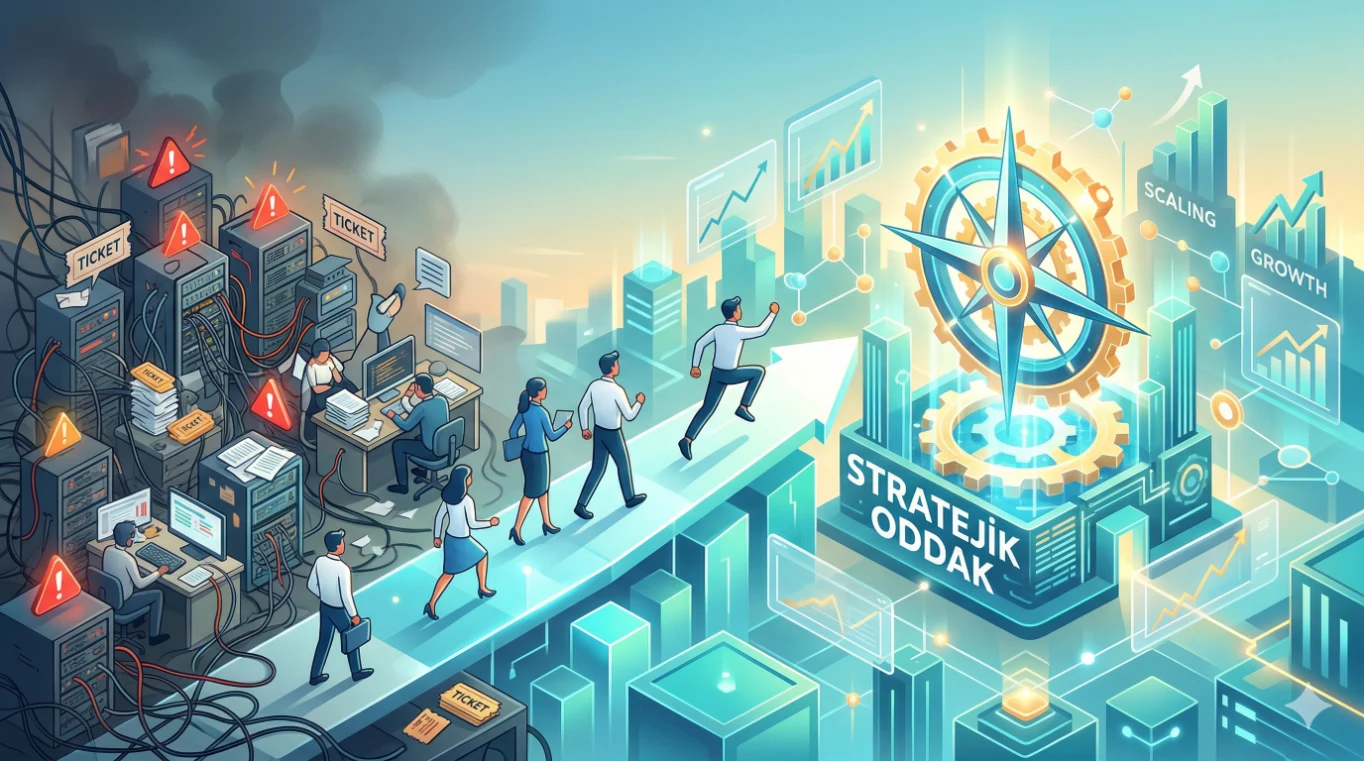
All three scenarios above share a common root: the overwhelming intensity of daily operations. Critical system migrations, SLA pressures, and constant customer expectations trap the company in an invisible cycle: Constant motion, but zero progress.
The organization spends its energy “saving the day” rather than choosing a direction. Over time, the illusion that “this chaotic pace is just the nature of our business” sets in. In reality, this frantic pace is often a direct symptom of a lack of strategic management.
A Brief Definition: What is Strategic Management?
Strategic management is the discipline of planning, implementing, and continuously monitoring an organization’s resources (human, technological, financial) to achieve and sustain a competitive advantage within a dynamic and uncertain environment.
For technology companies, this concept is far more than a mere “annual plan.” It is a corporate navigation system that adapts to market velocity, finds its way through data-driven decisions, and recalibrates its direction whenever necessary.
Strategic Management is an Architecture, Not Just an “Intention”
Strategic management is not just about knowing what to do or what to avoid; it requires the discipline and consistency to cascade these decisions through every layer of the company. Especially for scaling tech firms, this structure provides a management architecture that reduces fragmentation and sharpens focus. This framework aligns with modern strategic literature, specifically Michael Porter’s competitive advantage approach and Henry Mintzberg’s perspective of strategy as a living, emergent process.
This architecture stands on four primary pillars:
The Core Compass (Mission, Vision, Values): This clarifies why the company exists, what it does today, and where it aims to be in the long run. These are not just sentences on a wall; they are a reference frame that guides decisions and creates a common language across teams.
Strategic Analysis (From SWOT to TOWS): An approach to generating concrete strategies by correlating internal strengths and weaknesses with external opportunities and threats. This discipline moves beyond mere analysis to clarify which services to invest in, which risks to manage, and how to differentiate in the market.
Focused Objectives: The transformation of the vision into strategic goals, and subsequently into measurable KPI (Key Performance Indicators) and OKR (Objectives and Key Results) frameworks. Instead of “well-intentioned goals,” this layer represents a prioritized and trackable performance system where everyone knows exactly where to focus.
Execution and Monitoring: Ensuring that the strategy does not remain a static presentation file but evolves into a living management ritual through quarterly reviews. It builds a structure that, with the reflex of a learning organization, updates its direction based on data and enables rapid decision-making.
Building this architecture is only the beginning; the real difference emerges in how this strategy is measured and balanced.
Further Reading: The Depth of Strategic Management
The architecture outlined in this section is explored through more comprehensive models in strategic literature. For those wishing to examine the subject in greater depth, the following works offer a powerful perspective:
Measuring Strategy: Balanced Management with a 360-Degree Perspective
Evaluating strategy solely through financial results creates a significant blind spot, particularly in tech companies. A true Balanced Scorecard approach necessitates viewing company performance through four interconnected perspectives, as lasting success is born from the synergy of these areas. Developed by Robert S. Kaplan and David P. Norton, this model makes it possible not only to define strategy but also to measure and manage it effectively.
Customer Experience: Does the client view us merely as a “service provider” or as a “strategic solution partner” impacting their business outcomes? This view goes beyond satisfaction to measure trust, loyalty, and long-term collaboration.
Operational Processes: How standardized, scalable, and error-proof are our internal workflows? Operational excellence signifies not just efficiency, but the consistency of the customer experience and the sustainability of service quality.
Learning and Growth: How quickly is the team adapting to new technologies, methodologies, and evolving client needs? This perspective indicates the company’s future readiness, as competency development translates directly into competitive advantage.
Financial Health: Are all investments and improvements yielding sustainable growth and profitability? Financial results gain true meaning when treated as the natural outcome of success in the other three perspectives.
When these four perspectives are managed together, a company begins to see not only “what it earned” but “how it earned it” and “how sustainable that success is.” True strategic superiority stems precisely from this visibility.

Further Reading
Explore the critical difference between growth and scalability in greater depth. In this article, read why technology companies struggle as they grow and how they can overcome this threshold.

Why is Strategy More Critical for Technology Companies?
Strategic management is essential for every business; however, the unique dynamics of the tech world transform this necessity from a “competitive advantage” into a matter of sheer “survival.” Technology companies do not just compete in a market; they must position themselves within a constantly shifting reality. In this context, strategy is less of a directional compass and more of a core competency in managing uncertainty:
Velocity and Short Product Lifecycles: In tech, what is true today may be insufficient tomorrow. An architecture, platform, or standard can lose its relevance within a few years. Strategy enables the distinction between fleeting trends and permanent transformations, ensuring the company chooses the right wave rather than jumping on every new one.
The War for Talent: The most critical asset of a tech firm is its human capital. High-caliber engineers and specialists do not work for a salary alone; they want to be part of a meaningful vision. Companies that lack a clear direction or fail to articulate their “why” either lose their best talent or fail to attract them in the first place. Strategy is a promise made not just to the market, but to talent.
The Scalability Paradox: By nature, tech companies can grow rapidly. However, when this growth occurs without a solid architecture and strategic prioritization, processes become convoluted, technical debt increases, and the organization becomes uncontrollable. Strategy is a tool for managing growth just as much as it is for accelerating it.
The “Do-It-All” Trap: The flexibility of technology offers companies a wide field of maneuver. Teams can handle many different tasks and develop solutions for diverse clients. However, this flexibility often leads to a loss of focus. Strategy creates an organization that selects the right opportunities rather than chasing every single one.
Uncertainty and Continuous Transformation: Competition in the tech sector is not just against current players, but against business models that have yet to emerge. Today’s rival may be tomorrow’s partner; today’s solution may become tomorrow’s commodity. Strategy ensures that one does not lose their way amidst this uncertainty.
Ultimately, for technology companies, strategy is not a “planning document”; it is the capacity to make the right decisions amidst speed, uncertainty, and complexity. Companies lacking this capacity may grow, but they cannot grow sustainably.
Conclusion: Growth Without Direction is a Hidden Regression
In the world of technology, growing is no longer the hardest part. The real challenge is staying in the right direction while scaling. Some companies manage their growth, while others are managed by the chaos that growth creates. Strategic management is the fine but critical line between these two states.
The ultimate test for scaling tech firms is this: Not every opportunity is a true opportunity. Strategic management is often the courage to say “no” to seemingly attractive options. Because focus requires determining not only what will be done, but also what will not be done.
This is not an easy decision. Opportunities that seem missed in the short term return as clear positioning and sustainable growth in the long run. Companies unable to make these choices eventually transform into entities that can do everything but master nothing, failing to secure a distinct place in the market.
True strategic superiority emerges here: Instead of trying to appeal to everyone, it is about moving forward with the right focus, the right value proposition, and for the right customer. Because in the long run, the winners are not those who do the most work, but those who best know what not to do.