

In the SAP ecosystem, the “Go-Live” moment is a celebratory milestone—the fruit of months of sleepless nights. However, as the spotlights fade and the project team gradually exits the field, a silent tension begins for the true owners of the system: the operations teams. While the project team views the system as a “mission successfully accomplished,” the maintenance team sees it as a continuous chain of open-ended responsibilities.
The reality is that failure in SAP projects rarely stems from technical inadequacy; rather, it originates from treating the handover process as a mere formality instead of a strategic phase. A genuine handover is not just about sharing a folder full of PDFs and user passwords; it is the transfer of the system’s unique character, the rationale behind the “temporary” workarounds implemented during installation, and most importantly, the “soul” of the project. In this guide, we will explore the thin line between building an SAP system and sustaining it, addressing the hidden risks and how to mitigate them through battle-tested experience.
1. The Human Factor and the Risk of “Knowledge Flight”
In the world of SAP, if there is anything more critical than the technical architecture, it is the person who holds the knowledge. The most common yet least discussed risk during project handovers is “Key Person Dependency.”
The Invisible Risk: Critical technical details, complex integration points, and bespoke, non-standard solutions often remain trapped in the minds of just one or two senior consultants. When these individuals leave the site or become unexpectedly unavailable, any system outage transforms into “operational blindness.” A handover that hasn’t passed the “What if someone gets hit by a bus?” test is not a true handover. You must analyze the SPOF (Single Point of Failure) points within your human capital. If a key consultant becomes unreachable during a crisis, does the maintenance team possess an ‘Emergency Runbook’ to manage that specific disaster?
The Strategic Solution: The answer lies beyond simple documentation; it requires establishing Backup Ownership and a robust RACI Matrix. Responsibility for specific interfaces, certificate renewals, or kernel updates must be defined through a functional matrix rather than a simple list of names. Knowledge transfer should never be a “tell-and-go” session; it must be solidified through a transition period where responsibilities are actively shared and mentored.

Further Reading
Beyond the strategic risks, if you are looking for a detailed, step-by-step technical checklist tailored for S/4HANA, we recommend exploring this comprehensive resource on the SAP Community.

2. Documentation’s Silent Betrayal and the Necessity of Shadowing
We all know the drill: hundreds of pages of Technical Design Documents (TDD) typically end up gathering digital dust on a server. This happens because these documents usually explain what was done, but they fail to explain why it was done.
The Invisible Risk: Documentation captures the values of system parameters, but it rarely records the justification for deviating from standard values to overcome a specific performance bottleneck during installation. Months later, when the maintenance team performs a standard upgrade, they may unwittingly revert these parameters, unaware of their purpose, and drive the system into instability.
The Strategic Solution: A Decision Log must be an integral part of the handover package. Every non-standard step or workaround should have its backstory documented here. Furthermore, to turn paper-based knowledge into practical expertise, a Shadowing process must be implemented. For the final two weeks before Go-Live, the maintenance team should act as the “shadow” of the project team—getting hands-on with the keyboard and learning the “intuitive” interventions required during errors in real-time.
3. Authorization Wreckage and Security Discipline
The project phase is a race, and in this race, “access denied” messages are the ultimate enemy. Consequently, installation teams often grow accustomed to working with overly broad permissions, such as SAP_ALL.
The Invisible Risk: After Go-Live, these expansive privileges are frequently forgotten or left active under the “it might be useful later” excuse. This is not just a security vulnerability; it is a precursor to a disaster during audit cycles. Moreover, handovers conducted without clear Emergency Access Management (Firefighter) procedures lead to “who has the rights?” chaos during the very first crisis.
The Strategic Solution: A clear Post-Go-Live Cleanup Schedule must be established. It should be declared upfront that all project-specific authorizations will be revoked on day 15 or 30 after Go-Live. For emergency interventions, SAP GRC Access Control (EAM) or, at the very least, a logged and subsequently audited Firefighter access model must be activated at the moment of handover.
4. High Availability (HA) and Cluster Architecture: “Fault Tolerance” is Non-Transferable
An SAP system being “up” does not mean the system is “resilient.” While installation teams focus on the “ideal state” where the system runs at peak performance, operations teams need to know how the system behaves in the “worst-case scenario.” High Availability (HA) architectures should not be “paper tigers”—looking flawless on a diagram but falling silent during the first real hardware failure.
The Invisible Risk: Relying solely on synchronization-based checks for HANA System Replication (HSR) and performing ASCS/ERS Cluster failover tests only during the initial days of installation. In many handovers, signatures are collected without ever testing if the secondary node truly takes over the database or how the cluster software reacts to “split-brain” scenarios. This negligence means the system is likely to fail during its first actual outage.
The Strategic Solution: A rigorous and physical “Failover Drill” must be demanded at the time of handover. Recovery Time Objectives (RTO) should be measured with a stopwatch, not based on theoretical figures in a document. It is essential to verify how long it takes for the SAP application servers to detect the failover. Additionally, a comprehensive SPOF (Single Point of Failure) Analysis report should be included in the delivery package, clarifying how a single component failure (disk, network, switch) impacts the entire architecture.
Further Reading
To move beyond mere technicalities and grasp how your SAP environment should be strategically positioned and managed according to enterprise architecture standards, the SAP Enterprise Architecture Framework portal serves as the definitive reference point for your roadmap.”
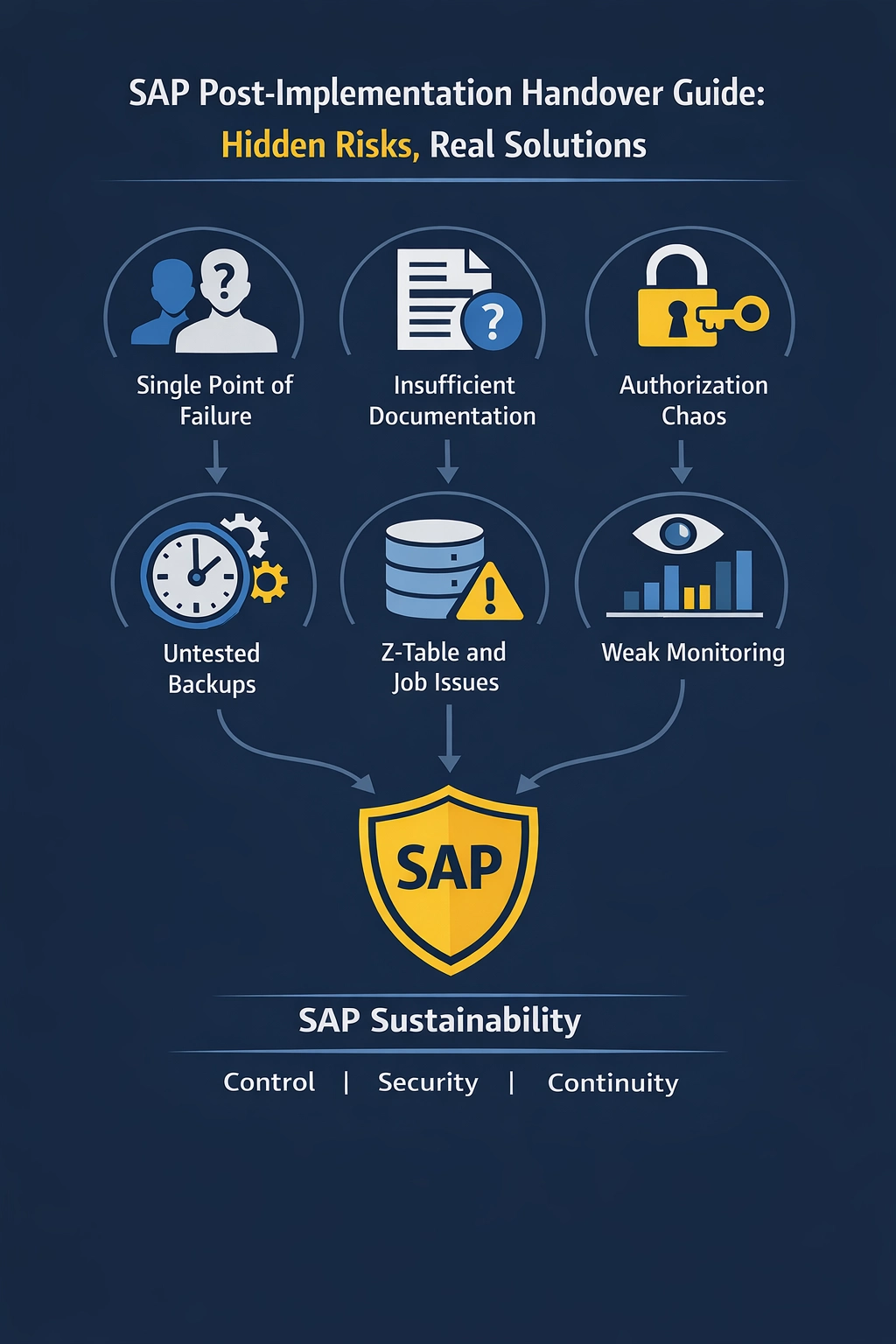
5. Invisible System Burdens: Jobs, Z-Tables, and Integrations
An SAP system is a living organism that begins to accumulate “clutter” from the very second it goes live.
The Invisible Risk: Batch jobs set up by the project team for testing—often with deleted owners or incorrect frequencies; “Z” tables that grow uncontrollably without a defined housekeeping strategy; and most dangerously, unlisted SSL certificates nearing their expiration dates. A sudden loss of connectivity to the outside world on a random Monday morning is usually hidden in a small, “unnoted” certificate detail.
The Strategic Solution: The operations team must demand a Connectivity Runbook during the handover. This document should list all external connection stakeholders, certificate expiration dates, and technical contact points for crisis moments. Furthermore, a centralized housekeeping strategy must be automated on day one, defining exactly which logs and temporary data will be purged and when.
6. Disaster Recovery: A Plan Without a Drill Is Not a “Plan”
The most frequent question from CFOs or IT Directors is: “If the system crashes, how soon can we be back up?”
The Invisible Risk: Taking backups does not guarantee that the system can be restored. In many projects, backups appear successful, yet during the first actual restore attempt, it is discovered that the database is inconsistent or the backup media is faulty. A Disaster Recovery (DR) plan that has never been rehearsed is nothing more than a “statement of goodwill.”
The Strategic Solution: As a mandatory part of the handover process, a Restore Drill must be performed using live data. RPO (Recovery Point Objective) and RTO (Recovery Time Objective) values should be tested with a physical stopwatch rather than being accepted as theoretical figures on paper, and the results must be reported to management.
7. Technical Debt and Observability: Is Your System Speaking to You?
Traditional monitoring methods answer the question, “Is the system up?” The modern world, however, asks, “How is the system feeling?”
The Invisible Risk: Technical debt accumulated through a “don’t touch it if it’s working” culture. Freezing versions, delaying kernel updates, and failing to analyze trends beyond simple logs will eventually drive the system into a performance crisis. When monitoring tools provide alerts without context, it inevitably leads to “alarm fatigue.”
The Strategic Solution: Transition to an Observability culture. A structure must be built that can correlate logs and provide capacity forecasting through trend analysis. The maintenance team should inherit not just dashboards from the project team, but the baseline behavior (the system’s normal reflexes) of the environment.
Handover Is Over, The Real Journey Begins
In conclusion, SAP projects do not end with “Go-Live”; in fact, that is exactly when they truly begin. As the installation team exits the stage, the operations team is left alone with the invisible risks mentioned above. A successful handover is not just a transfer of responsibility; it is the single most important investment in the system’s sustainability.
It must be remembered that SAP operations are not a cost center; they are a vital Risk Insurance policy for business continuity. A handover process that is aware of invisible risks and merges technical depth with strategic vision will keep an organization’s digital backbone resilient for years to come.
The steps in this guide will transform your company’s SAP journey from a state of “constant crisis management” to a model of “peaceful operation.”
How many of these invisible dangers have you brought under control in your own system?