

2025 was not the year of major launches or bold slogans for the SAP ecosystem.
Instead, it became the year when it was clearly revealed what actually works, what only looks good in presentations, and which decisions translate into real costs for organizations.
Especially in markets like Türkiye—where inflationary pressure, currency volatility, and limited skilled talent are daily realities—SAP decisions are no longer merely technical.
They have become critical strategic choices that directly affect business continuity and financial stability.
The 2027 Reality: The End of ECC Is No Longer Distant
2025 was a year in which many long-debated topics in the SAP ecosystem finally became clear.
Among all of them, one reality stood out as both unavoidable and decisive: the end of SAP ECC support by the end of 2027 is no longer theoretical—it is operational.
For many organizations, 2025 marked the moment when the comfort of saying “we still have time until 2027” effectively disappeared.
Because the questions have fundamentally changed:
- Is RISE with SAP the right path, or is a classic Brownfield conversion more realistic?
- Are we truly ready for Public Cloud, or is Private Cloud a more sustainable option?
- What are the cost and operational risks of migrating without first cleaning up custom code?
2025 was the year when organizations clearly recognized the following reality:
An S/4HANA transformation is not an IT project—
it is a time- and risk-management challenge against 2027.
This realization moved transformation initiatives beyond a purely technical agenda and elevated them to a strategic priority at the board, CFO, and CIO levels.
The Real Picture at the Start of 2025
- S/4HANA transformations were planned, but many organizations struggled to absorb the change.
- Cloud adoption was inevitable, yet costs escalated faster than expected.
- AI was widely discussed, but data quality and process readiness were insufficient.
- Basis and architectural decisions were no longer only on the CIO’s agenda—they had firmly entered the CFO’s domain.
In 2025, SAP placed not its promising ideas on the table, but its hard realities.
Let’s take a closer look at what truly changed.
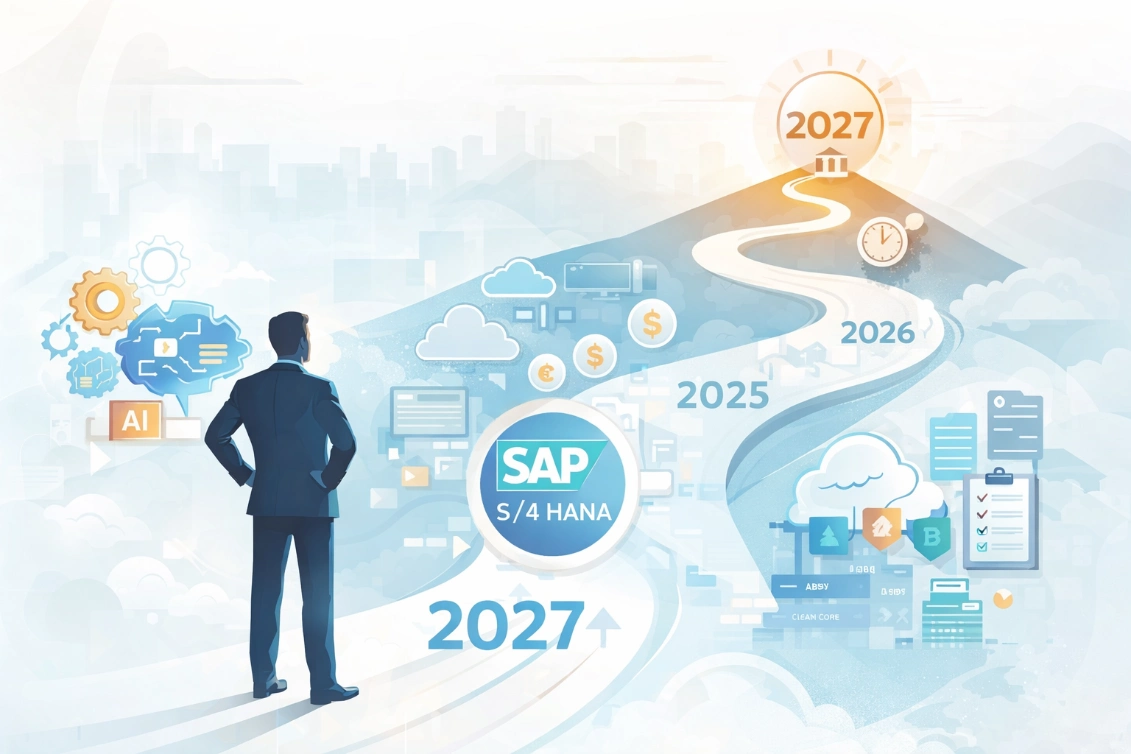
1. AI Became Real — But Only for Those Who Were Ready
In 2025, SAP Joule evolved beyond being a simple chatbot and moved decisively toward an Agentic AI approach.
It no longer just answered questions—it began to:
- Trigger actions via SAP BTP
- Operate within business workflows
- Provide context-aware, in-process recommendations
However, the reality observed in the field was clear:
In systems where:
- Data was fragmented
- Processes were not standardized
- Clean Core principles were ignored
AI turned into nothing more than an expensive showcase rather than a value driver.
🔎 Pro Tip (Expert Insight)
The first investment to unlock AI value is not an AI license.
It is master data quality and process discipline.
2. BTP: SAP’s New Operating System
By 2025, one question was no longer debated:
“Do we really need SAP BTP (Business Technology Platform)?”
The real question became:
“How sustainable is SAP without BTP?”
AI, integration, event-driven architectures, side-by-side extensions—
all of them converged on SAP BTP.
The 2025 reality was unmistakable:
- No Clean Core without BTP
- No scalable AI without BTP
- No manageable hybrid architecture without BTP
BTP was no longer an optional platform.
It became the operating system of the SAP ecosystem.
3. Clean Core: From Technical Debt to Business Model Risk
2025 marked the year when Clean Core stopped being a “technical recommendation.”
Custom code was no longer just technical debt—it became a barrier to the future.
As a result:
- Upgrade cycles grew longer
- New AI capabilities could not be activated
- Public Cloud scenarios never even reached the decision table
Clean Core became something far more concrete:
The entry ticket to an Upgrade-as-a-Service world.

Further Reading
To gain a strategic perspective on where the SAP ecosystem is heading, explore our article summarizing the key topics discussed at SAP TechEd 2025.
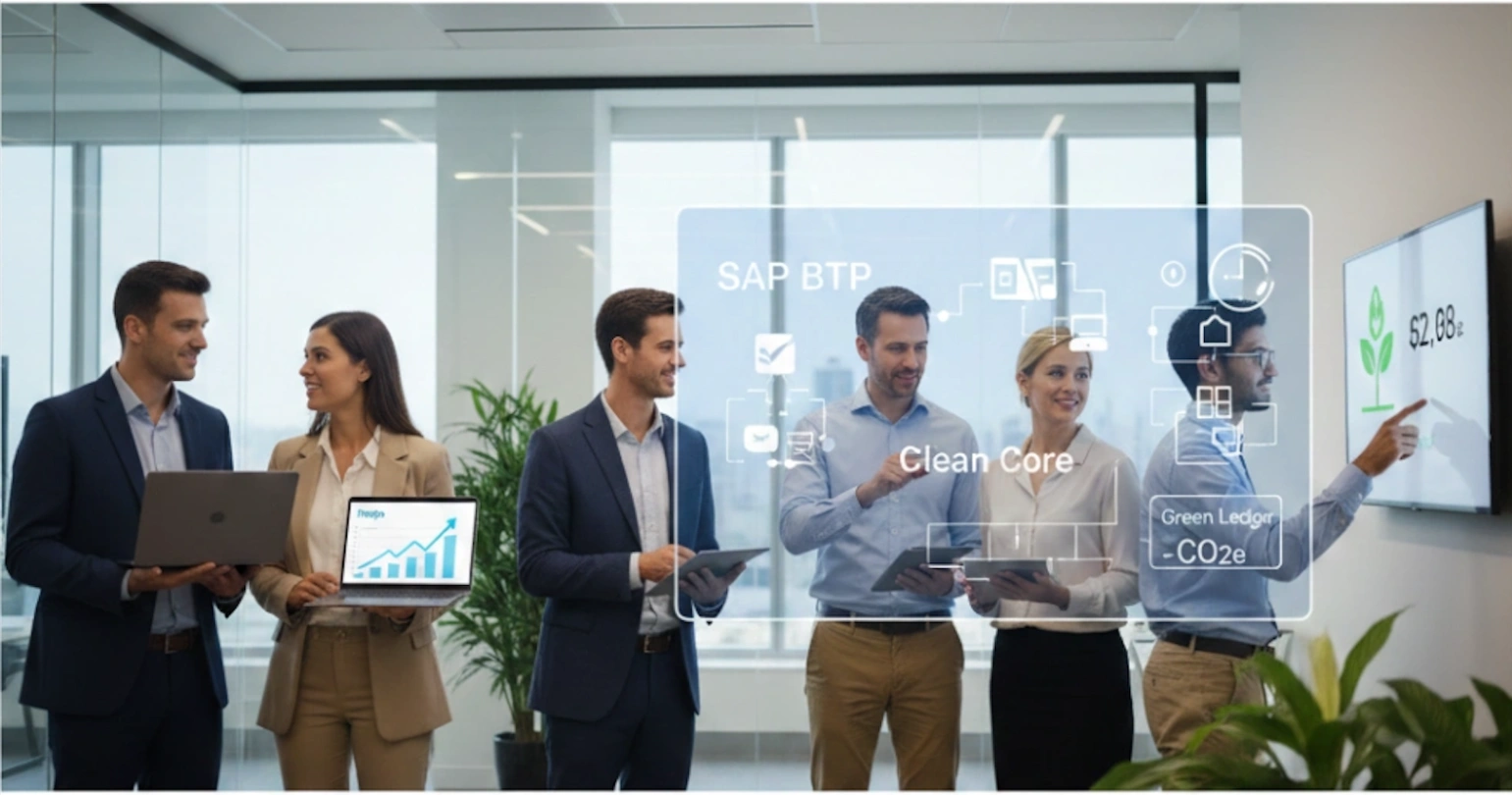
4. The Public Cloud–Private Cloud Divide Has Sharpened
In 2025, SAP’s message was no longer implicit—it was explicit:
- The roadmap is in Public Cloud
- Incentives are in Public Cloud
- Standardization expectations are in Public Cloud
The majority of SAP’s investments in innovation, AI, and automation were directed toward this model.
As of 2025, the concept of “Standard SAP” ceased to be theoretical and became an operational reality.
On the Private Cloud side, however, the picture looked very different:
- More flexibility
- Higher costs
- A stronger need for FinOps, governance, and operational discipline
In 2025, many organizations asked themselves—honestly—for the first time:
“Can we truly afford the cost of flexibility?”
This question clearly demonstrated that cloud decisions had moved beyond technical teams and become a shared agenda for CIOs and CFOs.
4.1 Hyperscaler Selection: Not a Technical Decision, but a Financial One
In 2025, the cloud debate moved one step further.
The question was no longer “Cloud or on-prem?”
It became: “Which hyperscaler?”
Today, SAP operates across three primary platforms:
- Azure → Strong integration with the Microsoft ecosystem, with local data center advantages in Türkiye
- AWS → The most mature service portfolio, with the largest number of global SAP references
- GCP → Strong in AI/ML, with a relatively younger SAP ecosystem; BigQuery integration stands out
The reality observed in the field in Türkiye was clear:
Choosing the wrong hyperscaler can create a 30–40% difference in total cost of ownership.
This gap is not driven by licensing alone—it stems from the combined impact of data transfer costs, storage tiers, and support models.
As a result, hyperscaler selection is no longer: A decision made solely by technical teams
It has become a strategic choice jointly shaped by finance, architecture, and operations.
4.2 The Critical Question: RISE with SAP — Package or Constraint?
Immediately following this divide, the most debated topic of 2025 came to the forefront: RISE with SAP.
With RISE, SAP bundled the S/4HANA transformation into a single commercial and operational package—
creating a fast entry point, especially for organizations struggling to initiate their transformation journey.
However, real-world experience showed that the topic could not be explained by “package convenience” alone.
The practical reality observed in Türkiye and across projects was the following:
✓ Accelerates the initial phase
✗ Can limit architectural flexibility
✗ Exit and re-positioning costs are not clearly defined
✗ Vendor lock-in risk increases significantly
As a result, mature organizations began asking a more strategic question in 2025:
“If we start with RISE, how free will we be in 3–5 years?”
RISE is not a flawed model.
However, the key realization of 2025 was clear:
RISE is not a technical decision—
it is a long-term operating model commitment.
When approached without adequate preparation, RISE may accelerate the early stages of transformation,
but reduce strategic maneuverability in the long run.
Strategic Perspective
Before choosing RISE, organizations must evaluate—based on concrete data:
- Target architectural flexibility
- Clean Core readiness and custom code footprint
- BTP and integration requirements
- Long-term cost implications and exit scenarios
Otherwise, a cloud transition risks becoming an operational dependency rather than a strategic advantage.

5. Signavio: The Era of Assumptions Is Over — Data Speaks
SAP Signavio became a game changer in transformation initiatives.
Statements like “this is how our process works” no longer held up:
- Actual process variations surfaced
- Hidden inefficiencies were exposed
- Invisible costs became measurable
Successful transformation programs now begin:
Not with workshops, but with process data.
6. The Basis Role: FinOps + Observability Is the New Normal
In 2025, the definition of success for SAP Basis teams fundamentally changed.
Asking “Is the system up?”
was no longer sufficient.
The new question became:
“At what cost is the system running—and how observable is it?”
The expanded responsibilities of the modern Basis role now include:
- Cloud FinOps
- Observability
- License and consumption awareness
- Automation
🔎 Pro Tip
Cloud being expensive is not the real problem.
Uncontrolled cloud spending is.
7. SAP Licensing: No Longer About Purchasing, but About Continuous Management
The most important realization around SAP licensing in 2025 was this:
Licensing is no longer a one-time purchasing decision—it is an ongoing management discipline.
Challenges intensified across three key areas:
a) Digital / Indirect Access
Third-party applications—such as APIs, middleware, CRM systems, e-commerce platforms, and mobile apps—interacting with SAP created unexpected licensing risks.
b) Named User Licenses
Incorrect user classifications resulted in unnecessary license costs.
c) Cloud Consumption Models
The pay-as-you-go approach expanded rapidly when left unchecked.
This led CIOs to ask a critical question:
“Do we truly understand the licensing impact of our integrations?”
As a result, SAP licensing became one of the topics where CIOs and CFOs most frequently sat at the same table in 2025.
During the year, many organizations conducted an SAP License Review for the first time — often uncovering significant optimization opportunities.
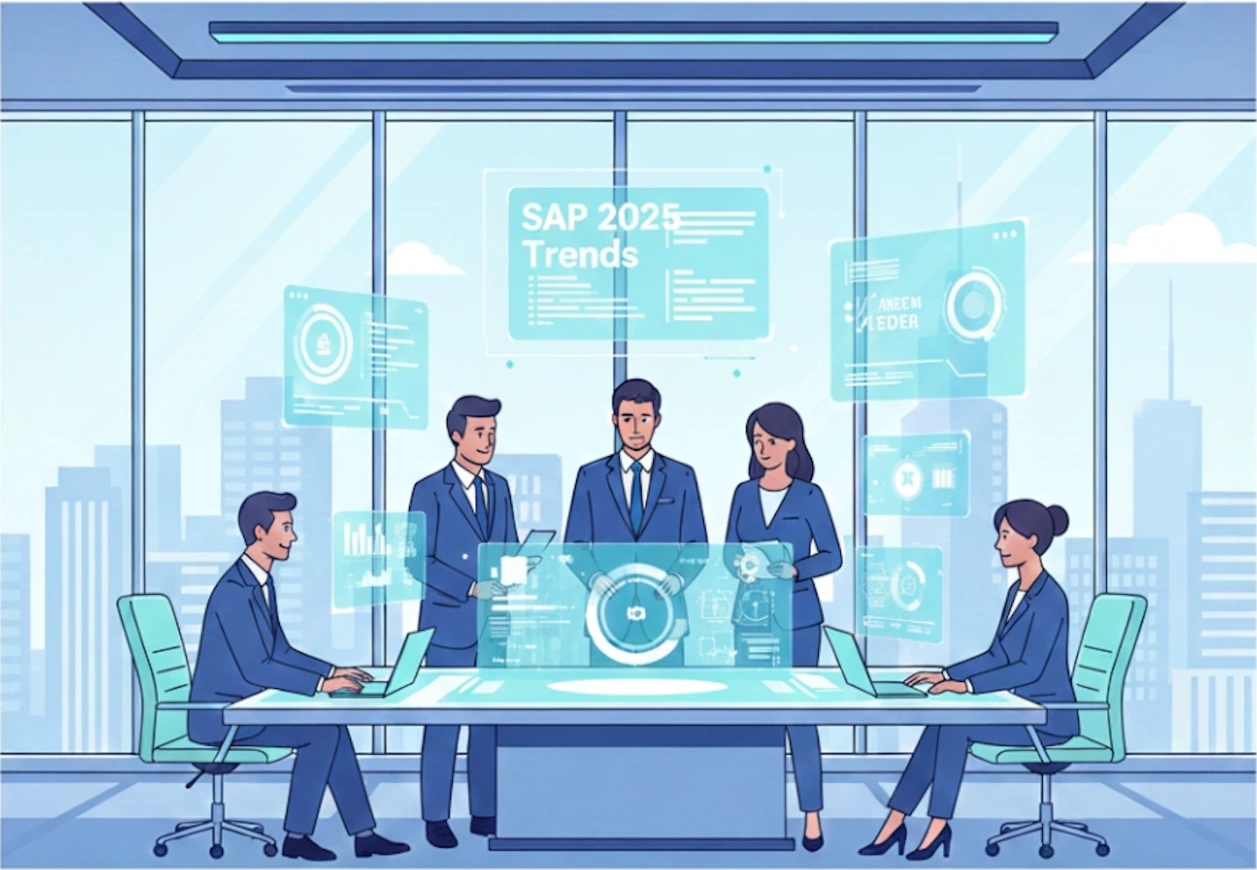
8. Green Ledger: Sustainability Became a Financial Reality
The European Green Deal and increasing regulatory pressure moved sustainability out of the realm of good intentions.
With SAP’s Green Ledger approach:
- Carbon footprints
- Began to be recorded in the same ledger as financial data
The reality that became clear in 2025 was unmistakable:
Sustainability is no longer a reporting topic—it is a matter of financial accounting.
9. The Türkiye Reality: Talent Scarcity
In 2025, the challenge was not technology alone.
- Consultants with strong BTP expertise were scarce
- ABAP developers able to code with a Clean Core mindset were limited
- Professionals who could think across Cloud and SAP architecture together were extremely rare
As a result, many projects slowed down:
Not because of technology, but because of talent constraints.
Four Critical Questions Every SAP Professional Should Ask
Is our system inventory ready?
How many custom codes are blocking a Clean Core approach?Is our data truly clean?
Is our master data suitable for AI-driven use cases?Is our team ready?
Does our SAP team have sufficient expertise in BTP, Cloud, and FinOps?Do we have an exit strategy?
When cloud costs or performance issues arise,
do we know how to optimize—or reposition—our architecture?
Conclusion: 2025 Was Not Just a Year: It Was a Turning Point
2025 was not a year defined by the introduction of new technologies in the SAP ecosystem. It was a turning point where the cost of wrong decisions became visible, and the value of the right architecture became undeniable.
AI, Cloud, Clean Core, and BTP are no longer separate topics.
They all converge around a single, critical question:
“Can we operate this system sustainably in and beyond 2027?”
2025 made the answer to that question impossible to ignore.
The key lessons of 2025 were clear:
- Technology alone is not a solution
- Architectural discipline is no longer optional—it is mandatory
- Systems do not transform unless people and organizations do
And most importantly:
In the SAP world, winners will no longer be those who believe in promises — but those who prepare for reality.
Not those who adopt the newest technology first,
but those who manage time, cost, and risk together.