
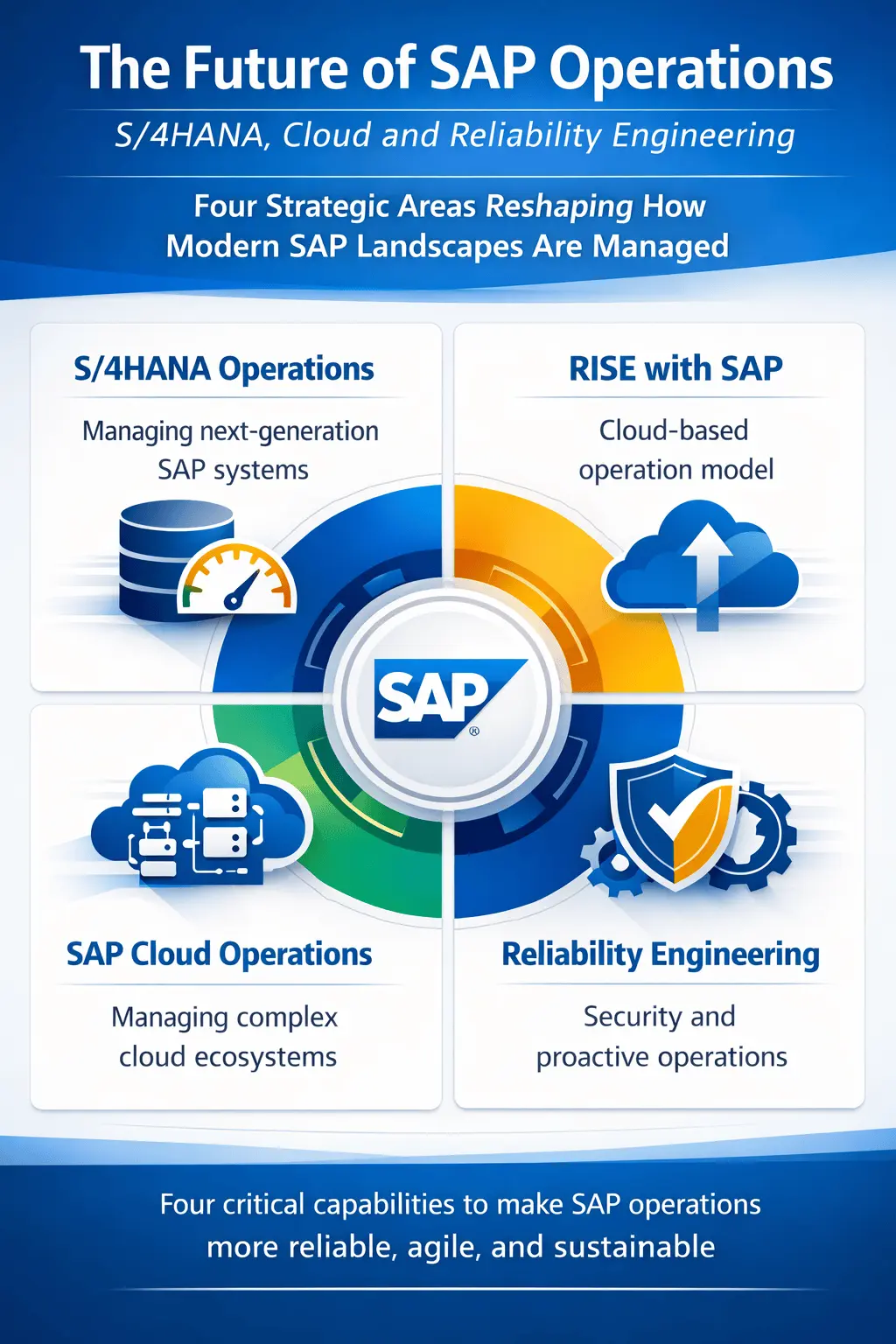


The Future of SAP Operations: S/4HANA, Cloud and Reliability Engineering

The SAP ecosystem has been undergoing a quiet yet profound transformation over the past few years. The shift to S/4HANA, the adoption of cloud architectures, and increasingly complex system integrations are reshaping how enterprises view and manage their SAP environments. In the past, SAP operations were often perceived simply as keeping the system running. Today, however, these same systems sit at the very core of companies’ financial, manufacturing, logistics, and customer processes. As a result, the role of SAP operations is being fundamentally redefined.

In this new landscape, many CIOs and IT leaders are facing similar questions. How should SAP operations be managed when systems run in the cloud? How can the performance and reliability of S/4HANA environments be maintained? And how can system stability be ensured in increasingly complex SAP landscapes filled with integration layers, APIs, and data flows? While the traditional SAP Basis operations model can address some of these challenges, the operational approach required by modern SAP landscapes demands a broader and more strategic perspective.

The numbers illustrate the scale of this transition. Today, only about 32% of organizations have fully completed their migration to S/4HANA, while another 27% are still actively in the migration process. With the approaching 2027 ECC end-of-maintenance deadline, these figures are expected to rise rapidly. In practical terms, this means that a large number of organizations will reach go-live within the next two years, placing significant new pressure on SAP operations teams.
(Source: SAPinsider – SAP S/4HANA Migration 2025 Report)

As a result, SAP operations are evolving beyond a purely technical maintenance function into a strategic capability. Managing cloud environments, optimizing S/4HANA systems, adopting automation-driven operations, and embracing reliability engineering are becoming the new building blocks of modern SAP operations. In this article, we explore four critical capabilities shaping the future of SAP operations—and what this transformation means for enterprises in the years ahead.

1. S/4HANA Operations: Managing the Next Generation of SAP Systems

For many organizations, the transition to S/4HANA is not merely a technology upgrade—it also represents a shift in the operating model. The S/4HANA architecture introduces performance dynamics that differ significantly from traditional SAP systems. Memory usage, data processing logic, and real-time analytics capabilities require operations teams to approach system management from a different perspective.

As a result, managing S/4HANA environments is no longer limited to routine maintenance tasks. Performance optimization, capacity planning, data growth strategies, and system architecture management have become essential components of modern SAP operations.

While many organizations invest heavily in the implementation phase, the complexity of the operations phase is sometimes underestimated. In reality, the true operational workload often begins after go-live. To ensure that S/4HANA systems run reliably and at high performance, operations teams must develop a deep understanding of both the platform architecture and the impact of business processes on system behavior.

This shift is also creating a new area of specialization within the SAP ecosystem. Teams capable of effectively managing S/4HANA operations are no longer performing purely technical roles—they are becoming critical enablers of business continuity and digital process stability.

Real-world data confirms this growing pressure. Studies show that S/4HANA projects take on average 30% longer to complete, while 65% of organizations experience budget overruns. Moreover, many implementation teams report that the knowledge transfer to operations teams before go-live is often insufficient. Systems are handed over to IT operations, yet teams may not be fully prepared for the unique architecture and operational requirements of S/4HANA.
(Source: Horváth, 2025 / IBsolution)


2. RISE with SAP: A Changing Operations Model

In recent years, one of the most widely discussed concepts in the SAP ecosystem has been the RISE with SAP model. This approach aims to deliver SAP systems through a cloud-based service model, accelerating the digital transformation journey for many organizations.

However, this model also introduces a new question:

Who will manage SAP operations when systems run in the cloud—and how?

This uncertainty is not only technical but also strategic. Research shows that 23% of organizations still cannot clearly determine how RISE with SAP will affect their operational plans. Some organizations have even paused their projects while trying to answer this question.
(Source: SAPinsider – RISE with SAP 2025 Benchmark Report)

Although the RISE model delivers infrastructure and software as a service, organizations still require strong governance over operational visibility, performance management, and incident management processes. Activities such as system monitoring, early detection of performance issues, change management, and the coordination of operational processes remain critical responsibilities for enterprises.

For this reason, managing RISE environments is emerging as a new specialization area. For organizations, the goal is not simply to keep the system running, but to ensure that this new cloud-based operations model aligns with their enterprise IT governance frameworks.

This shift is also creating a new economic model within the SAP services ecosystem. Unlike project-based engagements, operations services generate long-term and sustainable revenue streams. As a result, many technology firms are investing in operations capabilities, developing service models that deliver value throughout the entire lifecycle of SAP systems.

Further Reading

Discover the right SAP Basis operations model for your organization by comparing in-house, outsourced and hybrid approaches.

3. SAP Cloud Operations: Managing Complex Technology Ecosystems

The migration of SAP systems to cloud environments has significantly expanded the scope of SAP operations. Today, many SAP landscapes are no longer limited to the application layer alone. Infrastructure services, integration platforms, data services, and security layers must operate together as part of a broader technology ecosystem.

As a result, modern SAP operations now extend beyond managing the SAP application itself. Operating SAP systems in the cloud requires expertise across several critical areas, including:

  • Infrastructure optimization
  • Cost management
  • Performance monitoring
  • Integration architecture management

While cloud environments offer scalability and flexibility, they also require operations teams to manage multiple disciplines simultaneously. This means that SAP operations teams must now understand not only the application layer, but also the underlying infrastructure and platform architecture that support the SAP landscape.

For organizations developing strong cloud operations capabilities, this shift also represents a significant growth opportunity. Enterprises increasingly require reliable partners not only for implementing SAP systems, but also for operating them securely and efficiently over the long term.


4. Reliability Engineering: From Maintenance to Engineering in SAP Operations

One of the most important transformations in modern SAP operations is the growing adoption of reliability engineering principles. The origins of this approach lie in the rapid scaling of modern internet platforms. Large technology companies began redesigning their operations processes using engineering disciplines in order to ensure the reliability of systems serving millions of users.

From this mindset emerged the concept of reliability engineering. The core objective is not simply to keep systems running, but to manage system reliability in a measurable and sustainable way.

In this model, operations are built around several key principles:

  • Measuring system reliability
  • Automation-driven operations processes
  • Early detection and alert mechanisms
  • Proactive capacity management

Within SAP operations, the Site Reliability Engineering (SRE) discipline plays a particularly important role in reducing what is known as “toil”—manual, repetitive operational tasks that provide little long-term value. Through automation tools such as Ansible and Terraform, these routine workloads can be significantly minimized.

Another important concept within SRE is the Error Budget approach. Rather than pursuing unrealistic goals such as 100% system uptime, this model helps organizations balance the level of reliability required by business operations with the need for continuous innovation and system evolution.

This approach offers clear advantages, especially in large and complex SAP landscapes. Because the cost of system downtime can be extremely high, operations teams shift their focus from simply resolving issues to preventing them before they occur.

Research highlights the scale of this challenge. In critical sectors such as manufacturing, finance, and retail, the average hourly cost of downtime can exceed $5 million, while 41% of organizations report losses between $1–5 million per hour.
(Source: ITIC – 2024 Hourly Cost of Downtime Survey)

As a result, reliability engineering is becoming a defining paradigm for the future of SAP operations. Teams that develop expertise in this discipline move beyond providing operational support—they take on a strategic role in ensuring the continuity, stability, and resilience of mission-critical enterprise systems.

Table: The Evolution of SAP Operations: Traditional vs. Modern
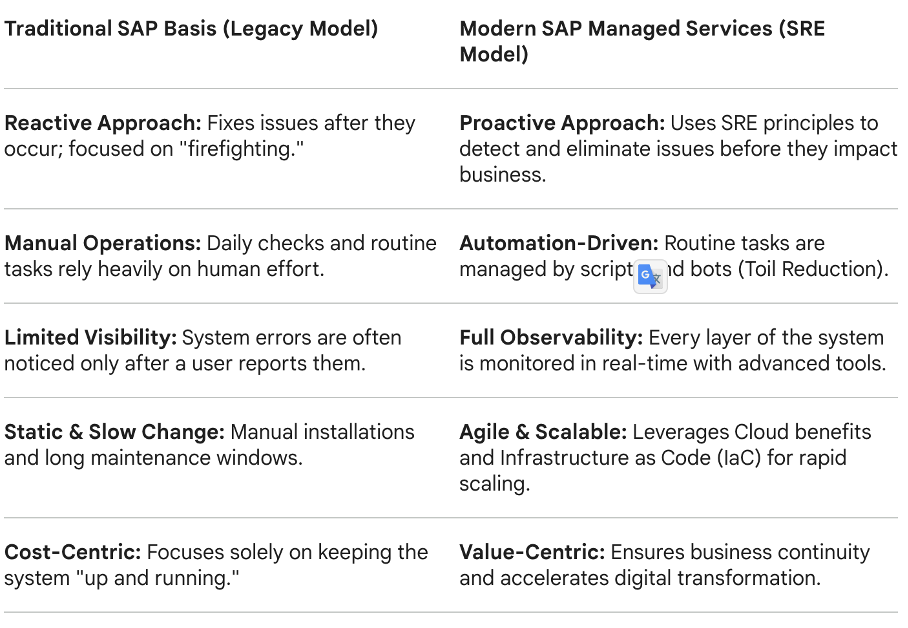

The Hidden Power of Modern SAP Operations: Automation and Observability

Another critical component of modern SAP operations is the growing role of automation and advanced monitoring capabilities. Traditional operations models often relied heavily on manual interventions. In today’s complex environments, however, automation has become a key factor in improving system stability and operational efficiency.

Through observability platforms, system performance can be monitored in real time, potential anomalies can be detected at an early stage, and operations teams can respond more quickly to emerging issues. At the same time, automation tools help standardize many operational processes while significantly reducing the risk of human error.

Today, many organizations rely on a combination of SAP-native monitoring tools and modern observability platforms to monitor and manage their SAP landscapes. These technologies provide operations teams with deeper visibility into system behavior while enabling more efficient and proactive operations management.


Conclusion: Redefining SAP Operations

For decades, SAP systems have formed the digital backbone of many enterprises. However, as the architecture and operating models of these systems evolve, the approach to SAP operations must evolve as well.

Modern SAP operations are no longer limited to routine technical maintenance. Managing S/4HANA platforms, optimizing cloud environments, operating RISE with SAP landscapes, and adopting reliability engineering principles are becoming the core pillars of the new operations model.

These four areas represent not only a technological transformation, but also a new value creation opportunity within the SAP services ecosystem. Teams that develop expertise in these domains are able to deliver more reliable and sustainable SAP operations models, while also building the foundation for a long-term and scalable service economy.

In the coming years, the success of SAP operations will depend not only on technical expertise but also on the ability of operations teams to approach system management with an engineering mindset. Organizations that adopt this transformation early will gain a clear advantage in managing their SAP landscapes in a more reliable, scalable, and sustainable way.

You Might Also Like These

SAP Basis Operations: The Fine Line Between a Running System and a Resilient One
SAP Post-Implementation Handover Guide: Invisible Risks & Proven Solutions
Bridging the Gap: An Empathy Guide for IT Support Teams and Users
Basisci
Privacy Overview

This website uses cookies so that we can provide you with the best user experience possible. Cookie information is stored in your browser and performs functions such as recognising you when you return to our website and helping our team to understand which sections of the website you find most interesting and useful.