

A New Era in SAP Basis Services: Risks, Opportunities, and a Redefined Playing Field
In recent years, the SAP ecosystem has entered what may be one of the most significant turning points in its history. The RISE with SAP approach, hyperscaler-based infrastructures (Azure, AWS, Google Cloud), and AI-driven operational tools are not only reshaping technology choices but fundamentally transforming how SAP systems are operated.
However, interpreting this transformation correctly is critical. Today, the SAP landscape remains largely hybrid. Many organizations continue to run their most critical production and financial systems on-premise, while new investments and transformation initiatives are increasingly shifting toward the cloud.
For this reason, the current state should not be seen as a complete departure from the past, but rather as a transition phase in which both models will coexist for a period of time.
The Traditional SAP Basis Model: The Limits of Operational Excellence
The traditional SAP Basis model has long been built on system stability and operational continuity. In this model, success is clearly defined:
- Ensuring uninterrupted system availability
- Maintaining acceptable performance levels
- Managing transports and changes in a controlled manner
- Providing reliable backup and disaster recovery processes
This structure is largely based on a deterministic operational model. Infrastructure is fixed, system behavior is predictable, and capacity planning is conducted over long-term horizons.
However, these fundamental assumptions are beginning to lose their validity in the cloud era. Infrastructure is no longer static but dynamic; system workloads are no longer predictable but variable; and costs are no longer one-time investments but continuous parameters that must be actively managed.
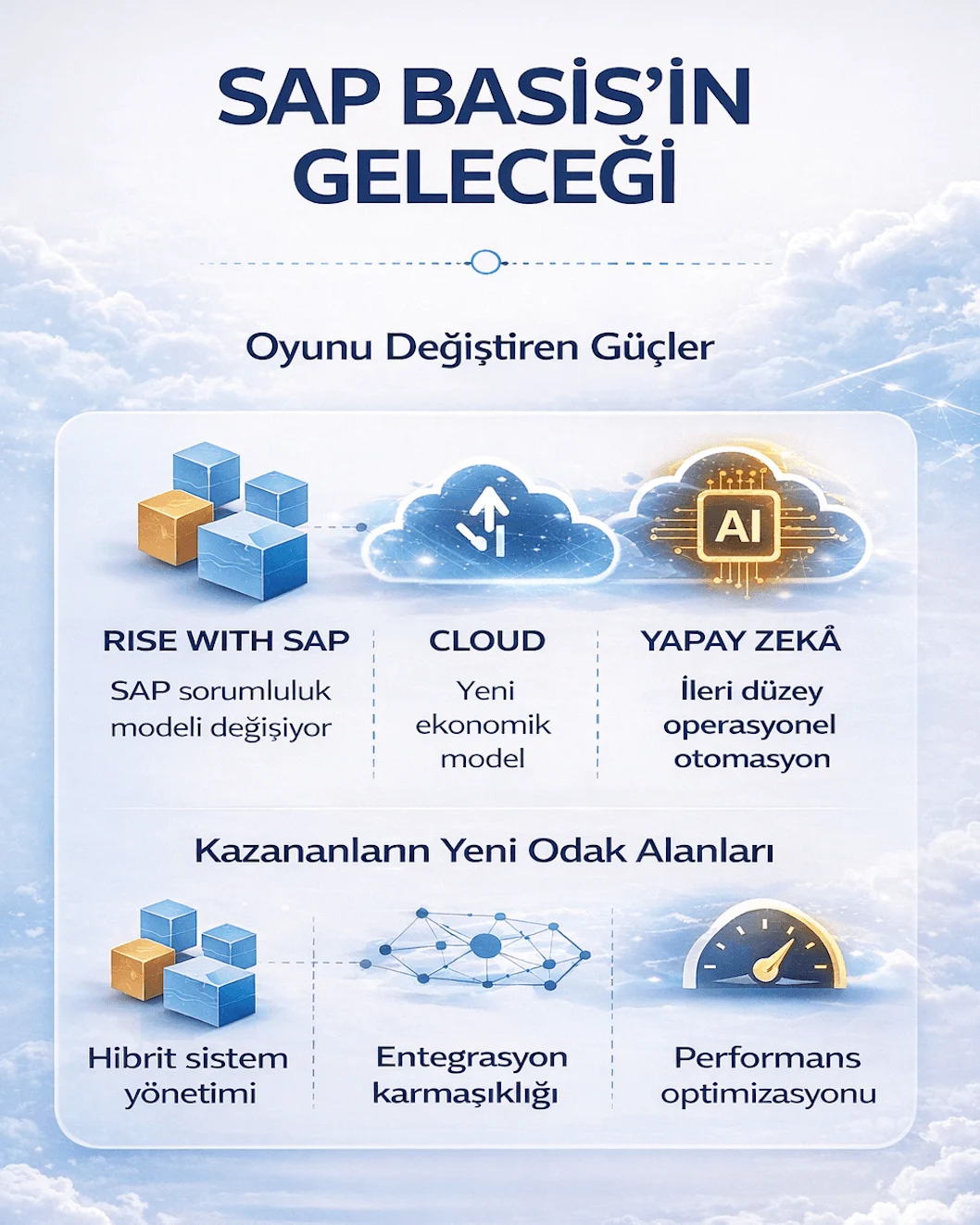
Key Drivers of Change: RISE with SAP, Cloud, and Artificial Intelligence
RISE with SAP: Redistribution of Technical Responsibility
RISE with SAP represents a shift from SAP’s traditional licensing and maintenance model to a service-based approach in which SAP assumes responsibility for a significant portion of operations. In this model, infrastructure, core technical operations, and a defined level of system management are delivered by SAP.
This shift introduces changes in several key areas:
- Standardization of kernel, patching, and core maintenance operations
- Partial transfer of technical responsibility to SAP
- Redefinition of operational roles on the customer side
However, this model does not eliminate SAP operations entirely; it reshapes the distribution of responsibilities. SAP takes over the Infrastructure layer and Technical Managed Services (TMS), effectively absorbing much of the standardized operational workload.
A critical distinction remains. Application operations, transport alignment with business processes, authorization design, and performance-driven optimization continue to reside within the domain of the customer and their SAP partners. In other words, while SAP provides the “engine,” the “driving and route management” remain the responsibility of SAP Basis teams.
Cloud: The Economic Model of SAP Operations Is Changing
The transition to cloud impacts far more than the technical architecture of SAP systems. The most fundamental shift lies in the economic model.
In the on-premise world:
- Capacity planning is long-term
- Hardware investments are made upfront
- Systems are typically running continuously
In the cloud environment:
- Capacity is managed dynamically
- Costs are usage-based
- Even system uptime directly affects overall cost
This shift moves SAP Basis beyond a purely technical function into a role with direct financial impact.
SAP BTP: The New Operational Core
With the adoption of SAP’s Clean Core strategy, the working domain of SAP Basis consultants is expanding beyond traditional tools such as SAP GUI and HANA Studio into the SAP BTP Cockpit.
Success is no longer measured solely by system stability, but by the ability to orchestrate side-by-side extensions, manage service subscriptions, and govern increasingly complex integration landscapes.
SAP’s Clean Core approach requires that custom developments move out of the ERP core and onto SAP BTP. As a result, the SAP Basis role is evolving into that of a platform orchestrator, enabling business units to innovate with agility through BTP services.
Artificial Intelligence and Automation: A New Operational Layer
While the adoption of artificial intelligence in SAP operations is still at an early stage, its impact is already becoming visible. Notable advancements can be observed in areas such as:
- Anomaly detection
- Root cause analysis
- Automated incident classification
The more profound transformation, however, lies in the increasing level of automation. Script-driven management, runbook automation, and event-driven operational models are gradually replacing traditional manual interventions.
With the integration of generative AI assistants such as SAP Joule into system management, complex log analysis can now be performed within seconds, providing actionable recommendations. This significantly reduces mean time to resolution (MTTR) and shifts operations from reactive to increasingly proactive models.

Further Reading
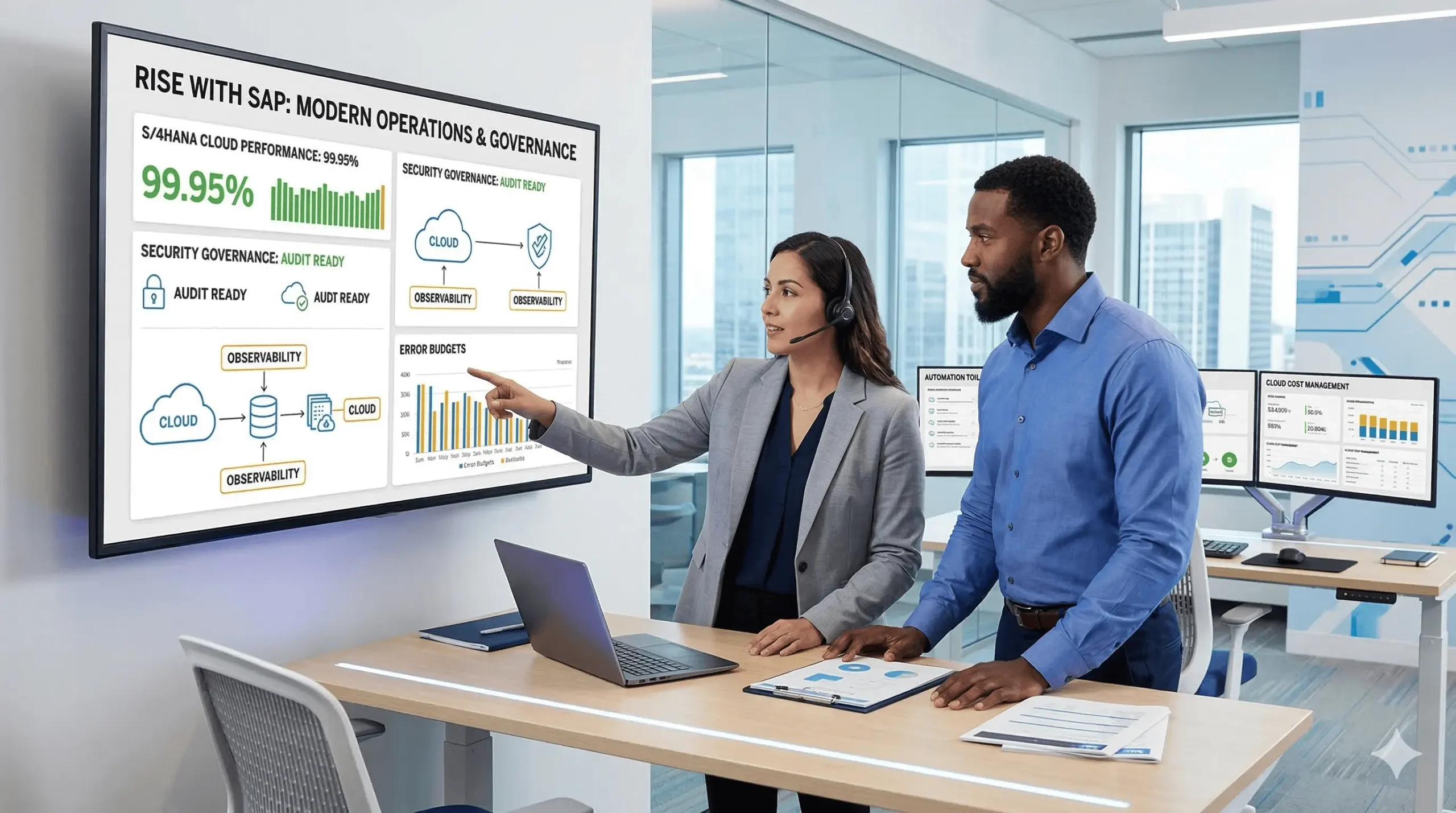
Explore how the future of SAP operations is shifting from traditional maintenance to reliability engineering (SRE) to ensure system sustainability amidst S/4HANA transformations, RISE with SAP models, and cloud architectures.
SAP’s Strategic Direction: A Cloud-First, AI-Driven Future
SAP’s product and licensing strategy in recent years points to a clear direction: a cloud-first, AI-driven ERP ecosystem. RISE with SAP represents the commercial and operational model of this strategy, while SAP BTP and AI components such as Joule form its technological foundation.
SAP is no longer positioning itself solely as an ERP software provider. Instead, it aims to deliver a unified platform that brings together data, processes, and artificial intelligence. In this model, ERP is not a standalone solution but a core component of a broader digital architecture.
One of the most concrete indicators of this strategic direction is SAP’s maintenance policy. SAP plans to provide mainstream support for ECC systems until 2027, making this date a critical milestone that is already accelerating transformation decisions across many organizations. Although this deadline may be extended to 2030 under certain conditions, SAP’s investment focus is clearly on S/4HANA—particularly cloud-based solutions.
As a result, the key question for organizations is no longer whether they will move to the cloud, but when and how. This shift has a direct impact on the role of SAP Basis and operations teams.
Threats: Real Risks for SAP Basis Services
This transformation introduces several tangible risks.
Shrinking Scope of Standard Operations
Routine activities such as patching, monitoring, and basic maintenance are increasingly automated. As a result, the value of services centered solely around these tasks is declining.
Weakening of the Hosting Model
For organizations managing their own data centers or offering hosting services, cloud adoption represents a fundamental shift in the business model.
Unsustainability of Reactive Service Models
Service models based purely on ticket handling are rapidly losing competitiveness in the face of automation and standardization.
Talent Shortage and Adaptation Risk
The modern SAP landscape—spanning BTP, cloud, and AI—requires more than traditional SAP GUI expertise. It demands knowledge of network architecture, cloud security, and automation languages. The inability of existing teams to adapt at this pace, or the difficulty of accessing talent with these capabilities, creates a significant operational bottleneck. For teams that fail to invest in transformation, technical inadequacy becomes one of the most critical risks.
Opportunities: The New Value Domain of SAP Basis
This transformation also defines a higher-value role for SAP Basis.
Hybrid Landscape Management
Today, many organizations operate complex environments where on-premise systems, private cloud environments, and hyperscaler platforms coexist. Managing such landscapes requires an architectural approach that goes beyond traditional SAP Basis expertise.
SAP FinOps: A New Critical Capability
One of the most common challenges in cloud environments is uncontrolled cost growth. Incorrect sizing, idle systems, and inefficient resource utilization can lead to significant budget deviations. As a result, SAP Basis is evolving into a function that not only ensures system stability but also actively manages cost.
Security Architecture and Access Management
As cloud and hybrid environments dissolve traditional network perimeters, security responsibilities are increasingly shifting toward SAP Basis teams. Managing SAP Cloud Connector, configuring Single Sign-On (SSO), and handling complex Identity and Access Management (IAM) processes are now integral parts of daily operations. SAP Basis professionals are evolving into security architects—responsible not only for system performance, but also for ensuring that cloud entry points are securely protected against cyber threats.
Automation and Operational Efficiency
Operational efficiency is no longer measured by human effort alone, but by the level of automation achieved. Standardized, repeatable, and automated processes improve both quality and scalability.
Increasing Role in Transformation Projects
S/4HANA transitions, RISE with SAP initiatives, and broader system transformation programs are bringing SAP Basis teams back to the center of strategic initiatives. However, this role now extends beyond technical execution to include system design and decision support.

Why SAP Basis Is Still Essential in RISE with SAP and Cloud Environments
Although RISE with SAP and cloud models are reshaping the nature of SAP operations, they do not eliminate the need for SAP Basis. On the contrary, this need continues at a different scope and requires a higher level of expertise.
While the RISE model transfers infrastructure and certain technical operations to SAP, several critical areas remain on the customer side. These include cross-system integration management, performance optimization aligned with business processes, transport and change management, security and authorization architecture, and the coordination of testing and transition processes.
These are not standardized functions; they are organization-specific and deeply tied to business context. For this reason, SAP’s service model does not cover the entire operational landscape—it addresses only a specific layer of it.
Secondly, cloud environments do not necessarily reduce complexity; in many cases, they increase it. Hybrid landscapes, interconnected systems, and BTP-driven integrations make operational management more critical and more sophisticated than before.
Thirdly, cost management remains entirely the responsibility of the customer. Neither SAP nor hyperscalers optimize resource consumption—they simply bill based on usage. As a result, a poorly designed SAP landscape can lead to significantly higher costs in a cloud environment, often much faster than in traditional setups.
In this new context, what organizations need is not less SAP Basis, but a more advanced and more capable SAP Basis function.
The New Role of SAP Basis: From Technical Expert to Operations Architect
In the past, the success of a SAP Basis professional was measured by system uptime. In the era of RISE and cloud, success is increasingly defined by how efficiently cloud resources are utilized and how quickly flexibility can be delivered to business units. In this sense, the SAP Basis role is evolving from a system guardian into something closer to a cloud economist, incorporating FinOps thinking into daily operations.
SAP Basis is no longer confined to system administration; it is evolving toward operational architecture.
In this new role, the focus shifts from individual systems to the management of the entire landscape. Technical performance is no longer sufficient on its own; cost optimization becomes equally critical. Operational processes are no longer manual and reactive but designed, automated, and continuously improved.
This transformation requires not only deep technical expertise but also systems thinking and an architectural mindset.
Ultimately, the new playing field for SAP Basis extends beyond the internal workings of systems. It encompasses how these systems interact with cloud environments, platforms such as SAP BTP, and the broader digital ecosystem. Success in this new landscape depends less on isolated technical skills and more on the ability to think and operate at an architectural level.

Same Storm, Different Ships: Diverging Paths for In-House and Outsourced Teams
This technological shift does not impact every SAP operation in the same way. The nature of risks and opportunities varies depending on how SAP Basis services are structured within an organization.
In-House Teams
Organizations managing SAP with internal teams face a different kind of risk—falling into the comfort of routine. As infrastructure management moves to SAP or cloud providers, teams that remain focused solely on patching and backup activities risk losing their strategic relevance within the organization.
The role of internal teams is evolving. Instead of focusing on how systems run, they must shift toward how effectively those systems serve business units.
A critical responsibility emerges here: acting as the guardian of SAP’s Clean Core strategy. This means ensuring that new requirements are not embedded into the core ERP system but are instead directed toward SAP BTP, preserving long-term agility and maintainability.
Outsourced Service Providers
For outsourcing providers, the transformation is even more disruptive. Traditional models based on ticket resolution or time-and-material billing are increasingly exposed to commoditization in a standardized cloud environment.
As customers begin to ask, “If SAP already handles core operations, why do I need an external provider?”, the rules of the game fundamentally change.
The role of service providers must evolve from delivering technical support to offering operational intelligence. This includes helping clients optimize cloud costs through FinOps practices, addressing security gaps in hybrid environments, and guiding complex transformation initiatives such as RISE with SAP and S/4HANA transitions.
In essence, while in-house teams must elevate their capabilities to an architectural level to maintain their organizational value, outsourcing providers must shift toward outcome-driven models to sustain their relevance in the market.
A Roadmap for SAP Basis Service Providers
To remain competitive in this new landscape, SAP Basis service providers must redefine both their capabilities and their positioning.
Expanding the scope of services becomes essential. SAP Basis can no longer be treated as a standalone offering; it must be integrated with cloud operations, automation, and cost management.
Capability transformation is equally critical. Teams must develop expertise not only in SAP technologies but also in cloud platforms, automation tools, and data-driven operational approaches.
Service models must also evolve. Traditional time-based or ticket-based approaches are being replaced by value-driven and outcome-oriented delivery models.
Finally, positioning must change. To stand out in the market, companies need to move beyond being perceived as SAP Basis support providers and reposition themselves as partners that manage SAP operations holistically.
A Note on Türkiye: Data Regulations and the Hybrid Reality
While global trends clearly point toward full cloud adoption, regulatory requirements and data protection sensitivities in Türkiye—particularly under KVKK—are driving organizations toward hybrid architectures.
For SAP operations teams in Türkiye, the real challenge lies in balancing these constraints: keeping sensitive data on-premise while still leveraging the flexibility of the cloud and the capabilities of artificial intelligence.
Teams that successfully establish this balance will be best positioned to lead in the next five years.
Conclusion: Evolution Is Inevitable, Timing Varies
The transformation within the SAP ecosystem is clear, but its pace varies depending on industry, geography, and organizational risk appetite.
On-premise systems remain strong today, yet the direction of new investments is unmistakable.
The right approach is not to abandon existing systems, but to protect current operations, prepare for the new model, and manage the transition in a controlled and strategic manner.
SAP Basis is not disappearing. It is evolving into a broader, more strategic role that delivers greater business value.
For organizations and service providers that understand this shift and position themselves accordingly, the coming years represent a significant opportunity for growth.