

In the SAP Basis world, Tuesdays carry a different weight than any other day of the week.
Especially SAP Security Patch Day, released on the second Tuesday of every month, is not just a routine maintenance window for a Basis professional—it is a strategic chess match against the system’s immune vulnerabilities.
Yet let’s be honest. For most of us, this process feels like a painful operation in which we get lost among thousands of lines of technical documentation, trapped in a familiar dilemma:
“If I apply the patch, will something break?
If I don’t, will we get hacked?”
Why Patching Alone Is No Longer Enough
The reality is clear: you can no longer escape this labyrinth by patching alone.
Today, cyber resilience must go beyond technical procedures and become a strategic reflex.
So let’s set aside the traditional “how-to” guides for a moment.
Instead, let’s talk about the invisible gaps, irrational behaviors, and next-generation defense strategies in the Basis world—strategies that extend far beyond patches themselves.
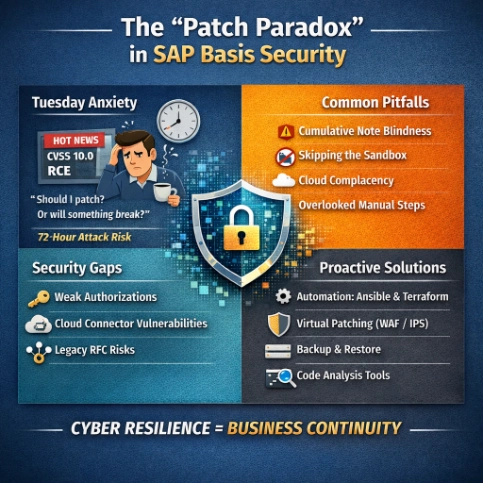
“Tuesday Anxiety”: A Real Scenario and the 72-Hour Rule
Imagine this scenario.
It’s Wednesday morning, 09:00.
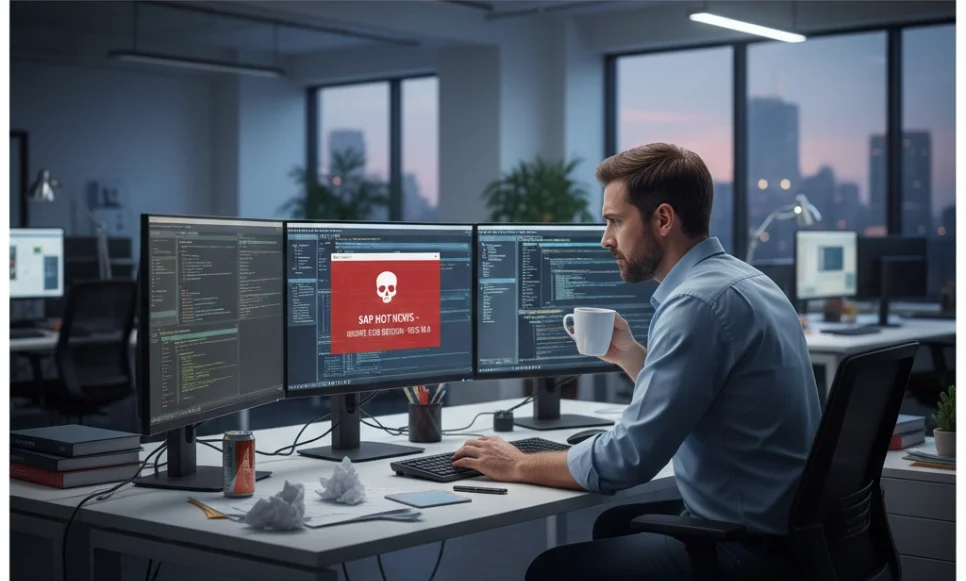
You’ve just grabbed your coffee. SAP for Me is open on your screen.
There it is—a Hot News note.
- CVSS score: 10.0
- Topic: Remote Code Execution via ICM (Internet Communication Manager)
You already know that feeling.
This is where the “Basis Paradox” kicks in.
On one side, your security instincts say:
“I need to protect the system immediately.”
On the other, operational fear whispers:
“If I apply this note, will HTTP services stop?
Will our integrations collapse?”
Critical Insight: The 72-Hour Reality
According to Onapsis and multiple cybersecurity research reports, the time attackers need to exploit a critical vulnerability has now dropped to as little as 72 hours after disclosure.
Yet in large enterprise environments, the average time it takes for a Hot News note to reach production (PRD) systems is between 14 and 30 days.
This “30-day gray zone” is the period during which your castle gate remains partially open.
And that gap—more than any single missing patch—is where real risk lives.
Common Field Mistakes and Irrational Behaviors
As Basis professionals, we sometimes end up sabotaging ourselves.
Here are some of the all-too-familiar scenarios we frequently encounter in real projects:
The “Cumulative Note” Illusion
Focusing only on the highest CVSS score is a critical mistake.
In some cases, a 5.5-rated Information Disclosure vulnerability can leak user data that enables an attacker to trigger a 10.0-rated vulnerability.
Security is a chain—and its strength is defined by its weakest link.
Skipping Manual Post-Implementation Steps
You download and apply the SNOTE successfully.
But in that familiar gray section under “Manual Activities,” it clearly states that you must update a table or restart a specific service.
If that line goes unread, the note may appear as applied—
but the system remains vulnerable.
It’s the equivalent of locking the door and leaving the key under the doormat.
The “RISE with SAP” Complacency
Cloud does not eliminate responsibility—it redistributes it.
SAP may handle infrastructure and kernel patching under RISE,
but application-level security notes (SNOTE-based fixes) remain your responsibility.
Cloud does not retire you from the SNOTE screen.
🔎 Quick TipSeeing a green status in the SNOTE screen does not always mean you are secure.
For example, in critical ICM-related notes, the system may show green,
but unless you execute the Z_CHECK_ICM report referenced in the note’s final table,
the patch is not actually active.Make sure you haven’t locked the door
while still leaving the key under the mat.
The Authorization Reality: The Invisible Threat
Security is not limited to SNOTE implementation or kernel updates.
More often than not, the largest attack surface is created not by technical vulnerabilities,
but by uncontrolled authorizations.
Common examples include:
- Service users running with SAP_ALL
- RFC authorizations that haven’t been reviewed for years
- Overly broad roles left open “temporarily for testing”
These weaknesses are often more dangerous than sophisticated zero-day attacks,
because the system treats the attacker as a legitimate user.
Regular reviews using SUIM and ST01 are therefore
just as critical as applying security patches.

Further Reading
If you want to gain deep insight into the critical responsibilities of Basis specialists in SAP system cybersecurity, this article is for you!

Automation: Blindly Applying SNOTE?
The introduction of tools like Ansible and Terraform into the SAP Basis world is exciting.
However, one point must be made absolutely clear:
automation does not mean “find the note and blindly apply it across the entire landscape.”
That approach is extremely dangerous.
Strategic automation must include:
- Landscape Discovery
- Impact Analysis
- Pre-checks
- Governance
Rather than blindly applying a note, automation should identify which systems are actually affected, manage dependencies, and control the rollout process in a structured and risk-aware manner.
Cyber Resilience and the Human Factor
The “Tuesday Anxiety” mentioned earlier is not purely technical—it is psychological.
A Basis professional often carries significant risk but is not the final decision-maker.
Being forced to take responsibility alone is one of the heaviest burdens of the role.
This is where Cyber Resilience comes into play.
Patching may protect you—but being able to recover keeps you alive.
Immutable backup strategies and regular restore tests are what truly allow a Basis professional to sleep peacefully at night.
2025 Outlook: Does RISE with SAP Make the Basis Role Obsolete?
One of the biggest misconceptions in the industry is the belief that RISE with SAP or a move to Cloud ERP eliminates the need for Basis expertise.
In reality, the opposite is true.
In 2025, no matter how managed a technology becomes,
the intelligence that ensures it serves business continuity and security still belongs to the Basis professional.
The New Critical Basis Roles in 2025
Service Orchestrator
SAP may manage infrastructure patching, but the security of SAP BTP components—such as Identity Authentication Services (IAS) and Cloud Connector—now sits squarely on your desk.
AI Governance Lead
Secure configuration of SAP Joule and Business AI services, data privacy enforcement, and access control for AI models have become some of the most critical Basis responsibilities of 2025.
Zero Trust Architect
In 2025, the Basis role evolves beyond ABAP.
Basis professionals must become cloud-aware architects—capable of integrating SAP with hyperscaler security services across Azure, AWS, and GCP.
🔎 Expert Note
Under the RISE model, SAP is responsible for the building exterior and elevators (infrastructure and kernel).
But the locks inside the apartment—application-level SNOTE fixes—are still your keys to manage.Cloud does not retire you from the SNOTE screen.
It simply elevates you to a more strategic position.
Breaking Developments: The 2025 Threat Agenda
As of the first quarter of 2025, we are observing a 39% year-over-year increase in the number of security notes. Three areas, in particular, are raising serious alarms:
SAP NetWeaver Visual Composer (CVE-2025-42944)
Hot News notes involving Remote Code Execution (RCE) risks directly target internet-facing portals, making them an immediate and critical threat vector.
RFC Callback Vulnerabilities
SAP is increasingly focusing on notes that challenge legacy trust relationships between systems.
Failing to address these notes effectively provides attackers with a highway between connected systems.
Clean Core and Security
Security is no longer limited to standard SAP code.
Custom “Z” developments have become potential vulnerability hotspots.
As a result, Code Vulnerability Analyzer (CVA) is no longer a luxury—it is a baseline requirement by 2025 standards.
Conclusion: Uptime or Security?
Think of an SAP system as a skyscraper.
A Basis professional is far more than a technician managing elevators (background jobs) and plumbing (the database);
they are the security architect of the building.
This leads to the classic conflict with management:
“We can’t afford to shut the system down for two hours to apply a patch.”
Yet explaining the difference between:
- a two-hour planned outage, and
- a two-week shutdown after a ransomware attack
is part of our responsibility.
In 2025, security is no longer a cost.
It is business continuity insurance.
As a company providing SAP Basis services, we do not offer merely “hands that apply notes.” At Basisci, we stand by your side as architects who build cyber resilience for SAP systems— designed to withstand the complexity of 2025’s hybrid enterprise landscape.